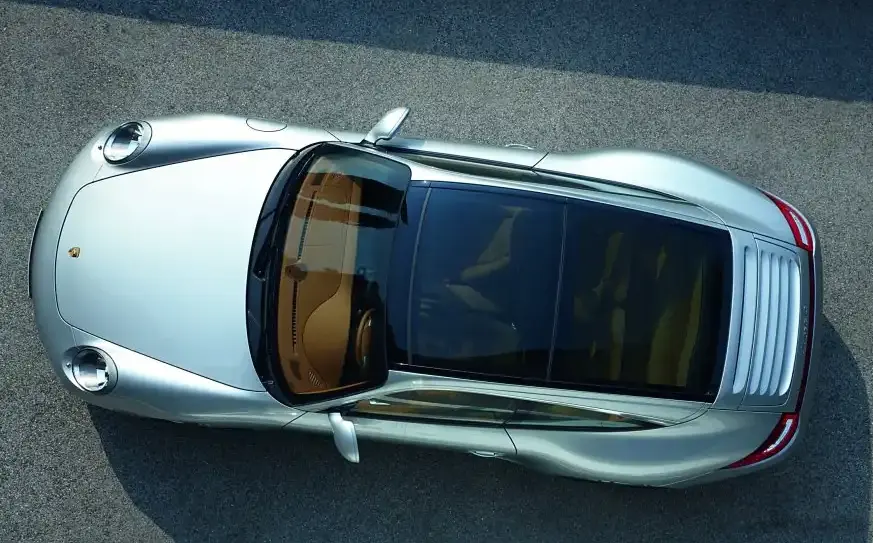
The Porsche 911 Targa 4 3.6, produced from 2008 to 2013, represents a compelling blend of open-air motoring and all-weather capability within the iconic 997 generation of the 911. This facelifted version, often referred to as the 997.2, built upon the foundation laid by its predecessor, introducing refinements to the engine, interior, and technology. The Targa 4 3.6 occupied a unique position in the 911 lineup, offering a distinctive semi-convertible experience with the added security of Porsche’s renowned all-wheel-drive system. It catered to buyers seeking a more versatile and comfortable 911 without sacrificing performance or prestige.
Technical Specifications
| Brand | Porsche |
| Model | 911 |
| Generation | 911 Targa (997, facelift 2008) |
| Type (Engine) | Targa 4 3.6 (345 Hp) |
| Start of production | 2008 |
| End of production | 2013 |
| Powertrain Architecture | Internal Combustion engine |
| Body type | Targa |
| Seats | 4 |
| Doors | 2 |
| Fuel consumption (economy) – urban | 15.9 l/100 km (14.8 US mpg, 17.8 UK mpg, 6.3 km/l) |
| Fuel consumption (economy) – extra urban | 7.7 l/100 km (30.5 US mpg, 36.7 UK mpg, 13 km/l) |
| Fuel consumption (economy) – combined | 10.6 l/100 km (22.2 US mpg, 26.6 UK mpg, 9.4 km/l) |
| CO2 emissions | 249 g/km |
| Fuel Type | Petrol (Gasoline) |
| Acceleration 0 – 100 km/h | 5.2 sec |
| Acceleration 0 – 62 mph | 5.2 sec |
| Acceleration 0 – 60 mph | 4.9 sec |
| Maximum speed | 284 km/h (176.47 mph) |
| Emission standard | Euro 5 |
| Weight-to-power ratio | 4.4 kg/Hp, 225.5 Hp/tonne |
| Weight-to-torque ratio | 3.9 kg/Nm, 254.9 Nm/tonne |
| Power | 345 Hp @ 6500 rpm |
| Power per litre | 95.5 Hp/l |
| Torque | 390 Nm @ 4400 rpm (287.65 lb.-ft. @ 4400 rpm) |
| Engine layout | Front, Transverse |
| Engine Model/Code | MA1.02 |
| Engine displacement | 3614 cm3 (220.54 cu. in.) |
| Number of cylinders | 6 |
| Engine configuration | Boxer |
| Compression ratio | 12.5:1 |
| Number of valves per cylinder | 4 |
| Fuel injection system | Direct injection |
| Engine oil capacity | 7.5 l (7.93 US qt | 6.6 UK qt) |
| Coolant | 28.9 l (30.54 US qt | 25.43 UK qt) |
| Kerb Weight | 1530 kg (3373.07 lbs.) |
| Max. weight | 1910 kg (4210.83 lbs.) |
| Max load | 380 kg (837.76 lbs.) |
| Trunk (boot) space – maximum | 105 l (3.71 cu. ft.) |
| Fuel tank capacity | 67 l (17.7 US gal | 14.74 UK gal) |
| Length | 4435 mm (174.61 in.) |
| Width | 1852 mm (72.91 in.) |
| Height | 1310 mm (51.57 in.) |
| Wheelbase | 2350 mm (92.52 in.) |
| Drag coefficient (Cd) | 0.30 |
| Minimum turning circle | 10.9 m (35.76 ft.) |
| Drive wheel | All wheel drive (4×4) |
| Number of gears and type of gearbox | 6 gears, manual transmission |
| Front suspension | Independent type McPherson |
| Rear suspension | Independent multi-link suspension |
| Front brakes | Ventilated discs, 330 mm |
| Rear brakes | Ventilated discs, 330 mm |
| Assisting systems | ABS (Anti-lock braking system) |
| Steering type | Steering rack and pinion |
| Power steering | Hydraulic Steering |
| Tires size | 235/40 ZR18; 295/35 ZR18 |
| Wheel rims size | 8J x 18; 11J x 18 |
Powertrain & Engine Architecture
At the heart of the 911 Targa 4 3.6 lies the MA1.02 engine, a 3.6-liter naturally aspirated flat-six. This engine benefited from Porsche’s Direct Fuel Injection (DFI) technology, introduced with the 997.2 generation. DFI improved both power output and fuel efficiency by injecting fuel directly into the combustion chamber, allowing for more precise control of the combustion process. The engine produced 345 horsepower at 6,500 rpm and 390 Nm (287.65 lb-ft) of torque at 4,400 rpm. The engine’s flat-six configuration, also known as a boxer engine, contributes to a low center of gravity, enhancing handling and stability. The standard transmission was a six-speed manual, although a five-speed Tiptronic S automatic transmission was also available. The automatic transmission featured adaptive shift programs, allowing the driver to select between comfort and sport modes.
Driving Characteristics
The 911 Targa 4 3.6 offered a refined and engaging driving experience. While not as overtly aggressive as the Carrera S or GT3 models, the 3.6-liter engine provided ample power for both spirited driving and comfortable cruising. The all-wheel-drive system ensured excellent traction, particularly in inclement weather, making it a practical choice for year-round use. The manual transmission offered precise shifts and a direct connection to the engine, while the automatic provided smooth and convenient gear changes. The Targa top, a complex electro-hydraulic mechanism, allowed for open-air driving at the touch of a button, adding to the car’s appeal. Compared to the rear-wheel-drive Carrera models, the Targa 4 offered increased stability and confidence, especially on slippery surfaces. However, some purists argued that the all-wheel-drive system slightly dulled the 911’s characteristic rear-biased handling.
Equipment & Trim Levels
The Targa 4 3.6 came standard with a generous array of features, including leather upholstery, automatic climate control, a Bose sound system, and bi-xenon headlights. Optional extras included adaptive sport seats, a navigation system, a sunroof, and various customization options through Porsche’s “Personalization” program. Interior trim options ranged from standard black leather to a variety of two-tone combinations. The dashboard layout was typical of the 997 generation, with a central tachometer flanked by gauges for speed, fuel level, and coolant temperature. The Targa-specific feature was, of course, the retractable glass roof panel, which provided a unique open-air experience.
Chassis & Braking
The 911 Targa 4 3.6 utilized a sophisticated chassis design, featuring independent suspension at all four corners. The front suspension employed McPherson struts, while the rear suspension utilized a multi-link setup. This configuration provided a balance of comfort and handling. The braking system consisted of ventilated discs on all four wheels, providing ample stopping power. Porsche’s ABS (Anti-lock Braking System) was standard, enhancing safety and control. The Targa 4 3.6’s suspension was tuned to provide a comfortable ride without sacrificing handling precision. The all-wheel-drive system distributed power between the front and rear axles as needed, optimizing traction and stability.
Market Reception & Comparison
The 911 Targa 4 3.6 was generally well-received by automotive critics. It was praised for its blend of performance, comfort, and versatility. However, some reviewers noted that it was not as focused or engaging as the Carrera S or GT3 models. Compared to the 911 Carrera 4 with the same engine, the Targa 4 offered a more unique and visually striking design, but at a higher price point. The Targa 4 also offered a more refined and comfortable driving experience than the base Carrera. Fuel economy was respectable for a high-performance sports car, but not exceptional. Reliability was generally good, although maintenance costs could be high, as with all Porsche models.
Legacy
The 911 Targa 4 3.6 remains a desirable and collectible Porsche model. The 997 generation is widely regarded as one of the most reliable and well-rounded 911s ever produced. The MA1.02 engine is known for its durability and relatively straightforward maintenance. Today, well-maintained examples of the Targa 4 3.6 command strong prices in the used car market. Its unique combination of open-air motoring, all-wheel-drive capability, and Porsche’s iconic design ensures its continued appeal to enthusiasts and collectors alike. The 997.2 Targa 4 3.6 represents a sweet spot in the 911 lineage, offering a compelling blend of performance, practicality, and style.