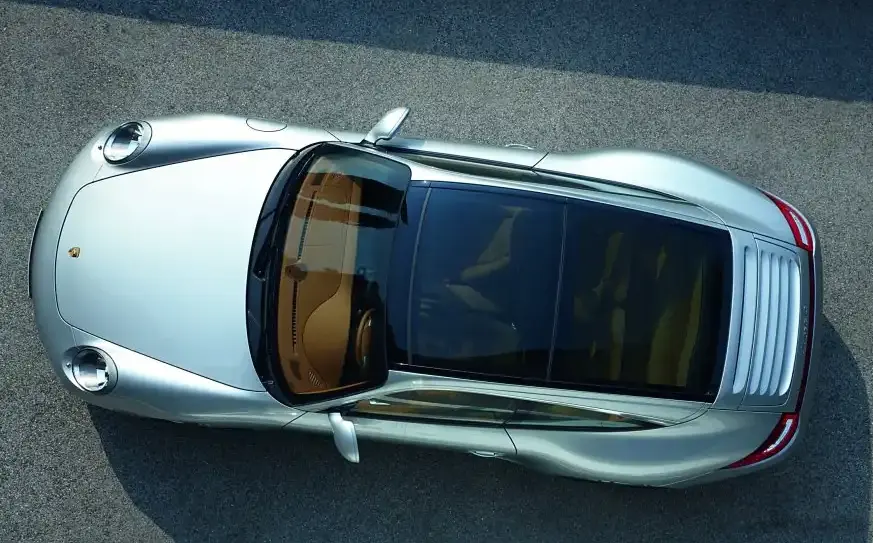
The Porsche 911 Targa 4S (997.2) with the 3.8-liter engine and Porsche Doppelkupplung (PDK) transmission represents a compelling blend of open-air motoring and all-weather performance within the iconic 911 lineage. Produced from 2008 to 2013, this variant occupied a premium position in the 997.2 Targa range, offering a significant step up in power and sophistication compared to the base Targa models. It built upon the foundation of the 997 generation, known for its refinement and driving dynamics, while introducing the innovative Targa roof system – a nod to Porsche’s heritage – combined with the advanced PDK dual-clutch transmission. This model aimed to deliver the classic 911 experience with added comfort and usability.
Technical Specifications
| Brand | Porsche |
| Model | 911 |
| Generation | 911 Targa (997, facelift 2008) |
| Type (Engine) | Targa 4S 3.8 (385 Hp) PDK |
| Start of production | 2008 |
| End of production | 2013 |
| Powertrain Architecture | Internal Combustion engine |
| Body type | Targa |
| Seats | 4 |
| Doors | 2 |
| Fuel consumption (economy) – urban | 15.8 l/100 km (14.9 US mpg, 17.9 UK mpg, 6.3 km/l) |
| Fuel consumption (economy) – extra urban | 7.7 l/100 km (30.5 US mpg, 36.7 UK mpg, 13 km/l) |
| Fuel consumption (economy) – combined | 10.7 l/100 km (22 US mpg, 26.4 UK mpg, 9.3 km/l) |
| CO2 emissions | 251 g/km |
| Fuel Type | Petrol (Gasoline) |
| Acceleration 0 – 100 km/h | 4.7 sec |
| Acceleration 0 – 62 mph | 4.7 sec |
| Acceleration 0 – 60 mph | 4.5 sec |
| Maximum speed | 295 km/h (183.3 mph) |
| Emission standard | Euro 5 |
| Weight-to-power ratio | 4.1 kg/Hp, 245.2 Hp/tonne |
| Weight-to-torque ratio | 3.7 kg/Nm, 267.5 Nm/tonne |
| Power | 385 Hp @ 6500 rpm |
| Power per litre | 101.3 Hp/l |
| Torque | 420 Nm @ 4200 rpm (309.78 lb.-ft. @ 4200 rpm) |
| Engine layout | Rear, Longitudinal |
| Engine Model/Code | MA1.01 |
| Engine displacement | 3800 cm3 (231.89 cu. in.) |
| Number of cylinders | 6 |
| Engine configuration | Boxer |
| Compression ratio | 12.5:1 |
| Number of valves per cylinder | 4 |
| Fuel injection system | Direct injection |
| Engine oil capacity | 7.5 l (7.93 US qt | 6.6 UK qt) |
| Coolant | 29 l (30.64 US qt | 25.52 UK qt) |
| Kerb Weight | 1570 kg (3461.26 lbs.) |
| Max. weight | 1950 kg (4299.01 lbs.) |
| Max load | 380 kg (837.76 lbs.) |
| Trunk (boot) space – maximum | 105 l (3.71 cu. ft.) |
| Fuel tank capacity | 67 l (17.7 US gal | 14.74 UK gal) |
| Length | 4435 mm (174.61 in.) |
| Width | 1852 mm (72.91 in.) |
| Height | 1300 mm (51.18 in.) |
| Wheelbase | 2350 mm (92.52 in.) |
| Drag coefficient (Cd) | 0.31 |
| Minimum turning circle | 10.9 m (35.76 ft.) |
| Drive wheel | All wheel drive (4×4) |
| Number of gears and type of gearbox | 7 gears, automatic transmission PDK |
| Front suspension | Independent type McPherson |
| Rear suspension | Independent multi-link suspension |
| Front brakes | Ventilated discs, 330 mm |
| Rear brakes | Ventilated discs, 330 mm |
| Assisting systems | ABS (Anti-lock braking system) |
| Steering type | Steering rack and pinion |
| Power steering | Hydraulic Steering |
| Tires size | 235/35 ZR19; 305/30 ZR19 |
| Wheel rims size | 8J x 19; 11J x 19 |
Powertrain & Engine Architecture
At the heart of the 911 Targa 4S PDK lies the MA1.01 engine, a 3.8-liter naturally aspirated flat-six. This engine benefits from direct fuel injection (DFI), a technology that significantly improves both power and fuel efficiency. The DFI system precisely meters fuel directly into the combustion chamber, allowing for a higher compression ratio (12.5:1) and more complete combustion. The engine also features an advanced valvetrain with variable valve lift, optimizing airflow for enhanced performance across the rev range. The engine produces 385 horsepower at 6,500 rpm and 420 Nm (309.78 lb-ft) of torque at 4,200 rpm.
Paired with this engine is the Porsche Doppelkupplung (PDK), a seven-speed dual-clutch transmission. The PDK offers incredibly fast and smooth gear changes, contributing to both acceleration and fuel economy. Unlike a traditional automatic transmission with a torque converter, the PDK utilizes two separate clutches – one for even-numbered gears and one for odd-numbered gears – allowing for pre-selection of the next gear. This results in near-instantaneous shifts without interruption of power delivery. The PDK also features paddle shifters, allowing the driver to manually control gear selection for a more engaging driving experience.
Driving Characteristics
The 911 Targa 4S PDK delivers a refined yet exhilarating driving experience. The 3.8-liter engine provides ample power for both spirited driving and comfortable cruising. The PDK transmission enhances this experience with its quick and precise shifts. While not as raw or visceral as a manual transmission, the PDK offers a level of responsiveness and control that is unmatched by traditional automatics. The all-wheel-drive system provides excellent traction, particularly in inclement weather, making the Targa 4S a capable year-round vehicle. Compared to the base Targa models with the 3.6-liter engine, the 4S offers a noticeable increase in performance and a more engaging driving experience. The PDK transmission also contributes to improved fuel economy compared to the traditional Tiptronic S automatic.
Equipment & Trim Levels
The Targa 4S came standard with a generous array of features, including leather upholstery, automatic climate control, a Bose sound system, and bi-xenon headlights. The Targa roof, with its automatically retracting glass panel, was a defining feature of this model. Optional extras included adaptive sport seats, a navigation system, and Porsche Dynamic Chassis Control (PDCC), which further enhanced handling and stability. Interior trim options allowed for personalization, with a range of leather colors and materials available.
Chassis & Braking
The 911 Targa 4S utilizes a sophisticated chassis design, featuring independent suspension at all four wheels. The front suspension employs McPherson struts, while the rear suspension utilizes a multi-link setup. This configuration provides a comfortable ride while maintaining excellent handling characteristics. The braking system consists of ventilated discs at all four wheels, providing ample stopping power. Anti-lock braking system (ABS) is standard, enhancing safety and control.
Market Reception & Comparison
The 911 Targa 4S PDK was generally well-received by automotive critics. It was praised for its blend of performance, comfort, and usability. The Targa roof was seen as a stylish and practical alternative to the coupe and cabriolet models. Compared to the 911 Carrera 4S, the Targa 4S offered a unique open-air experience, albeit with a slightly higher weight and a different aesthetic. Fuel economy was considered reasonable for a high-performance sports car, and reliability was generally good, although maintenance costs remained relatively high, as is typical for Porsche vehicles.
Legacy
The 997.2 generation 911 Targa 4S PDK has proven to be a durable and desirable vehicle in the used car market. The MA1.01 engine is known for its reliability, and the PDK transmission has also proven to be robust when properly maintained. These cars continue to appeal to enthusiasts who appreciate the combination of Porsche performance, open-air motoring, and all-weather capability. As with any Porsche, regular maintenance is crucial to ensure long-term reliability, but the 911 Targa 4S PDK remains a compelling choice for those seeking a sophisticated and engaging sports car experience.