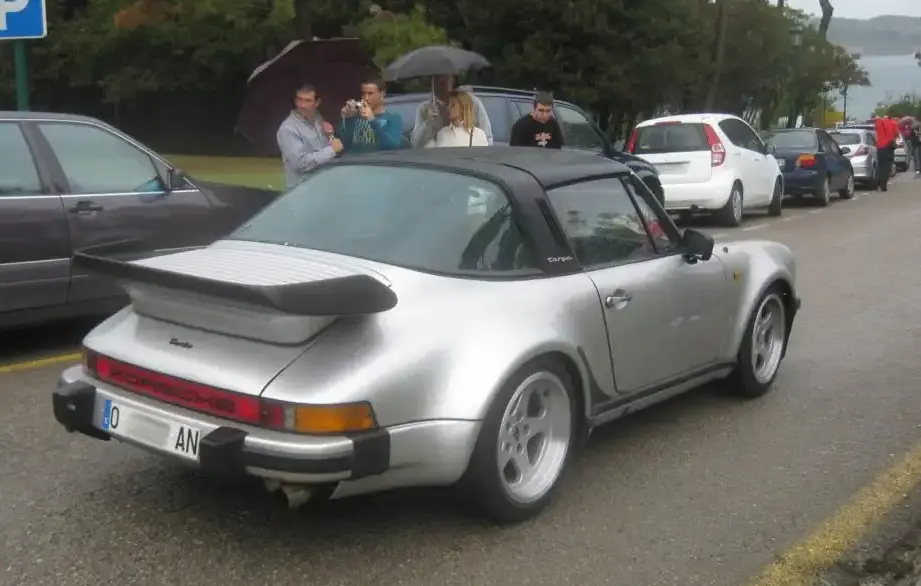
The Porsche 911 Targa 3.3 Turbo, internally designated as the 930, represents a high-performance iteration of the iconic 911 Targa, produced between 1987 and 1989. Positioned as the flagship Targa model during this period, it combined the open-air feel of the Targa top with the potent turbocharged engine derived from the 911 Turbo coupe. This variant sat at the very top of the Targa lineup, offering significantly more power and performance than the naturally aspirated 3.2-liter models. It was a relatively short-lived production run, bridging the gap between the earlier 930 Turbos and the subsequent 964 generation.
Technical Specifications
| Brand | Porsche |
| Model | 911 |
| Generation | 911 Targa (Type 930) |
| Type (Engine) | 3.3 Turbo (300 Hp) |
| Start of production | 1987 |
| End of production | 1989 |
| Powertrain Architecture | Internal Combustion engine |
| Body type | Targa |
| Seats | 4 |
| Doors | 2 |
| Fuel Type | Petrol (Gasoline) |
| Acceleration 0 – 100 km/h | 5.2 sec |
| Acceleration 0 – 62 mph | 5.2 sec |
| Acceleration 0 – 60 mph | 4.9 sec |
| Maximum speed | 260 km/h (161.56 mph) |
| Power | 300 Hp @ 5500 rpm |
| Power per litre | 90.9 Hp/l |
| Torque | 430 Nm @ 4000 rpm (317.15 lb.-ft. @ 4000 rpm) |
| Maximum engine speed | 6000 rpm |
| Engine layout | Rear, Longitudinal |
| Engine Model/Code | 930.66 |
| Engine displacement | 3299 cm3 (201.32 cu. in.) |
| Number of cylinders | 6 |
| Engine configuration | Boxer |
| Cylinder Bore | 97 mm (3.82 in.) |
| Piston Stroke | 74.4 mm (2.93 in.) |
| Compression ratio | 7:1 |
| Number of valves per cylinder | 2 |
| Fuel injection system | Multi-port manifold injection |
| Engine aspiration | Turbocharger, Intercooler |
| Valvetrain | SOHC |
| Engine oil capacity | 13 l (13.74 US qt | 11.44 UK qt) |
| Fuel tank capacity | 80.5 l (21.27 US gal | 17.71 UK gal) |
| Length | 4291 mm (168.94 in.) |
| Width | 1775 mm (69.88 in.) |
| Height | 1310 mm (51.57 in.) |
| Wheelbase | 2272 mm (89.45 in.) |
| Front track | 1432 mm (56.38 in.) |
| Rear (Back) track | 1492 mm (58.74 in.) |
| Ride height (ground clearance) | 130 mm (5.12 in.) |
| Minimum turning circle (turning diameter) | 10.95 m (35.93 ft.) |
| Drivetrain Architecture | The Internal combustion engine (ICE) drives the rear wheels of the vehicle. |
| Drive wheel | Rear wheel drive |
| Number of gears and type of gearbox | 5 gears, manual transmission |
| Front suspension | Spring Strut, Wishbone |
| Rear suspension | Trailing arm |
| Front brakes | Ventilated discs, 304 mm |
| Rear brakes | Ventilated discs, 309 mm |
| Steering type | Steering rack and pinion |
| Front wheel tires | 205/55 R16 |
| Rear wheel tires | 245/45 R16 |
| Front wheel rims | 7J x 16 |
| Rear wheel rims | 9J x 16 |
Powertrain & Engine Architecture
The heart of the 930 Targa Turbo is the 3.3-liter, air-cooled flat-six engine, designated the 930.66. This engine builds upon the earlier 3.0-liter turbo engine, featuring a larger displacement achieved through an increased bore. The engine utilizes a single KKK turbocharger with an intercooler to mitigate turbo lag and increase power output. Fuel delivery is managed by Bosch K-Jetronic mechanical fuel injection, a system known for its reliability and precision. The engine employs a single overhead camshaft (SOHC) design with two valves per cylinder. The compression ratio is relatively low at 7:1, necessary to accommodate the turbocharging system. The engine is mounted longitudinally at the rear of the vehicle, contributing to the 911’s distinctive handling characteristics. The 930.66 engine produces 300 horsepower at 5500 rpm and 317 lb-ft of torque at 4000 rpm. It’s paired with a robust 5-speed manual transmission, the only gearbox option available for this model.
Driving Characteristics
The 930 Targa Turbo delivers a thrilling driving experience, characterized by strong acceleration and unique handling dynamics. The turbocharger provides a noticeable surge of power, particularly in the mid-range, allowing for rapid overtaking and impressive top-end speed. While the 0-60 mph time is quoted around 4.9 seconds, the car feels significantly faster in real-world driving. The rear-wheel-drive layout and the engine’s rearward placement contribute to a distinct handling balance, requiring attentive driving and a respect for the car’s potential to oversteer. Compared to the naturally aspirated 3.2-liter Targa, the 3.3 Turbo offers a substantial performance upgrade, but it also demands more skill and concentration from the driver. The manual transmission provides precise control, but the turbo lag requires anticipation and careful gear selection.
Equipment & Trim Levels
The 930 Targa Turbo was relatively well-equipped, reflecting its position as the top-of-the-line Targa model. Standard features included leather upholstery, power windows, and a basic sound system. The interior trim was typically finished in black leather, although other colors were available as options. Optional extras included a limited-slip differential, which significantly improved traction and handling, and a more sophisticated sound system. Air conditioning was also a popular option, given the car’s performance-oriented nature and potential for spirited driving. The Targa top, with its removable roof panel, provided an open-air driving experience while maintaining a degree of structural rigidity.
Chassis & Braking
The 930 Targa Turbo utilizes a torsion bar suspension system, a hallmark of early Porsche 911s. The front suspension features spring struts and wishbones, while the rear suspension employs trailing arms. This setup provides a relatively firm ride, but it contributes to the car’s excellent handling and stability. Braking duties are handled by ventilated disc brakes on all four wheels, providing ample stopping power. The front brakes measure 304mm in diameter, while the rear brakes are slightly larger at 309mm. The steering is a rack-and-pinion system, offering precise and responsive control.
Market Reception & Comparison
The 930 Targa Turbo was generally well-received by automotive critics, who praised its performance and unique combination of open-air driving and turbocharged power. However, some critics noted the car’s demanding handling characteristics and the potential for turbo lag. Compared to the 911 Turbo coupe, the Targa Turbo offered a slightly more relaxed driving experience, thanks to the open-top design. However, the coupe was generally considered to be more rigid and offered slightly better performance. Compared to the naturally aspirated Targa models, the 3.3 Turbo was in a different league altogether, offering a significant performance advantage but also a higher price tag.
Legacy
The Porsche 911 Targa 3.3 Turbo (930) remains a highly sought-after classic Porsche. The 930.66 engine is known for its durability and relatively straightforward maintenance, although specialized knowledge is required for repairs. The car’s unique combination of performance, style, and open-air driving experience continues to appeal to enthusiasts today. Values for well-maintained examples have steadily increased in recent years, reflecting the car’s growing collectibility. While the car requires careful maintenance and a skilled driver, it offers a rewarding and unforgettable driving experience that is characteristic of the classic Porsche 911.