
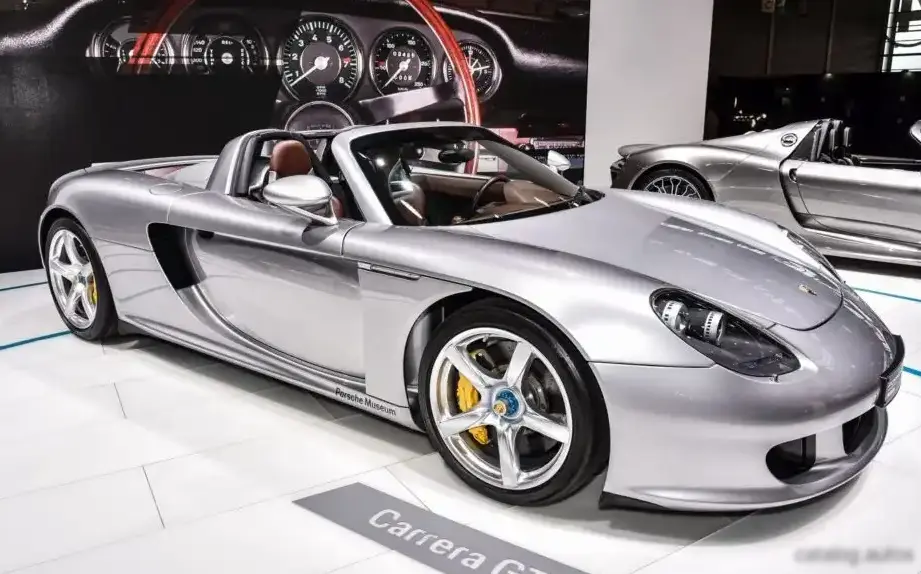
The Porsche Carrera GT, produced from 2003 to 2007, represents a pivotal moment in Porsche’s history, bridging the gap between their traditional road cars and the burgeoning world of high-performance supercars. Initially conceived as a potential replacement for the Porsche 960, a project ultimately cancelled, the Carrera GT evolved into a mid-engine, rear-wheel-drive sports car that showcased Porsche’s engineering prowess. It was a limited-production model, with approximately 1,270 units built, and quickly gained iconic status for its naturally aspirated V10 engine and uncompromising driving experience. The Carrera GT was offered exclusively as a two-seat roadster with a removable hardtop, emphasizing its focus on open-top driving pleasure.
Technical Specifications
| Brand | Porsche |
| Model | Carrera GT |
| Generation | Carrera GT |
| Type (Engine) | 5.7 i V10 40V (612 Hp) |
| Start of production | 2003 |
| End of production | 2007 |
| Powertrain Architecture | Internal Combustion engine |
| Body type | Cabriolet |
| Seats | 2 |
| Doors | 2 |
| Fuel consumption (urban) | 28.3 l/100 km (8.3 US mpg) |
| Fuel consumption (extra urban) | 11.7 l/100 km (20.1 US mpg) |
| Fuel Type | Petrol (Gasoline) |
| Acceleration 0 – 100 km/h | 3.9 sec |
| Acceleration 0 – 62 mph | 3.9 sec |
| Acceleration 0 – 60 mph | 3.7 sec |
| Maximum speed | 330 km/h (205.05 mph) |
| Weight-to-power ratio | 2.3 kg/Hp |
| Weight-to-torque ratio | 2.3 kg/Nm |
| Power | 612 Hp @ 8000 rpm |
| Power per litre | 106.8 Hp/l |
| Torque | 590 Nm @ 5750 rpm (435.16 lb.-ft. @ 5750 rpm) |
| Engine layout | Middle, Longitudinal |
| Engine Model/Code | M80.01 |
| Engine displacement | 5733 cm3 (349.85 cu. in.) |
| Number of cylinders | 10 |
| Engine configuration | V-engine |
| Cylinder Bore | 98 mm (3.86 in.) |
| Piston Stroke | 76 mm (2.99 in.) |
| Compression ratio | 12:1 |
| Number of valves per cylinder | 4 |
| Fuel injection system | Multi-port manifold injection |
| Engine aspiration | Naturally aspirated engine |
| Valvetrain | DOHC |
| Engine oil capacity | 10.5 l (11.1 US qt | 9.24 UK qt) |
| Coolant | 28 l (29.59 US qt | 24.64 UK qt) |
| Kerb Weight | 1380 kg (3042.38 lbs.) |
| Max. weight | 1600 kg (3527.4 lbs.) |
| Max load | 220 kg (485.02 lbs.) |
| Trunk (boot) space – maximum | 76 l (2.68 cu. ft.) |
| Fuel tank capacity | 92 l (24.3 US gal | 20.24 UK gal) |
| Length | 4613 mm (181.61 in.) |
| Width | 1921 mm (75.63 in.) |
| Height | 1166 mm (45.91 in.) |
| Wheelbase | 2730 mm (107.48 in.) |
| Front track | 1612 mm (63.46 in.) |
| Rear (Back) track | 1587 mm (62.48 in.) |
| Drivetrain Architecture | Rear wheel drive |
| Number of gears and type of gearbox | 6 gears, manual transmission |
| Front suspension | Double wishbone |
| Rear suspension | Double wishbone |
| Front brakes | Ventilated discs |
| Rear brakes | Ventilated discs |
| Assisting systems | ABS (Anti-lock braking system) |
| Tires size | 265/35 R20; 335/30 R20 |
| Wheel rims size | 9.5J x 19; 12.5J x 20 |
Powertrain & Engine Architecture
The heart of the Carrera GT is its 5.7-liter naturally aspirated V10 engine, designated the M80.01. This engine was originally developed for Porsche’s Le Mans racing program and adapted for road use. The engine boasts a 90-degree V-angle and utilizes a dry-sump lubrication system, a feature typically found in racing engines, to ensure consistent oil supply during high-g maneuvers. It features four valves per cylinder, operated by double overhead camshafts (DOHC), and utilizes multi-port fuel injection. The engine’s high 12:1 compression ratio contributes to its impressive power output. The Carrera GT exclusively employed a six-speed manual transmission, a deliberate choice by Porsche to maintain a pure driving experience. The transmission features a ceramic dual-plate clutch designed to handle the engine’s substantial torque.
Driving Characteristics
The Carrera GT delivers a raw and visceral driving experience. The naturally aspirated V10 engine provides a linear power delivery with a thrilling rush towards its 8,000 rpm redline. The manual transmission requires a skilled driver to extract the most performance, but offers precise control and engagement. The car’s relatively lightweight construction (around 3,042 lbs) and balanced chassis contribute to exceptional handling. Steering is direct and communicative, providing ample feedback to the driver. While not designed for everyday comfort, the Carrera GT excels on winding roads and race tracks, offering a level of performance and driver involvement rarely found in modern supercars. The gear ratios are closely spaced, allowing the driver to keep the engine within its optimal power band.
Equipment & Trim Levels
The Carrera GT was relatively sparsely equipped, reflecting its focus on performance. Standard features included leather upholstery, air conditioning, and a basic audio system. However, Porsche offered a range of optional extras, including carbon fiber interior trim, navigation system, and upgraded audio. The interior design was functional and driver-focused, with a minimalist dashboard and supportive bucket seats. The removable hardtop provided a degree of refinement and weather protection, but the car was primarily intended to be driven open-top. There were no distinct trim levels; customization was achieved through the extensive options list.
Chassis & Braking
The Carrera GT features a carbon fiber-reinforced plastic (CFRP) monocoque chassis, providing exceptional rigidity and lightweight construction. The suspension utilizes double wishbones at both the front and rear, with adjustable dampers and stabilizers. Braking is provided by ventilated discs at all four corners, with ABS (Anti-lock Braking System) as standard. The braking system was designed to withstand the stresses of high-performance driving and provide consistent stopping power. The car’s relatively low weight and balanced chassis contribute to its impressive handling characteristics.
Market Reception & Comparison
Upon its release, the Carrera GT was widely praised by automotive journalists for its performance, handling, and unique engine. Critics lauded the car’s raw driving experience and its connection to Porsche’s racing heritage. However, some criticized its lack of everyday usability and its relatively spartan interior. Compared to contemporary supercars like the Ferrari Enzo and the McLaren Mercedes SLR, the Carrera GT offered a more focused and engaging driving experience, albeit with less outright luxury. Its fuel economy, while not a primary concern for buyers in this segment, was relatively poor at around 8.3 mpg in urban conditions and 20.1 mpg on the highway.
Legacy
The Porsche Carrera GT has become a highly sought-after collector’s car. Its limited production run, iconic design, and exceptional performance have contributed to its enduring appeal. The M80.01 V10 engine is considered a masterpiece of engineering, and the car’s manual transmission and driver-focused design are increasingly appreciated in an era of automated driving systems. While maintenance can be expensive due to the car’s complexity and age, the Carrera GT remains a thrilling and rewarding machine to drive. Its influence can be seen in subsequent Porsche models, particularly in the development of the Porsche 918 Spyder, which incorporated hybrid technology but retained a similar focus on performance and driver engagement.
