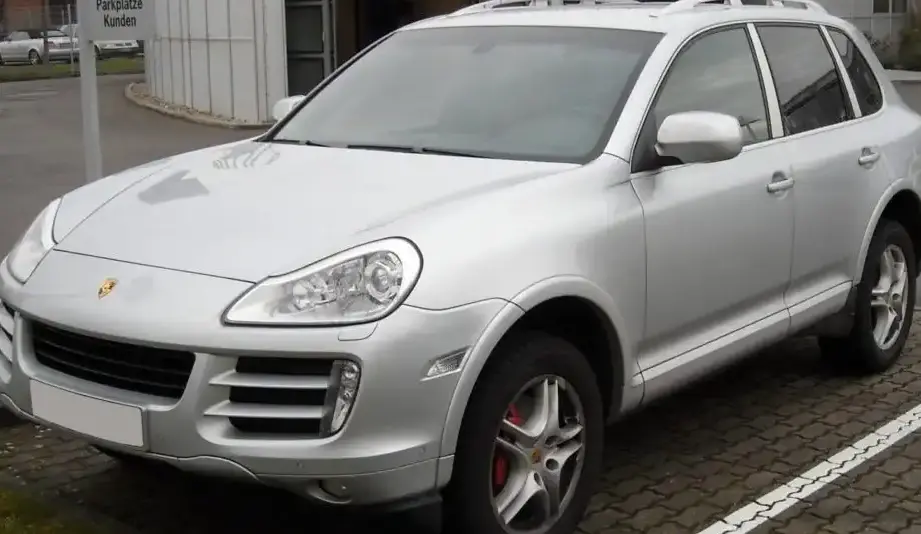
Technical Specifications
| Brand | Porsche |
| Model | Cayenne |
| Generation | Cayenne (955, facelift 2007) |
| Type (Engine) | GTS 4.8 V8 (405 Hp) AWD |
| Start of production | 2008 |
| End of production | 2010 |
| Powertrain Architecture | Internal Combustion engine |
| Body type | SUV |
| Seats | 5 |
| Doors | 5 |
| Fuel consumption (economy) – urban (NEDC) | 22.6 l/100 km (10.4 US mpg, 12.5 UK mpg, 4.4 km/l) |
| Fuel consumption (economy) – extra urban (NEDC) | 10.9 l/100 km (21.6 US mpg, 25.9 UK mpg, 9.2 km/l) |
| Fuel consumption (economy) – combined (NEDC) | 15.1 l/100 km (15.6 US mpg, 18.7 UK mpg, 6.6 km/l) |
| CO2 emissions (NEDC) | 361 g/km |
| Fuel Type | Petrol (Gasoline) |
| Acceleration 0 – 100 km/h | 6.1 sec |
| Acceleration 0 – 62 mph | 6.1 sec |
| Acceleration 0 – 60 mph | 5.8 sec |
| Maximum speed | 253 km/h (157.21 mph) |
| Emission standard | Euro 4 |
| Weight-to-power ratio | 5.5 kg/Hp, 182 Hp/tonne |
| Weight-to-torque ratio | 4.5 kg/Nm, 224.7 Nm/tonne |
| Power | 405 Hp @ 6500 rpm |
| Power per litre | 84.3 Hp/l |
| Torque | 500 Nm @ 3500 rpm (368.78 lb.-ft. @ 3500 rpm) |
| Maximum engine speed | 6700 rpm |
| Engine layout | Front, Longitudinal |
| Engine Model/Code | M48.01 |
| Engine displacement | 4806 cm3 (293.28 cu. in.) |
| Number of cylinders | 8 |
| Engine configuration | V-engine |
| Cylinder Bore | 96 mm (3.78 in.) |
| Piston Stroke | 83 mm (3.27 in.) |
| Compression ratio | 12.5:1 |
| Number of valves per cylinder | 4 |
| Fuel injection system | Direct injection |
| Engine aspiration | Naturally aspirated engine |
| Valvetrain | DOHC |
| Engine oil capacity | 8.5 l (8.98 US qt | 7.48 UK qt) |
| Coolant | 18 l (19.02 US qt | 15.84 UK qt) |
| Kerb Weight | 2225 kg (4905.29 lbs.) |
| Max. weight | 3080 kg (6790.24 lbs.) |
| Max load | 855 kg (1884.95 lbs.) |
| Trunk (boot) space – minimum | 540 l (19.07 cu. ft.) |
| Trunk (boot) space – maximum | 1770 l (62.51 cu. ft.) |
| Fuel tank capacity | 100 l (26.42 US gal | 22 UK gal) |
| Length | 4795 mm (188.78 in.) |
| Width | 1957 mm (77.05 in.) |
| Width including mirrors | 2200 mm (86.61 in.) |
| Height | 1675 mm (65.94 in.) |
| Wheelbase | 2855 mm (112.4 in.) |
| Front track | 1659 mm (65.31 in.) |
| Rear (Back) track | 1682 mm (66.22 in.) |
| Ride height (ground clearance) | 194 mm (7.64 in.) |
| Drag coefficient (Cd) | 0.36 |
| Approach angle | 25.6° |
| Departure angle | 21.1° |
| Ramp-over (brakeover) angle | 18.2° |
| Climb angle | 45° |
| Wading depth | 476 mm (18.74 in.) |
| Drivetrain Architecture | The Internal combustion engine (ICE) drives permanently the four wheels of the vehicle. |
| Drive wheel | All wheel drive (4×4) |
| Number of gears and type of gearbox | 6 gears, manual transmission |
| Front suspension | Double wishbone |
| Rear suspension | Independent multi-link suspension |
| Front brakes | Ventilated discs, 350×34 mm |
| Rear brakes | Ventilated discs, 330×28 mm |
| Assisting systems | ABS (Anti-lock braking system) |
| Steering type | Steering rack and pinion |
| Power steering | Hydraulic Steering |
| Tires size | 295/35 R21 |
| Wheel rims size | 10J x 21 |
The Porsche Cayenne GTS 4.8 V8 AWD, produced between 2008 and 2010, is a high-performance variant of the second-generation (955) Cayenne. Following the 2007 facelift, Porsche introduced the GTS model to offer a more focused driving experience than the standard Cayenne or Cayenne S. It slots into the lineup as a sportier alternative, offering increased power and a more aggressive suspension setup. The 955 platform, shared with the Volkswagen Touareg and Audi Q7, provided a solid foundation for Porsche’s first SUV, and the GTS variant aimed to capitalize on that platform’s potential for performance.
Powertrain & Engine Architecture
At the heart of the Cayenne GTS lies the M48.01, a naturally aspirated 4.8-liter V8 engine. This engine is a significant departure from the smaller displacement, supercharged V6 found in the Cayenne S. The M48.01 boasts a robust 405 horsepower at 6500 rpm and 500 Nm (368 lb-ft) of torque at 3500 rpm. It features direct fuel injection, a double overhead camshaft (DOHC) valvetrain with four valves per cylinder, and a high 12.5:1 compression ratio. The engine’s architecture is longitudinal, meaning it’s mounted lengthwise in the chassis. The 6-speed manual transmission was standard, delivering power to all four wheels via Porsche’s all-wheel-drive system. This system utilizes a multi-plate clutch to distribute torque between the front and rear axles, providing excellent traction in various conditions.
Driving Characteristics
The Cayenne GTS, with its 405 hp and manual transmission, delivers a noticeably more engaging driving experience than its lower-powered siblings. Acceleration from 0-60 mph takes approximately 5.8 seconds, and it reaches a top speed of 157 mph. The engine’s power delivery is linear and responsive, providing ample torque throughout the rev range. The manual gearbox, while offering greater driver control, requires more involvement than the optional Tiptronic S automatic transmission available on other Cayenne models. The GTS’s suspension is tuned for performance, with stiffer springs and dampers compared to the standard Cayenne. This results in reduced body roll and improved handling, but it also comes at the expense of some ride comfort. The all-wheel-drive system provides excellent grip, inspiring confidence in corners and on slippery surfaces.
Equipment & Trim Levels
The GTS trim level came standard with a number of features designed to enhance both performance and luxury. These included sport seats with increased bolstering, a sport steering wheel, and stainless steel pedals. Exterior styling cues included unique front and rear fascias, wider wheel arches, and dual exhaust outlets. Optional extras included adaptive air suspension, which allowed the driver to adjust the ride height and damping characteristics, and a panoramic sunroof. Interior options included various leather upholstery choices, carbon fiber trim, and a Bose sound system. The GTS was positioned as a premium offering, and buyers could customize their vehicles with a wide range of options to suit their individual preferences.
Chassis & Braking
The Cayenne GTS utilizes a robust chassis designed to handle the increased power and performance. The front suspension features double wishbones, while the rear suspension employs an independent multi-link setup. This configuration provides excellent wheel control and ride quality. Braking duties are handled by ventilated discs on all four wheels, measuring 350×34 mm at the front and 330×28 mm at the rear. The GTS also includes Porsche’s Anti-lock Braking System (ABS) as standard equipment. The suspension was tuned to be firmer than the standard Cayenne, offering a more connected feel to the road.
Market Reception & Comparison
The Cayenne GTS was generally well-received by automotive critics, who praised its performance, handling, and overall driving experience. It was seen as a compelling alternative to other high-performance SUVs, such as the BMW X5 M and the Mercedes-Benz ML63 AMG. Compared to the Cayenne S, the GTS offered a significant power increase and a more focused driving experience. However, it was less practical than the base Cayenne due to its firmer suspension and higher price tag. Fuel economy was also a concern, with the GTS averaging around 15.6 US mpg in combined driving. Compared to the Turbo model, the GTS offered a more engaging driving experience due to its manual transmission option, but it lacked the Turbo’s ultimate performance.
Legacy
The Cayenne GTS 4.8 V8 has established itself as a desirable used car, particularly among Porsche enthusiasts. The naturally aspirated V8 engine is known for its reliability and durability, although regular maintenance is essential. The manual transmission is highly sought after by driving purists. While the 955 generation Cayenne is now aging, the GTS variant remains a capable and rewarding SUV. Its combination of performance, luxury, and practicality continues to appeal to buyers looking for a unique and engaging driving experience. Parts availability is generally good, and a strong aftermarket support network exists for the Cayenne platform.