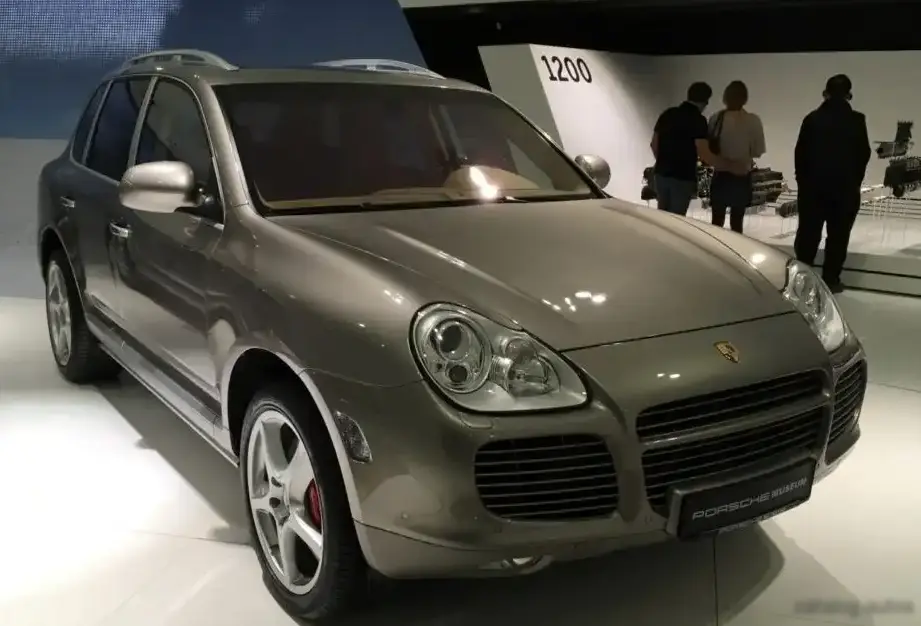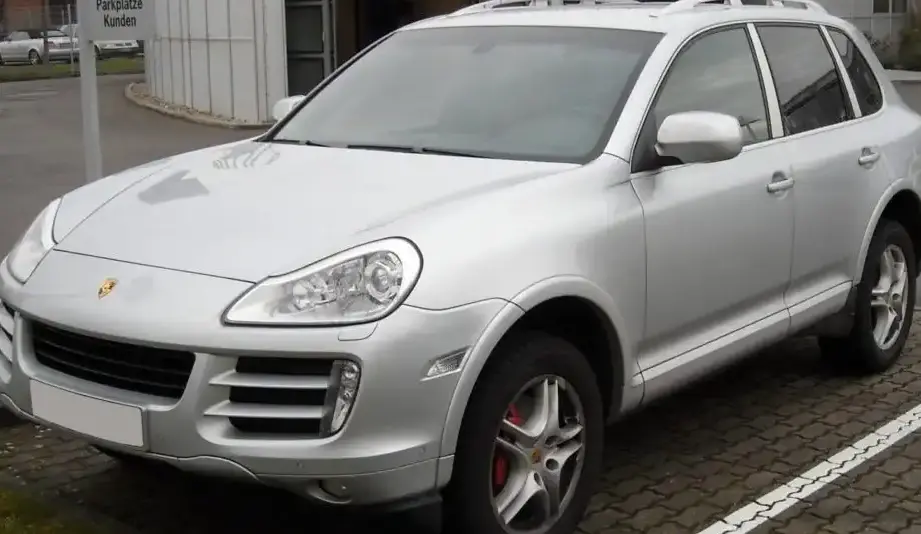
The Porsche Cayenne Turbo, specifically the 955 facelift model produced from 2007 to 2010, represents a significant evolution in Porsche’s foray into the luxury SUV market. This variant, equipped with a 4.8-liter twin-turbocharged V8 engine producing 500 horsepower and paired with a six-speed Tiptronic S automatic transmission, was positioned as the flagship performance model within the Cayenne range. It aimed to deliver the driving experience expected of a Porsche, combined with the practicality and space of a sport utility vehicle. The 955.2 generation (facelift) brought revised styling, improved interior materials, and updated technology compared to the original 955, solidifying the Cayenne’s appeal to a broader audience.
Technical Specifications
| Brand | Porsche |
| Model | Cayenne |
| Generation | Cayenne (955, facelift 2007) |
| Type (Engine) | Turbo 4.8 V8 (500 Hp) AWD Tiptronic S |
| Start of production | 2007 |
| End of production | 2010 |
| Powertrain Architecture | Internal Combustion engine |
| Body type | SUV |
| Seats | 5 |
| Doors | 5 |
| Fuel consumption (economy) – urban (NEDC) | 22.5 l/100 km (10.5 US mpg, 12.6 UK mpg, 4.4 km/l) |
| Fuel consumption (economy) – extra urban (NEDC) | 10.5 l/100 km (22.4 US mpg, 26.9 UK mpg, 9.5 km/l) |
| Fuel consumption (economy) – combined (NEDC) | 14.9 l/100 km (15.8 US mpg, 19 UK mpg, 6.7 km/l) |
| CO2 emissions (NEDC) | 358 g/km |
| Fuel Type | Petrol (Gasoline) |
| Acceleration 0 – 100 km/h | 5.1 sec |
| Acceleration 0 – 62 mph | 5.1 sec |
| Acceleration 0 – 60 mph | 4.8 sec |
| Maximum speed | 275 km/h (170.88 mph) |
| Emission standard | Euro 4 |
| Weight-to-power ratio | 4.7 kg/Hp, 212.3 Hp/tonne |
| Weight-to-torque ratio | 3.4 kg/Nm, 297.2 Nm/tonne |
| Power | 500 Hp @ 6000 rpm |
| Power per litre | 104 Hp/l |
| Torque | 700 Nm @ 2250-4500 rpm (516.29 lb.-ft. @ 2250-4500 rpm) |
| Maximum engine speed | 6700 rpm |
| Engine layout | Front, Longitudinal |
| Engine Model/Code | M48.51 |
| Engine displacement | 4806 cm3 (293.28 cu. in.) |
| Number of cylinders | 8 |
| Engine configuration | V-engine |
| Cylinder Bore | 96 mm (3.78 in.) |
| Piston Stroke | 83 mm (3.27 in.) |
| Compression ratio | 10.5:1 |
| Number of valves per cylinder | 4 |
| Fuel injection system | Direct injection |
| Engine aspiration | Twin-Turbo, Intercooler |
| Valvetrain | DOHC |
| Engine oil capacity | 8.5 l (8.98 US qt | 7.48 UK qt) |
| Coolant | 18 l (19.02 US qt | 15.84 UK qt) |
| Kerb Weight | 2355 kg (5191.89 lbs.) |
| Max. weight | 3080 kg (6790.24 lbs.) |
| Max load | 725 kg (1598.35 lbs.) |
| Trunk (boot) space – minimum | 540 l (19.07 cu. ft.) |
| Trunk (boot) space – maximum | 1770 l (62.51 cu. ft.) |
| Fuel tank capacity | 100 l (26.42 US gal | 22 UK gal) |
| Max. roof load | 100 kg (220.46 lbs.) |
| Length | 4795 mm (188.78 in.) |
| Width | 1928 mm (75.91 in.) |
| Width including mirrors | 2200 mm (86.61 in.) |
| Height | 1696 mm (66.77 in.) |
| Wheelbase | 2855 mm (112.4 in.) |
| Front track | 1641 mm (64.61 in.) |
| Rear (Back) track | 1656 mm (65.2 in.) |
| Ride height (ground clearance) | 215-271 mm (8.46 – 10.67 in.) |
| Drag coefficient (Cd) | 0.35 |
| Approach angle | 28.5-31.8° |
| Departure angle | 22.3-25.4° |
| Ramp-over (brakeover) angle | 20-24.7° |
| Wading depth | 500-555 mm (19.69 – 21.85 in.) |
| Drivetrain Architecture | The Internal combustion engine (ICE) drives permanently the four wheels of the vehicle. |
| Drive wheel | All wheel drive (4×4) |
| Number of gears and type of gearbox | 6 gears, automatic transmission Tiptronic S |
| Front suspension | Double wishbone |
| Rear suspension | Independent multi-link suspension |
| Front brakes | Ventilated discs |
| Rear brakes | Ventilated discs |
| Assisting systems | ABS (Anti-lock braking system) |
| Steering type | Steering rack and pinion |
| Power steering | Hydraulic Steering |
| Tires size | 275/45 R19 |
| Wheel rims size | 9J x 19 |
Powertrain & Engine Architecture
The heart of the Cayenne Turbo is the M48.51 engine, a 4.8-liter V8 featuring twin turbochargers and direct fuel injection. This engine is a significant departure from naturally aspirated designs, delivering substantial power and torque across a broad RPM range. The twin-turbo setup utilizes two BorgWarner turbochargers, providing increased airflow and boosting performance. Direct fuel injection, a key technology at the time, precisely meters fuel into the combustion chambers, improving efficiency and reducing emissions. The engine’s valvetrain employs double overhead camshafts (DOHC) with four valves per cylinder, optimizing gas flow for enhanced power output. The six-speed Tiptronic S automatic transmission offers both fully automatic operation and manual gear selection via steering wheel-mounted paddles, allowing drivers to tailor the driving experience to their preferences. This transmission is known for its relatively quick and smooth shifts, contributing to the Cayenne Turbo’s sporty character.
Driving Characteristics
The Cayenne Turbo’s 500 horsepower and 700 Nm (516 lb-ft) of torque translate into impressive acceleration. The 0-60 mph sprint takes approximately 4.8 seconds, and it reaches a top speed of 171 mph. The Tiptronic S transmission, while offering smooth shifts, isn’t as lightning-fast as some dual-clutch transmissions found in contemporary performance SUVs. However, its robustness and ability to handle the engine’s substantial torque are noteworthy. The all-wheel-drive system provides excellent traction in various conditions, enhancing stability and control. Compared to the base Cayenne or the V6 models, the Turbo offers a dramatically different driving experience, with significantly more power and a more responsive feel. It also differs from the Cayenne S, which uses a naturally aspirated V8, by delivering a broader torque curve and quicker acceleration thanks to the turbochargers.
Equipment & Trim Levels
The Cayenne Turbo came standard with a comprehensive list of features, reflecting its position as the range-topping model. These included leather upholstery, heated and ventilated front seats, a premium audio system, a sunroof, and automatic climate control. Optional extras were plentiful, allowing buyers to customize their Cayenne Turbo with features such as adaptive air suspension, Porsche Dynamic Chassis Control (PDCC), and a rear seat entertainment system. Interior trim options included various wood veneers and carbon fiber accents. The exterior could be further personalized with different wheel designs and paint colors.
Chassis & Braking
The Cayenne Turbo features a fully independent suspension system, with double wishbones at the front and a multi-link setup at the rear. This configuration provides a comfortable ride while maintaining precise handling. The standard suspension setup is tuned for a balance between comfort and performance, while the optional adaptive air suspension allows drivers to adjust the ride height and damping characteristics. Braking duties are handled by ventilated discs on all four wheels, providing ample stopping power. The Cayenne Turbo also incorporates ABS (Anti-lock Braking System) and other electronic stability control systems to enhance safety.
Market Reception & Comparison
The Cayenne Turbo was generally well-received by automotive critics, who praised its performance, luxurious interior, and surprisingly agile handling for a vehicle of its size. However, its high price tag and relatively poor fuel economy were often cited as drawbacks. Compared to other luxury SUVs of the time, such as the BMW X5 and Range Rover, the Cayenne Turbo offered a more focused driving experience and a more powerful engine. Fuel economy, however, was significantly worse than its competitors, averaging around 16 mpg combined. Reliability was generally good, but the complex turbocharging system and advanced electronics could require costly repairs.
Legacy
The 955 Cayenne Turbo played a crucial role in establishing Porsche as a viable player in the luxury SUV segment. Its combination of performance, luxury, and practicality appealed to a wide range of buyers, helping to drive Porsche’s sales and profitability. Today, the 955 Turbo remains a desirable vehicle on the used car market, particularly among Porsche enthusiasts. While maintenance costs can be higher than those of more mainstream SUVs, its performance and exclusivity continue to attract buyers. The M48.51 engine, while complex, is generally considered to be a robust and reliable unit when properly maintained, and parts availability remains relatively good.