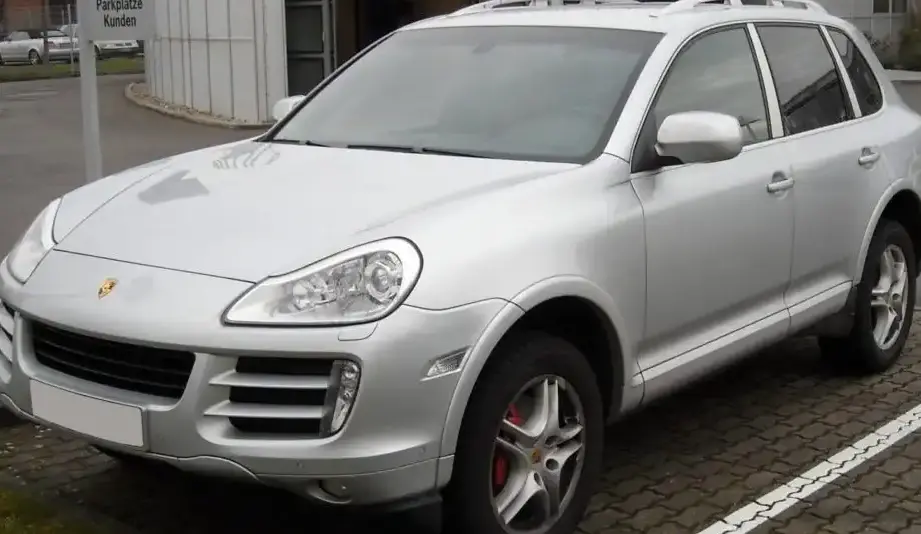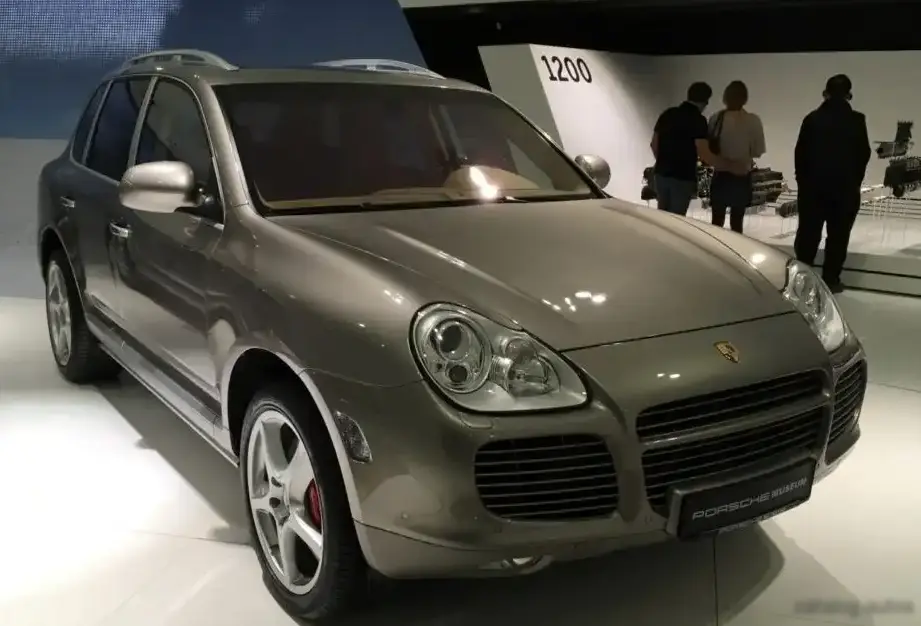
The Porsche Cayenne (955) Turbo, produced from 2002 to 2006, represented Porsche’s ambitious entry into the luxury SUV market. Powered by a 4.5-liter twin-turbocharged V8 engine producing 450 horsepower, this variant was positioned as the flagship model of the first-generation Cayenne lineup. It aimed to deliver the performance and handling expected of a Porsche, packaged within the practicality of a sport utility vehicle. The 955 generation Cayenne, built on the Volkswagen Group’s PL71 platform (shared with the Volkswagen Touareg and Audi Q7), was a significant departure for Porsche, and the Turbo model was intended to showcase the platform’s capabilities.
Technical Specifications
| Brand | Porsche |
| Model | Cayenne |
| Generation | Cayenne (955) |
| Type (Engine) | Turbo 4.5 V8 (450 Hp) Tiptronic S |
| Start of production | 2002 |
| End of production | 2006 |
| Powertrain Architecture | Internal Combustion engine |
| Body type | SUV |
| Seats | 5 |
| Doors | 5 |
| Fuel consumption (economy) – urban | 21.9 l/100 km (10.7 US mpg, 12.9 UK mpg, 4.6 km/l) |
| Fuel consumption (economy) – extra urban | 11.9 l/100 km (19.8 US mpg, 23.7 UK mpg, 8.4 km/l) |
| Fuel consumption (economy) – combined | 15.7 l/100 km (15 US mpg, 18 UK mpg, 6.4 km/l) |
| CO2 emissions | 378 g/km |
| Fuel Type | Petrol (Gasoline) |
| Acceleration 0 – 100 km/h | 5.6 sec |
| Acceleration 0 – 62 mph | 5.6 sec |
| Acceleration 0 – 60 mph | 5.3 sec |
| Maximum speed | 266 km/h (165.28 mph) |
| Emission standard | Euro 4 |
| Weight-to-power ratio | 5.4 kg/Hp, 185.2 Hp/tonne |
| Weight-to-torque ratio | 3.9 kg/Nm, 255.1 Nm/tonne |
| Power | 450 Hp @ 6000 rpm |
| Power per litre | 99.8 Hp/l |
| Torque | 620 Nm @ 2250-4750 rpm (457.29 lb.-ft. @ 2250-4750 rpm) |
| Engine layout | Front, Longitudinal |
| Engine Model/Code | M48.50 |
| Engine displacement | 4511 cm3 (275.28 cu. in.) |
| Number of cylinders | 8 |
| Engine configuration | V-engine |
| Cylinder Bore | 93 mm (3.66 in.) |
| Piston Stroke | 83 mm (3.27 in.) |
| Compression ratio | 9.5:1 |
| Number of valves per cylinder | 4 |
| Fuel injection system | Direct injection |
| Engine aspiration | Turbocharger, Intercooler |
| Valvetrain | DOHC |
| Engine oil capacity | 8.5 l (8.98 US qt | 7.48 UK qt) |
| Coolant | 18 l (19.02 US qt | 15.84 UK qt) |
| Kerb Weight | 2430 kg (5357.23 lbs.) |
| Max. weight | 3080 kg (6790.24 lbs.) |
| Max load | 650 kg (1433 lbs.) |
| Trunk (boot) space – minimum | 540 l (19.07 cu. ft.) |
| Trunk (boot) space – maximum | 1770 l (62.51 cu. ft.) |
| Fuel tank capacity | 100 l (26.42 US gal | 22 UK gal) |
| Length | 4782 mm (188.27 in.) |
| Width | 1928 mm (75.91 in.) |
| Height | 1699 mm (66.89 in.) |
| Wheelbase | 2855 mm (112.4 in.) |
| Front track | 1647 mm (64.84 in.) |
| Rear (Back) track | 1662 mm (65.43 in.) |
| Drag coefficient (Cd) | 0.39 |
| Drive wheel | All wheel drive (4×4) |
| Number of gears and type of gearbox | 6 gears, automatic transmission Tiptronic S |
| Front suspension | Double wishbone |
| Rear suspension | Independent multi-link suspension |
| Front brakes | Ventilated discs |
| Rear brakes | Ventilated discs |
| Assisting systems | ABS (Anti-lock braking system) |
| Steering type | Steering rack and pinion |
| Power steering | Hydraulic Steering |
| Tires size | 255/55 R 18 |
| Wheel rims size | 8J x 18 |
Powertrain & Engine Architecture
The heart of the Cayenne Turbo is the M48.50 engine, a 4.5-liter V8 featuring twin turbochargers and direct fuel injection. This engine, derived from Porsche’s experience with forced induction in the 911 Turbo, produced a substantial 450 horsepower and 457 lb-ft of torque. The direct fuel injection system, a key component of the engine’s efficiency and power output, precisely meters fuel directly into the combustion chamber. The engine utilizes a double overhead camshaft (DOHC) valvetrain, optimizing airflow for improved performance. The Tiptronic S automatic transmission, a six-speed unit, was specifically tuned to handle the engine’s high torque output. It offered both fully automatic operation and a manual shift mode, allowing drivers to exert more control over gear selection.
Driving Characteristics
The Cayenne Turbo delivered a unique driving experience for an SUV. Acceleration was brisk, with 0-60 mph times consistently around 5.3 seconds. The Tiptronic S transmission provided smooth shifts in automatic mode, but the manual shift function allowed for more engaging driving. While not as agile as a dedicated sports car, the Cayenne Turbo offered a surprisingly composed handling experience, thanks to its sophisticated suspension and all-wheel-drive system. Compared to the base Cayenne models, the Turbo offered significantly more power and a more refined driving experience. The lower-powered V6 variants, while more fuel-efficient, lacked the Turbo’s effortless acceleration and overall performance.
Equipment & Trim Levels
The Cayenne Turbo came standard with a comprehensive list of features, including leather upholstery, heated front seats, a premium audio system, and automatic climate control. Optional extras included adaptive air suspension, a sunroof, and upgraded interior trim options. The interior design was luxurious, reflecting Porsche’s commitment to quality and craftsmanship. The Turbo trim also featured unique exterior styling cues, such as distinctive wheels and body-colored fender flares, setting it apart from other Cayenne models.
Chassis & Braking
The Cayenne Turbo’s chassis was designed to handle the engine’s power and provide a comfortable ride. It featured a double wishbone front suspension and an independent multi-link rear suspension. Large ventilated disc brakes were fitted on all four wheels, providing ample stopping power. The all-wheel-drive system, Porsche Traction Management (PTM), distributed power between the front and rear axles as needed, enhancing traction and stability.
Market Reception & Comparison
The Cayenne Turbo was generally well-received by automotive critics, who praised its performance, handling, and luxurious interior. However, its high price and relatively poor fuel economy were often cited as drawbacks. Compared to other luxury SUVs of the time, such as the BMW X5 and Mercedes-Benz ML-Class, the Cayenne Turbo offered a more sporting driving experience but was also more expensive to operate. The fuel economy, averaging around 15 mpg combined, was significantly lower than that of the V6-powered Cayenne models.
Legacy
The first-generation Cayenne Turbo played a crucial role in establishing Porsche as a player in the luxury SUV segment. While early models experienced some reliability issues with the cooling system and air suspension, many have proven to be durable vehicles with proper maintenance. Today, the 955 Cayenne Turbo remains a desirable vehicle for enthusiasts seeking a high-performance SUV with a Porsche pedigree. The M48.50 engine, while complex, is capable of delivering years of reliable service when properly maintained. The Cayenne Turbo’s success paved the way for subsequent generations of Porsche SUVs, solidifying the brand’s position in this growing market segment.