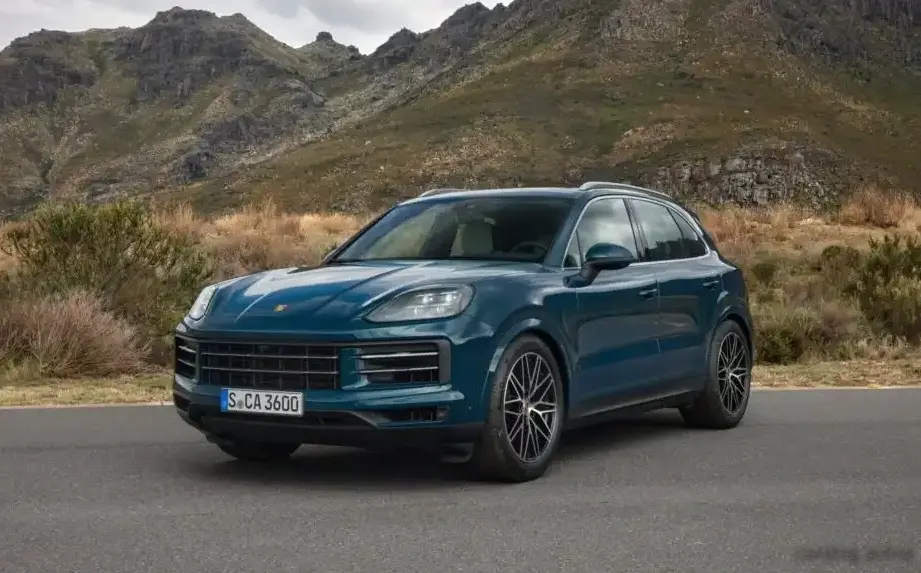
The Porsche Cayenne III facelift, introduced in July 2023, represents a significant evolution of Porsche’s popular luxury SUV. Among the various powertrain options available, the 3.0 V6 (470 Hp) E-Hybrid Tiptronic S variant occupies a compelling position, blending performance with efficiency through plug-in hybrid technology. This model builds upon the foundation of the third-generation Cayenne (introduced in 2018), incorporating updated styling, enhanced technology, and refined powertrain options. The E-Hybrid variant specifically caters to buyers seeking a premium SUV experience with reduced emissions and the flexibility of all-electric driving.
Technical Specifications
| Brand | Porsche |
| Model | Cayenne |
| Generation | Cayenne III (facelift 2023) |
| Type (Engine) | 3.0 V6 (470 Hp) E-Hybrid Tiptronic S |
| Start of production | July, 2023 |
| Powertrain Architecture | PHEV (Plug-in Hybrid Electric Vehicle) |
| Body type | SUV |
| Seats | 5 |
| Doors | 5 |
| Combined fuel consumption (WLTP) | 1.5-1.8 l/100 km (156.8 – 130.7 US mpg) |
| CO2 emissions (WLTP) | 33-42 g/km |
| Fuel Type | Petrol / electricity |
| Acceleration 0 – 100 km/h | 4.9 sec |
| Acceleration 0 – 62 mph | 4.9 sec |
| Acceleration 0 – 60 mph | 4.7 sec |
| Acceleration 0 – 200 km/h | 18.2 sec |
| Maximum speed | 254 km/h (157.83 mph) |
| Emission standard | Euro 6d-ISC-FCM |
| Weight-to-power ratio | 5.2 kg/Hp, 193.8 Hp/tonne |
| Weight-to-torque ratio | 3.7 kg/Nm, 268 Nm/tonne |
| Gross battery capacity | 25.9 kWh |
| Net (usable) battery capacity | 21.8 kWh |
| Battery technology | Lithium-ion (Li-Ion) |
| Battery location | Under the trunk |
| All-electric range (WLTP) | 66-74 km (41.01 – 45.98 mi) |
| Average Energy consumption (WLTP) | 28.7-30.8 kWh/100 km (46.19 – 49.57 kWh/100 mi) |
| Electric motor power | 176 Hp |
| Electric motor Torque | 460 Nm (339.28 lb.-ft.) |
| Electric motor location | Between the combustion engine and the transmission |
| System power | 470 Hp |
| System torque | 650 Nm (479.42 lb.-ft.) |
| Power | 304 Hp @ 5400-6400 rpm |
| Torque | 420 Nm @ 1400-4800 rpm (309.78 lb.-ft. @ 1400-4800 rpm) |
| Maximum engine speed | 6500 rpm |
| Engine displacement | 2995 cm3 (182.77 cu. in.) |
| Number of cylinders | 6 |
| Engine configuration | V-engine |
| Cylinder Bore | 84.5 mm (3.33 in.) |
| Piston Stroke | 89 mm (3.5 in.) |
| Number of valves per cylinder | 4 |
| Fuel injection system | Direct injection |
| Engine aspiration | Turbocharger, Intercooler |
| Kerb Weight | 2425 kg (5346.21 lbs.) |
| Max. weight | 3125 kg (6889.45 lbs.) |
| Max load | 700 kg (1543.24 lbs.) |
| Trunk (boot) space – minimum | 545 l (19.25 cu. ft.) |
| Trunk (boot) space – maximum | 1563 l (55.2 cu. ft.) |
| Fuel tank capacity | 75 l (19.81 US gal | 16.5 UK gal) |
| Length | 4930 mm (194.09 in.) |
| Width | 1983 mm (78.07 in.) |
| Width including mirrors | 2194 mm (86.38 in.) |
| Height | 1696 mm (66.77 in.) |
| Wheelbase | 2895 mm (113.98 in.) |
| Ride height (ground clearance) | 188 mm (7.4 in.) |
| Minimum turning circle | 12.2 m (40.03 ft.) |
| Gears/Gearbox | 8 gears, automatic transmission Tiptronic S |
Powertrain & Engine Architecture
At the heart of the Cayenne E-Hybrid lies a 3.0-liter V6 turbocharged engine, designated as part of the EA836 engine family. This engine produces 304 horsepower and 420 Nm (309.78 lb-ft) of torque. Combined with a 176 horsepower electric motor integrated between the engine and the eight-speed Tiptronic S automatic transmission, the system delivers a combined output of 470 horsepower and 650 Nm (479.42 lb-ft) of torque. The electric motor draws power from a 25.9 kWh (gross) / 21.8 kWh (net) lithium-ion battery pack located under the trunk floor. The Tiptronic S transmission is a sophisticated eight-speed automatic known for its smooth shifts and responsiveness, offering both automatic and manual shift modes. The engine utilizes direct fuel injection and a single turbocharger with an intercooler to optimize performance and efficiency. A start/stop system is standard, further contributing to fuel savings.
Driving Characteristics
The 3.0 V6 E-Hybrid Tiptronic S offers a unique driving experience. In electric-only mode, the Cayenne can travel between 66-74 km (41-46 miles) on a full charge, providing silent and emission-free operation for shorter commutes. When the battery is depleted or additional power is needed, the gasoline engine seamlessly kicks in, providing robust acceleration. The combined system delivers a 0-60 mph time of approximately 4.7 seconds. The Tiptronic S transmission is well-tuned for both comfort and performance, offering quick and precise gear changes. Compared to the base Cayenne or the higher-performance Turbo models, the E-Hybrid prioritizes efficiency and a more relaxed driving experience, while still offering ample power for everyday driving and occasional spirited runs. The automatic transmission, while convenient, may not offer the same level of driver engagement as the optional manual transmission available on some other Cayenne variants.
Equipment & Trim Levels
The Cayenne E-Hybrid typically comes well-equipped as standard. Interior features include leather upholstery, power-adjustable front seats with memory function, a touchscreen infotainment system with navigation, and a premium sound system. Standard safety features include Porsche Active Suspension Management (PASM), Porsche Stability Management (PSM), and a suite of driver-assistance systems such as lane keep assist and adaptive cruise control. Optional extras include air suspension, a panoramic sunroof, upgraded leather interiors, and various customization options through Porsche’s extensive personalization program. The E-Hybrid trim generally sits in the mid-range of the Cayenne lineup, offering a balance of luxury, performance, and efficiency.
Chassis & Braking
The Cayenne E-Hybrid utilizes an independent multi-link suspension system at both the front and rear axles, providing a comfortable ride and precise handling. The suspension is tuned to accommodate the added weight of the battery pack. Ventilated disc brakes are standard on all four wheels, providing ample stopping power. ABS (Anti-lock Braking System) and Porsche Stability Management (PSM) are standard safety features. The steering system is an electric power steering rack and pinion, offering precise and responsive steering feel. The vehicle is equipped with 255/55 ZR20 front and 295/45 ZR20 rear tires mounted on 9J x 20 and 10.5J x 20 alloy wheels, respectively.
Market Reception & Comparison
The Cayenne E-Hybrid has been well-received by critics and consumers alike, praised for its blend of performance, efficiency, and luxury. Compared to the standard Cayenne with a gasoline engine, the E-Hybrid offers significantly improved fuel economy and reduced emissions. However, the E-Hybrid’s higher purchase price and added weight are drawbacks. Compared to the Cayenne Turbo, the E-Hybrid offers less outright performance but provides the benefits of electric driving and lower running costs. Reliability has generally been good, although the complexity of the hybrid system may require specialized maintenance.
Legacy
The Porsche Cayenne E-Hybrid represents a significant step towards electrification for the brand. The powertrain, while complex, has proven to be relatively reliable, and the vehicle remains a popular choice in the used car market. As environmental concerns continue to grow, the demand for plug-in hybrid SUVs like the Cayenne E-Hybrid is expected to increase, solidifying its place as a key model in Porsche’s lineup and a benchmark in the luxury SUV segment.