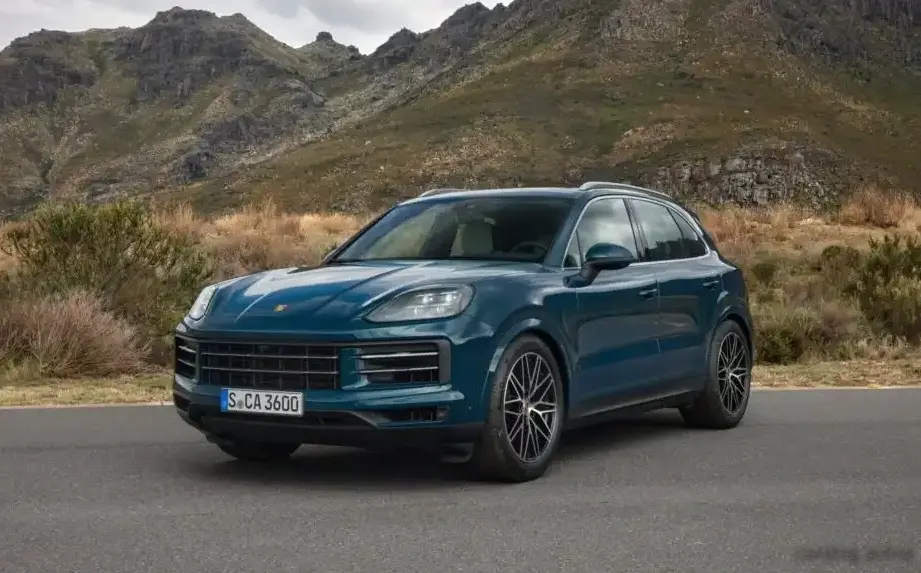
The Porsche Cayenne III S 3.0 V6 E-Hybrid Tiptronic S, introduced in September 2023 as part of the facelift for the third-generation Cayenne, represents Porsche’s commitment to blending high performance with increased efficiency through plug-in hybrid technology. Positioned as a mid-to-high range offering within the Cayenne lineup, it slots above the base model and below the more potent Turbo E-Hybrid. This variant is designed to appeal to buyers seeking a luxurious SUV with substantial power and the ability to operate on electric power for shorter commutes, while still delivering the dynamic driving experience expected of the Porsche brand. It builds upon the foundation of the 1HX0/A3 platform, shared with other Volkswagen Group SUVs like the Audi Q7 and Bentley Bentayga, but distinguishes itself through Porsche’s engineering and tuning expertise.
Technical Specifications
| Brand | Porsche |
| Model | Cayenne |
| Generation | Cayenne III (facelift 2023) |
| Type (Engine) | S 3.0 V6 (519 Hp) E-Hybrid Tiptronic S |
| Start of production | September, 2023 |
| Powertrain Architecture | PHEV (Plug-in Hybrid Electric Vehicle) |
| Body type | SUV |
| Seats | 5 |
| Doors | 5 |
| Combined fuel consumption (WLTP) | 1.4-1.7 l/100 km (168 – 138.4 US mpg, 201.8 – 166.2 UK mpg, 71.4 – 58.8 km/l) |
| CO2 emissions (WLTP) | 31-39 g/km |
| Fuel Type | Petrol / electricity |
| Acceleration 0 – 100 km/h | 4.7 sec |
| Acceleration 0 – 62 mph | 4.7 sec |
| Acceleration 0 – 60 mph | 4.4 sec |
| Acceleration 0 – 200 km/h | 16.8 sec |
| Maximum speed | 263 km/h (163.42 mph) |
| Emission standard | Euro 6 ea |
| Weight-to-power ratio | 4.6 kg/Hp, 215.4 Hp/tonne |
| Weight-to-torque ratio | 3.2 kg/Nm, 311.2 Nm/tonne |
| Battery technology | Lithium-ion (Li-Ion) |
| Battery location | Under the trunk |
| All-electric range (WLTP) | 71-78 km (44.12 – 48.47 mi) |
| Average Energy consumption (WLTP) | 29.1-31.7 kWh/100 km (46.83 – 51.02 kWh/100 mi, 72 – 66 MPGe, 3.4 – 3.2 km/kWh, 2.1 – 2 mi/kWh) |
| Max speed (electric) | 135 km/h (83.89 mph) |
| Electric motor power | 176 Hp @ 3200 rpm (460 Nm @ 0-2690 rpm / 339.28 lb.-ft. @ 0-2690 rpm) |
| Electric motor location | Between the combustion engine and the transmission |
| System power | 519 Hp @ 5000-6500 rpm (750 Nm @ 1000-4750 rpm / 553.17 lb.-ft. @ 1000-4750 rpm) |
| Power | 353 Hp @ 5400-6400 rpm (500 Nm @ 1450-4500 rpm / 368.78 lb.-ft. @ 1450-4500 rpm) |
| Power per litre | 117.9 Hp/l |
| Maximum engine speed | 6500 rpm |
| Engine layout | Front, Longitudinal |
| Engine Model/Code | EA839 |
| Engine displacement | 2995 cm3 (182.77 cu. in.) |
| Number of cylinders | 6 |
| Engine configuration | V-engine |
| Cylinder Bore | 84.5 mm (3.33 in.) |
| Piston Stroke | 89 mm (3.5 in.) |
| Compression ratio | 11.2:1 |
| Number of valves per cylinder | 4 |
| Fuel injection system | Direct injection |
| Engine aspiration | Turbocharger, Intercooler |
| Kerb Weight | 2410 kg (5313.14 lbs.) |
| Max. weight | 3135 kg (6911.49 lbs.) |
| Max load | 725 kg (1598.35 lbs.) |
| Trunk (boot) space – minimum | 627 l (22.14 cu. ft.) |
| Trunk (boot) space – maximum | 1563 l (55.2 cu. ft.) |
| Fuel tank capacity | 70 l (18.49 US gal | 15.4 UK gal) |
| Max. roof load | 100 kg (220.46 lbs.) |
| Permitted trailer load with brakes (12%) | 3500 kg (7716.18 lbs.) |
| Permitted trailer load without brakes | 750 kg (1653.47 lbs.) |
| Permitted towbar download | 140 kg (308.65 lbs.) |
| Length | 4930 mm (194.09 in.) |
| Width | 1983 mm (78.07 in.) |
| Width including mirrors | 2194 mm (86.38 in.) |
| Height | 1678 mm (66.06 in.) |
| Wheelbase | 2895 mm (113.98 in.) |
| Front track | 1680 mm (66.14 in.) |
| Rear (Back) track | 1656 mm (65.2 in.) |
| Ride height (ground clearance) | 190-235 mm (7.48 – 9.25 in.) |
| Drag coefficient (Cd) | 0.35 |
| Minimum turning circle (turning diameter) | 12.1 m (39.7 ft.) |
| Front brakes | Ventilated discs, 410×38 mm |
| Rear brakes | Ventilated discs, 365×28 mm |
| Number of gears and type of gearbox | 8 gears, automatic transmission Tiptronic S |
Powertrain & Engine Architecture
At the heart of the Cayenne S E-Hybrid lies a 3.0-liter V6 engine, designated the EA839. This engine utilizes direct fuel injection and is coupled with a single turbocharger and intercooler, producing 353 horsepower and 369 lb-ft of torque. The engine’s design prioritizes both power and efficiency, incorporating features like a variable valve timing system and a start-stop function. Crucially, this engine is paired with an electric motor, integrated between the engine and the eight-speed Tiptronic S automatic transmission. The electric motor contributes an additional 176 horsepower and 295 lb-ft of torque. The combined system output reaches a substantial 519 horsepower and 553 lb-ft of torque. The Tiptronic S transmission is a sophisticated eight-speed automatic known for its smooth and responsive shifts, offering both automatic and manual shift modes. The lithium-ion battery pack, positioned under the trunk floor, provides an all-electric range of 44 to 48 miles (WLTP cycle).
Driving Characteristics
The Cayenne S E-Hybrid delivers a refined and powerful driving experience. In electric mode, the vehicle offers near-silent operation and brisk acceleration for urban driving. Switching to hybrid mode seamlessly blends the power of the V6 engine and the electric motor, providing strong acceleration and responsive performance. The 0-60 mph sprint takes just 4.4 seconds. The Tiptronic S transmission contributes to smooth gear changes, and the suspension, while comfort-oriented, maintains Porsche’s signature handling characteristics. Compared to the base Cayenne, the E-Hybrid offers significantly more power and torque. While not as overtly sporty as the Cayenne Turbo, it provides ample performance for most drivers. The added weight of the battery pack is noticeable, but the instant torque from the electric motor helps to mitigate this.
Equipment & Trim Levels
The Cayenne S E-Hybrid comes standard with a comprehensive suite of features, including Porsche Active Suspension Management (PASM), a panoramic sunroof, leather upholstery, and a premium sound system. Infotainment is handled by Porsche Communication Management (PCM) with a large touchscreen display. Optional extras include adaptive air suspension, rear-axle steering, and a variety of interior customization options. The interior trim typically features aluminum or wood accents, and buyers can choose from a range of upholstery colors and materials. The standard seats provide excellent support and comfort, with optional sport seats available for a more aggressive driving position.
Chassis & Braking
The Cayenne S E-Hybrid utilizes an independent multi-link suspension at both the front and rear axles. Adaptive air suspension is available as an option, allowing drivers to adjust the ride height and damping characteristics. The braking system consists of ventilated discs at all four corners, providing ample stopping power. Porsche’s Surface Coated Brake (PSCB) system, which applies a tungsten carbide coating to the brake discs, is also available, offering improved durability and reduced brake dust. The steering is a power-assisted rack-and-pinion system, providing precise and responsive steering feel.
Market Reception & Comparison
The Cayenne S E-Hybrid has been well-received by critics for its blend of performance, efficiency, and luxury. It offers a compelling alternative to traditional gasoline-powered SUVs, particularly for buyers who prioritize fuel economy and the ability to drive in electric mode. Compared to the Cayenne E-Hybrid (without the ‘S’ designation), the S model offers significantly more power and performance. Against competitors like the BMW X5 xDrive45e and the Mercedes-Benz GLE 450e, the Cayenne S E-Hybrid stands out with its engaging driving dynamics and premium interior. Fuel economy is impressive, with the potential for over 138 mpg in combined driving (WLTP cycle), and the all-electric range is competitive within its class.
Legacy
The EA839 engine, in various iterations, has proven to be a reliable and durable powerplant within the Volkswagen Group. The hybrid system, while complex, has also demonstrated good long-term reliability. The Cayenne S E-Hybrid, as a relatively recent model, is still establishing its long-term reliability record. However, early reports suggest that the powertrain is robust and well-engineered. On the used car market, these models are holding their value well, reflecting the demand for plug-in hybrid SUVs and the Porsche brand’s reputation for quality and performance. Regular maintenance, including servicing of the hybrid system components, will be crucial to ensuring the longevity of this vehicle.