
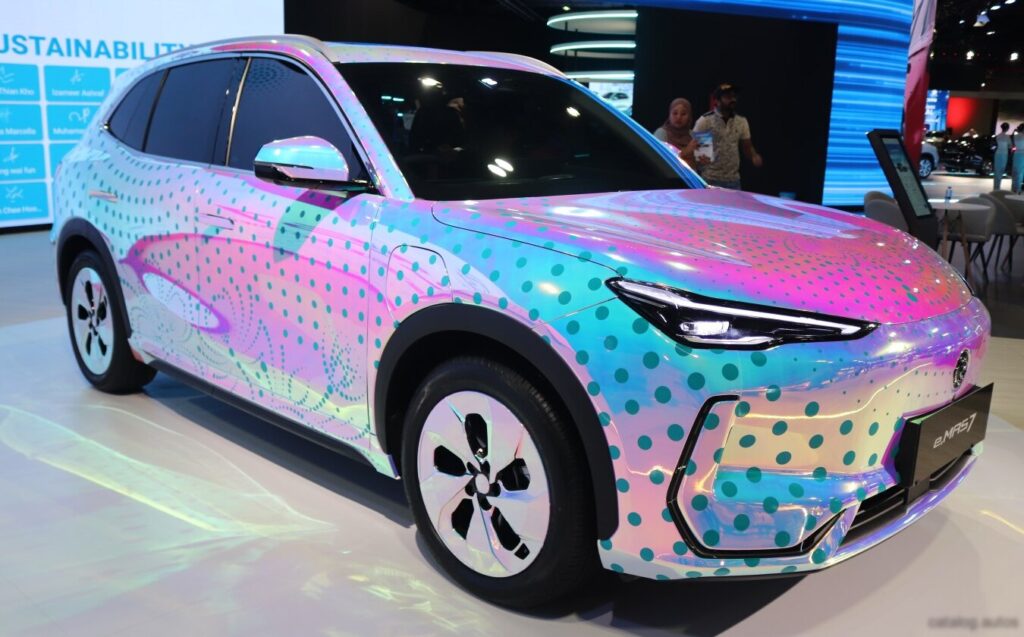
The Proton e.MAS 7, launched in December 2024, represents Proton’s entry into the burgeoning all-electric SUV market. Positioned as a mainstream, family-oriented vehicle, the e.MAS 7 aims to provide a practical and affordable electric vehicle option. It’s built upon a dedicated electric vehicle architecture, signifying Proton’s commitment to electrification. This particular variant features a 49.52 kWh battery pack paired with a single electric motor producing 218 horsepower, making it a competitive offering in its segment. The e.MAS 7 is primarily targeted at the Southeast Asian market, with potential for expansion into other regions.
Technical Specifications
| Brand | Proton |
| Model | e.MAS 7 |
| Generation | e.MAS 7 |
| Type (Engine) | 49.52 kWh (218 Hp) Electric |
| Start of production | December, 2024 |
| Powertrain Architecture | BEV (Electric Vehicle) |
| Body type | SUV |
| Seats | 5 |
| Doors | 5 |
| Fuel Type | Electricity |
| Acceleration 0 – 100 km/h | 6.9 sec |
| Acceleration 0 – 62 mph | 6.9 sec |
| Acceleration 0 – 60 mph | 6.6 sec |
| Maximum speed | 175 km/h (108.74 mph) |
| Weight-to-power ratio | 7.6 kg/Hp, 131.2 Hp/tonne |
| Weight-to-torque ratio | 5.2 kg/Nm, 192.5 Nm/tonne |
| Gross battery capacity | 49.52 kWh |
| Battery voltage | 378 V |
| Battery technology | Lithium iron phosphate (LiFePO4) |
| Battery location | Below the floor |
| All-electric range (WLTP) | 345 km (214.37 mi) |
| All-electric range (NEDC) | 410 km (254.76 mi) |
| Electric motor power | 218 Hp |
| Electric motor Torque | 320 Nm (236.02 lb.-ft.) |
| Electric motor model/code | TZ184XY101 |
| Maximum revolutions of the electric motor | 16500 rpm |
| Electric motor location | Front axle, Transverse |
| Electric motor type | Synchronous |
| System power | 218 Hp |
| System torque | 320 Nm (236.02 lb.-ft.) |
| Kerb Weight | 1662 kg (3664.08 lbs.) |
| Max. weight | 2089 kg (4605.46 lbs.) |
| Max load | 427 kg (941.37 lbs.) |
| Trunk (boot) space – minimum | 461 l (16.28 cu. ft.) |
| Trunk (boot) space – maximum | 1877 l (66.29 cu. ft.) |
| Length | 4615 mm (181.69 in.) |
| Width | 1901 mm (74.84 in.) |
| Height | 1670 mm (65.75 in.) |
| Wheelbase | 2750 mm (108.27 in.) |
| Front track | 1630 mm (64.17 in.) |
| Rear (Back) track | 1621 mm (63.82 in.) |
| Ride height (ground clearance) | 173 mm (6.81 in.) |
| Drag coefficient (Cd) | 0.275 |
| Drivetrain Architecture | One electric motor drives the front wheels. |
| Drive wheel | Front wheel drive |
| Number of gears and type of gearbox | 1 gears, automatic transmission |
| Front suspension | Independent, type McPherson with coil spring and anti-roll bar |
| Rear suspension | Independent multi-link spring suspension with stabilizer |
| Front brakes | Ventilated discs |
| Rear brakes | Disc |
| Assisting systems | ABS (Anti-lock braking system) |
| Steering type | Steering rack and pinion |
| Power steering | Electric Steering |
| Tires size | 225/55 R18 |
| Wheel rims size | 18 |
Powertrain & Engine Architecture
The Proton e.MAS 7 utilizes a front-wheel-drive, all-electric powertrain. The heart of the system is the TZ184XY101 synchronous electric motor, delivering 218 horsepower and 320 Nm (236 lb-ft) of torque. This motor is powered by a 49.52 kWh Lithium Iron Phosphate (LiFePO4) battery pack, strategically positioned under the vehicle floor to optimize weight distribution and lower the center of gravity. LiFePO4 chemistry is favored for its enhanced thermal stability and longer lifespan compared to other lithium-ion variants. The single-speed automatic transmission efficiently transfers power to the front wheels. The battery supports fast charging capabilities, though specific charging times depend on the charging infrastructure used. The system operates at a high voltage of 378V.
Driving Characteristics
The e.MAS 7 offers brisk acceleration, achieving 0-60 mph in approximately 6.6 seconds. The instant torque delivery characteristic of electric motors provides responsive performance in urban driving conditions. While not designed for outright performance, the 218 hp output is sufficient for confident highway cruising and overtaking. The single-speed transmission provides seamless acceleration, eliminating the need for gear changes. Compared to potential higher-performance variants (should Proton offer them), this version prioritizes efficiency and affordability over raw speed. The front-wheel-drive configuration offers predictable handling, but may exhibit some torque steer under hard acceleration.
Equipment & Trim Levels
Details regarding specific trim levels for the e.MAS 7 are still emerging, but the base model is expected to include standard features such as a touchscreen infotainment system, digital instrument cluster, automatic climate control, and a comprehensive suite of safety features including ABS and potentially advanced driver-assistance systems (ADAS). Interior upholstery is likely to be cloth on the base model, with higher trims offering leather options. Optional extras may include a panoramic sunroof, premium audio system, and upgraded interior trim materials. The spacious interior and flexible seating configuration (with folding rear seats) contribute to the e.MAS 7’s practicality.
Chassis & Braking
The e.MAS 7 features an independent suspension system, with McPherson struts at the front and a multi-link setup at the rear. This configuration aims to provide a comfortable ride and stable handling. Anti-roll bars are included at both ends to minimize body roll during cornering. The braking system consists of ventilated discs at the front and solid discs at the rear, coupled with an Anti-lock Braking System (ABS) for enhanced safety. The vehicle rides on 18-inch alloy wheels with 225/55 R18 tires. The relatively low curb weight of 1662 kg (3664 lbs) contributes to the vehicle’s agility.
Market Reception & Comparison
As a newly launched vehicle, comprehensive market reception data for the e.MAS 7 is still developing. However, initial impressions suggest that it offers a compelling value proposition in the Southeast Asian EV market. Compared to other electric SUVs in its class, the e.MAS 7 aims to undercut competitors on price while offering a comparable range and feature set. Its LiFePO4 battery technology is seen as a positive attribute, offering potential longevity benefits. Fuel economy, expressed as energy consumption, is expected to be competitive with other EVs, translating to low running costs. Reliability is yet to be fully assessed, but Proton’s established presence in the region should provide a degree of confidence.
Legacy
The Proton e.MAS 7 represents a significant step for Proton in its transition towards electric mobility. Its long-term reliability will depend on the durability of the battery pack and the electric motor. The use of LiFePO4 chemistry suggests a potentially longer battery lifespan compared to some other EV battery technologies. As the used car market matures, the e.MAS 7 is likely to become an attractive option for budget-conscious buyers seeking an affordable and practical electric SUV. Its success will play a crucial role in shaping Proton’s future as a key player in the electric vehicle landscape.
