
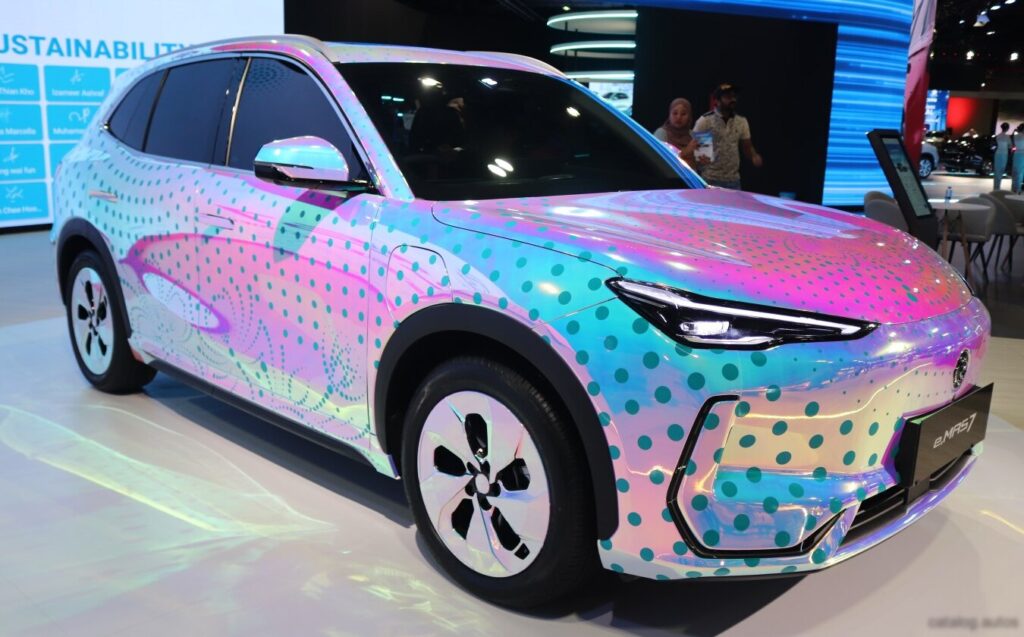
The Proton e.MAS 7, launched in December 2024, represents Proton’s entry into the burgeoning all-electric SUV market. Positioned as a mid-range offering, the e.MAS 7 aims to provide a compelling blend of practicality, technology, and affordability for consumers transitioning to electric vehicles. It’s built upon a dedicated electric vehicle architecture, signifying Proton’s commitment to a future beyond internal combustion engines. The “e.MAS” designation stands for “Electric Mobility Advanced System,” highlighting the vehicle’s core technology. This model is primarily targeted towards the Southeast Asian market, with potential for expansion into other regions depending on market demand and infrastructure development.
Technical Specifications
| Brand | Proton |
| Model | e.MAS 7 |
| Generation | e.MAS 7 |
| Type (Engine) | 60.22 kWh (218 Hp) Electric |
| Start of production | December, 2024 |
| Powertrain Architecture | BEV (Electric Vehicle) |
| Body type | SUV |
| Seats | 5 |
| Doors | 5 |
| Fuel Type | Electricity |
| Acceleration 0 – 100 km/h | 7.1 sec |
| Acceleration 0 – 62 mph | 7.1 sec |
| Acceleration 0 – 60 mph | 6.7 sec |
| Maximum speed | 175 km/h (108.74 mph) |
| Weight-to-power ratio | 8.1 kg/Hp, 123.5 Hp/tonne |
| Weight-to-torque ratio | 5.5 kg/Nm, 181.3 Nm/tonne |
| Gross battery capacity | 60.22 kWh |
| Battery voltage | 376 V |
| Battery technology | Lithium iron phosphate (LiFePO4) |
| Battery location | Below the floor |
| All-electric range (WLTP) | 410 km (254.76 mi) |
| All-electric range (NEDC) | 470 km (292.04 mi) |
| Electric motor power | 218 Hp |
| Electric motor Torque | 320 Nm (236.02 lb.-ft.) |
| Electric motor model/code | TZ184XY101 |
| Maximum revolutions of the electric motor | 16500 rpm |
| Electric motor location | Front axle, Transverse |
| Electric motor type | Synchronous |
| System power | 218 Hp |
| System torque | 320 Nm (236.02 lb.-ft.) |
| Kerb Weight | 1765 kg (3891.16 lbs.) |
| Max. weight | 2215 kg (4883.24 lbs.) |
| Max load | 450 kg (992.08 lbs.) |
| Trunk (boot) space – minimum | 461 l (16.28 cu. ft.) |
| Trunk (boot) space – maximum | 1877 l (66.29 cu. ft.) |
| Length | 4615 mm (181.69 in.) |
| Width | 1901 mm (74.84 in.) |
| Height | 1670 mm (65.75 in.) |
| Wheelbase | 2750 mm (108.27 in.) |
| Front track | 1620 mm (63.78 in.) |
| Rear (Back) track | 1611 mm (63.43 in.) |
| Ride height (ground clearance) | 173 mm (6.81 in.) |
| Drag coefficient (Cd) | 0.275 |
| Drivetrain Architecture | One electric motor drives the front wheels. |
| Drive wheel | Front wheel drive |
| Number of gears and type of gearbox | 1 gears, automatic transmission |
| Front suspension | Independent, type McPherson with coil spring and anti-roll bar |
| Rear suspension | Independent multi-link spring suspension with stabilizer |
| Front brakes | Ventilated discs |
| Rear brakes | Disc |
| Assisting systems | ABS (Anti-lock braking system) |
| Steering type | Steering rack and pinion |
| Power steering | Electric Steering |
| Tires size | 235/50 R19 |
| Wheel rims size | 19 |
Powertrain & Engine Architecture
The Proton e.MAS 7 utilizes a single electric motor, designated TZ184XY101, producing 218 horsepower and 320 Nm (236 lb-ft) of torque. This synchronous motor is mounted transversely on the front axle, driving the front wheels. Power is drawn from a 60.22 kWh Lithium Iron Phosphate (LiFePO4) battery pack located under the vehicle floor, contributing to a low center of gravity and improved handling. The battery operates at 376 volts. The e.MAS 7 employs a single-speed automatic transmission, typical of most electric vehicles, simplifying the driving experience and maximizing efficiency. The choice of LiFePO4 chemistry is notable; it’s known for its thermal stability and longer lifespan compared to some other lithium-ion battery types, though it generally offers slightly lower energy density.
Driving Characteristics
The e.MAS 7 delivers brisk acceleration, achieving 0-60 mph in approximately 6.7 seconds and 0-100 km/h in 7.1 seconds. The instant torque characteristic of electric motors provides responsive acceleration, particularly at lower speeds. While the single-speed transmission simplifies operation, it means the motor operates within a narrower RPM range. The front-wheel-drive configuration offers predictable handling, but may exhibit some torque steer under hard acceleration. Compared to potential future variants with dual-motor all-wheel drive, this front-wheel-drive setup prioritizes efficiency and cost-effectiveness. The vehicle’s weight of 1765 kg (3891 lbs) is typical for its class, and the suspension tuning aims for a balance between comfort and handling.
Equipment & Trim Levels
Specific trim levels and standard equipment for the Proton e.MAS 7 will vary depending on the market. However, standard features are expected to include a modern infotainment system with touchscreen display, digital instrument cluster, automatic climate control, and a comprehensive suite of safety features including ABS, electronic stability control, and multiple airbags. Higher trim levels are likely to offer features such as leather upholstery, a panoramic sunroof, advanced driver-assistance systems (ADAS) like adaptive cruise control and lane-keeping assist, and premium audio systems. The interior design emphasizes spaciousness and practicality, with a focus on user-friendly controls and comfortable seating.
Chassis & Braking
The e.MAS 7 features an independent suspension system at all four wheels. The front utilizes a McPherson strut setup with coil springs and an anti-roll bar, while the rear employs a multi-link suspension with a stabilizer bar. This configuration aims to provide a comfortable ride and stable handling. The braking system consists of ventilated discs at the front and solid discs at the rear, providing adequate stopping power. The electric motor also incorporates regenerative braking, which helps to recapture energy during deceleration and extend the vehicle’s range. Electric power steering provides light and precise steering feel.
Market Reception & Comparison
As a newly launched vehicle, comprehensive market reception data for the Proton e.MAS 7 is still emerging. However, initial impressions suggest that it offers a competitive package in terms of price, range, and features compared to other electric SUVs in the Southeast Asian market. Its WLTP range of 410 km (254.76 miles) is competitive, though not class-leading. The LiFePO4 battery chemistry is seen as a positive attribute for long-term durability. Compared to potential internal combustion engine (ICE) alternatives, the e.MAS 7 offers significantly lower running costs due to the reduced expense of electricity versus gasoline, and lower maintenance requirements.
Legacy
The Proton e.MAS 7 represents a significant step for Proton in its transition to electric mobility. Its long-term reliability will depend on the durability of the battery pack and the electric motor. The LiFePO4 battery chemistry is expected to contribute to a longer lifespan compared to some other battery technologies. As the electric vehicle market matures, the e.MAS 7 is likely to be viewed as a pioneering model that helped to accelerate the adoption of electric vehicles in Southeast Asia. Its success will depend on Proton’s ability to continue innovating and offering competitive electric vehicle options to meet evolving consumer demands.
