
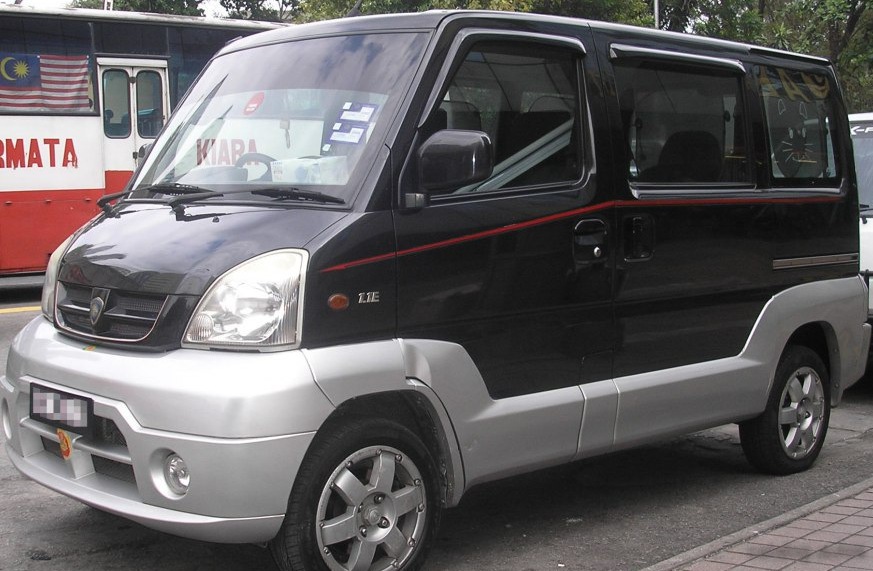
The Proton Juara 1.1 i 16V, produced between 2001 and 2004, was a compact five-door minivan designed and manufactured by Proton, Malaysia’s national car manufacturer. Positioned as an affordable and practical family vehicle, the Juara aimed to cater to the growing demand for multi-purpose vehicles in the Southeast Asian market. This particular variant, powered by the 1.1-liter 16-valve engine paired with a four-speed automatic transmission, represented an entry-level offering within the Juara lineup, prioritizing ease of use and fuel efficiency over outright performance. The Juara was based on a modified Proton Saga platform, representing Proton’s attempt to diversify its product range beyond traditional sedans.
Technical Specifications
| Brand | Proton |
| Model | Juara |
| Generation | Juara |
| Type (Engine) | 1.1 i 16V (71 Hp) |
| Start of production | 2001 year |
| End of production | 2004 year |
| Powertrain Architecture | Internal Combustion engine |
| Body type | Minivan |
| Seats | 4 |
| Doors | 5 |
| Fuel Type | Petrol (Gasoline) |
| Acceleration 0 – 100 km/h | 18.1 sec |
| Acceleration 0 – 62 mph | 18.1 sec |
| Acceleration 0 – 60 mph | 17.2 sec |
| Maximum speed | 135 km/h / 83.89 mph |
| Weight-to-power ratio | 14.2 kg/Hp, 70.6 Hp/tonne |
| Weight-to-torque ratio | 10.7 kg/Nm, 93.5 Nm/tonne |
| Power | 71 Hp @ 6000 rpm |
| Power per litre | 64.9 Hp/l |
| Torque | 94 Nm @ 4500 rpm / 69.33 lb.-ft. @ 4500 rpm |
| Engine layout | Front, Longitudinal |
| Engine displacement | 1094 cm3 / 66.76 cu. in. |
| Number of cylinders | 4 |
| Engine configuration | Inline |
| Cylinder Bore | 66 mm / 2.6 in. |
| Piston Stroke | 80 mm / 3.15 in. |
| Compression ratio | 9.5:1 |
| Number of valves per cylinder | 4 |
| Fuel injection system | Multi-port manifold injection |
| Engine aspiration | Naturally aspirated engine |
| Kerb Weight | 1005 kg / 2215.65 lbs |
| Max. weight | 1335 kg / 2943.17 lbs |
| Max load | 330 kg / 727.53 lbs |
| Fuel tank capacity | 30 l / 7.93 US gal | 6.6 UK gal |
| Length | 3660 mm / 144.09 in. |
| Width | 1535 mm / 60.43 in. |
| Height | 1810 mm / 71.26 in. |
| Wheelbase | 2390 mm / 94.09 in. |
| Front track | 1305 mm / 51.38 in. |
| Rear (Back) track | 1305 mm / 51.38 in. |
| Drivetrain Architecture | The Internal combustion engine (ICE) drives the front wheels of the vehicle. |
| Drive wheel | Front wheel drive |
| Number of gears and type of gearbox | 4 gears, automatic transmission |
| Front suspension | Spring Strut |
| Rear suspension | Coil spring |
| Front brakes | Disc |
| Rear brakes | Disc |
| Assisting systems | ABS (Anti-lock braking system) |
| Steering type | Steering rack and pinion |
| Tires size | 165/65 R14 |
| Wheel rims size | 14 |
Powertrain & Engine Architecture
The heart of the Juara 1.1 i 16V is the 4G15 engine, a 1.1-liter inline-four cylinder gasoline engine. This engine, while relatively simple in design, featured a 16-valve dual overhead camshaft (DOHC) configuration, contributing to improved breathing and a slightly higher power output compared to older 8-valve designs. The engine utilized a multi-point fuel injection system, delivering fuel directly to each intake port for more precise fuel metering. The 4G15 engine produced 71 horsepower at 6000 rpm and 94 Nm (69.33 lb-ft) of torque at 4500 rpm. The four-speed automatic transmission was a conventional hydraulic automatic, chosen for its affordability and ease of use. It wasn’t known for particularly quick shifts or advanced features, but it provided smooth operation suitable for the Juara’s intended purpose.
Driving Characteristics
The Juara 1.1 i 16V with the automatic transmission offered a decidedly unhurried driving experience. Acceleration was slow, taking approximately 18.1 seconds to reach 100 km/h (62 mph). The automatic transmission’s gear ratios were geared towards fuel economy rather than performance, resulting in a noticeable delay during acceleration. Compared to the available manual transmission versions, the automatic Juara felt significantly less responsive. However, the automatic transmission made the Juara exceptionally easy to drive in urban environments, reducing driver fatigue. The longitudinal engine layout and front-wheel drive configuration provided predictable handling, although the car wasn’t designed for spirited driving.
Equipment & Trim Levels
The Juara 1.1 i 16V typically came with a fairly basic level of equipment. Standard features included power steering, air conditioning, and a basic audio system. Interior upholstery was typically cloth, and the dashboard featured a simple, functional design. Optional extras included power windows, central locking, and upgraded audio systems. The trim level was generally consistent across the 1.1L automatic models, with limited customization options available. The focus was on providing a functional and affordable vehicle, rather than luxury or extensive features.
Chassis & Braking
The Juara’s chassis was based on a modified Proton Saga platform, utilizing a front MacPherson strut suspension and a rear coil spring suspension. This setup provided a reasonably comfortable ride, although it wasn’t particularly sporty. The braking system consisted of disc brakes on all four wheels, which was a notable feature for a vehicle in this price segment. An Anti-lock Braking System (ABS) was included as standard, enhancing safety. The relatively lightweight construction of the Juara helped to compensate for the modest engine power, contributing to acceptable braking performance.
Market Reception & Comparison
The Proton Juara 1.1 i 16V was generally well-received in the Malaysian market as an affordable and practical family vehicle. Critics praised its spacious interior and ease of driving, particularly with the automatic transmission. However, the engine’s lack of power was a common criticism, especially when compared to competitors offering larger displacement engines. Fuel economy was a strong point, making it an attractive option for budget-conscious buyers. Compared to other trims in the Juara lineup, such as the 1.3-liter variants, the 1.1-liter automatic offered the lowest price point but also the lowest performance. It targeted buyers who prioritized affordability and ease of use over driving excitement.
Legacy
The Proton Juara, while not a groundbreaking vehicle, played an important role in expanding Proton’s product range and catering to a wider range of customers. The 1.1-liter engine and automatic transmission combination, while not known for its reliability issues, is relatively simple to maintain and repair. Today, the Juara 1.1 i 16V is a relatively common sight on Malaysian roads, often found in the hands of first-time car owners or as a practical second vehicle. Its affordability and ease of maintenance continue to make it a popular choice in the used car market, although finding well-maintained examples is becoming increasingly challenging. The Juara represents a snapshot of Proton’s early efforts to establish itself as a major player in the automotive industry.
