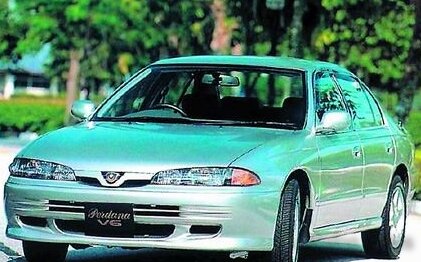
The Proton Perdana I 2.0 i 16V, produced between 1995 and 1998, represented a significant step forward for Malaysia’s national car project, Proton. Positioned as the company’s flagship sedan, the Perdana I was based on the Mitsubishi Galant, but heavily localized and adapted for the Malaysian market. This 2.0-liter, 16-valve variant, producing 137 horsepower, occupied a mid-range position within the Perdana I lineup, offering a balance between performance and affordability. It aimed to provide a domestically produced alternative to imported sedans, appealing to government officials, corporate clients, and increasingly, private buyers seeking a comfortable and prestigious vehicle.
Technical Specifications
| Brand | Proton |
| Model | Perdana |
| Generation | Perdana I |
| Type (Engine) | 2.0 i 16V (137 Hp) |
| Start of production | January, 1995 |
| End of production | 1998 |
| Powertrain Architecture | Internal Combustion engine |
| Body type | Sedan |
| Seats | 5 |
| Doors | 4 |
| Fuel Type | Petrol (Gasoline) |
| Acceleration 0 – 100 km/h | 13 sec |
| Acceleration 0 – 62 mph | 13 sec |
| Acceleration 0 – 60 mph | 12.4 sec |
| Maximum speed | 195 km/h (121.17 mph) |
| Weight-to-power ratio | 9.1 kg/Hp, 110 Hp/tonne |
| Weight-to-torque ratio | 7.1 kg/Nm, 141.4 Nm/tonne |
| Power | 137 Hp @ 6000 rpm |
| Power per litre | 68.5 Hp/l |
| Torque | 176 Nm @ 4750 rpm (129.81 lb.-ft. @ 4750 rpm) |
| Engine layout | Front, Transverse |
| Engine Model/Code | 4G63 |
| Engine displacement | 1999 cm3 (121.99 cu. in.) |
| Number of cylinders | 4 |
| Engine configuration | Inline |
| Number of valves per cylinder | 4 |
| Fuel injection system | Multi-port manifold injection |
| Engine aspiration | Naturally aspirated engine |
| Valvetrain | DOHC |
| Engine oil capacity | 4.3 l (4.54 US qt | 3.78 UK qt) |
| Kerb Weight | 1245 kg (2744.76 lbs) |
| Max. weight | 1760 kg (3880.14 lbs) |
| Max load | 515 kg (1135.38 lbs) |
| Fuel tank capacity | 64 l (16.91 US gal | 14.08 UK gal) |
| Length | 4610 mm (181.5 in) |
| Width | 1730 mm (68.11 in) |
| Height | 1400 mm (55.12 in) |
| Wheelbase | 2635 mm (103.74 in) |
| Front track | 1510 mm (59.45 in) |
| Rear (Back) track | 1505 mm (59.25 in) |
| Drivetrain Architecture | The Internal combustion engine (ICE) drives the front wheels of the vehicle. |
| Drive wheel | Front wheel drive |
| Number of gears and type of gearbox | 5 gears, manual transmission |
| Front suspension | Spring Strut |
| Rear suspension | Coil spring |
| Front brakes | Ventilated discs |
| Rear brakes | Disc |
| Assisting systems | ABS (Anti-lock braking system) |
| Steering type | Steering rack and pinion |
| Power steering | Hydraulic Steering |
| Tires size | 205/55 R16 |
| Wheel rims size | 16 |
Powertrain & Engine Architecture
The heart of the Perdana I 2.0 i 16V was the Mitsubishi 4G63 engine, a 2.0-liter inline-four cylinder powerplant. This engine, well-regarded for its robustness and tunability, featured a double overhead camshaft (DOHC) valvetrain operating 16 valves (four per cylinder). Multi-port fuel injection delivered fuel to each cylinder, optimizing combustion efficiency. The 4G63 in this application was tuned to produce 137 horsepower at 6000 rpm and 176 Nm (129.81 lb-ft) of torque at 4750 rpm. The engine’s transverse mounting and front-wheel drive configuration were standard for vehicles in this class. The 5-speed manual transmission was the only gearbox option available for this variant, providing drivers with full control over the engine’s power delivery.
Driving Characteristics
The Perdana I 2.0 i 16V offered a reasonably engaging driving experience for its time. While not a sports sedan, the 137 hp engine provided adequate power for comfortable highway cruising and overtaking. Acceleration to 60 mph took around 12.4 seconds, and the car could reach a top speed of 195 km/h (121 mph). The 5-speed manual transmission allowed drivers to keep the engine in its optimal power band, maximizing performance. Compared to the base model Perdana with a smaller engine, the 2.0 i 16V offered a noticeable improvement in acceleration and overall responsiveness. However, it didn’t possess the outright performance of some of its competitors, particularly those from Japan or Europe.
Equipment & Trim Levels
The Perdana I 2.0 i 16V was generally well-equipped for its price point. Standard features included power windows, power steering, air conditioning, and an AM/FM radio. The interior typically featured cloth upholstery, although leather options were available. The dashboard layout was functional and straightforward, prioritizing ease of use. Optional extras included a sunroof, upgraded audio system, and alloy wheels. The trim level was positioned as a step up from the base models, offering a more refined interior and a more powerful engine.
Chassis & Braking
The Perdana I utilized a conventional chassis design with a MacPherson strut front suspension and a coil spring rear suspension. This setup provided a comfortable ride, although it wasn’t particularly sporty. The car featured ventilated disc brakes at the front and solid disc brakes at the rear, providing adequate stopping power. An Anti-lock Braking System (ABS) was included as standard, enhancing safety. The steering was rack and pinion, offering precise control. The car rode on 205/55 R16 tires, mounted on 16-inch wheels.
Market Reception & Comparison
The Proton Perdana I 2.0 i 16V was generally well-received in the Malaysian market. Critics praised its spacious interior, comfortable ride, and relatively affordable price. However, some noted that its performance wasn’t as competitive as some of its rivals. Compared to other trims in the Perdana I lineup, the 2.0 i 16V offered a significant performance upgrade over the base models, but it was less expensive than the range-topping variants. Fuel economy was reasonable for a car of its size and engine displacement. Reliability was generally good, although some owners reported minor issues with the electrical system.
Legacy
The Proton Perdana I 2.0 i 16V remains a popular classic car in Malaysia. The 4G63 engine is known for its durability and is relatively easy to maintain. Parts availability is generally good, although some components may be becoming increasingly difficult to find. The Perdana I 2.0 i 16V is often sought after by enthusiasts who appreciate its classic styling and reliable powertrain. In the used car market, well-maintained examples command a reasonable price, reflecting the car’s enduring appeal and its place in Malaysian automotive history. The Perdana I, and this variant specifically, helped establish Proton as a viable national car manufacturer and paved the way for future models.