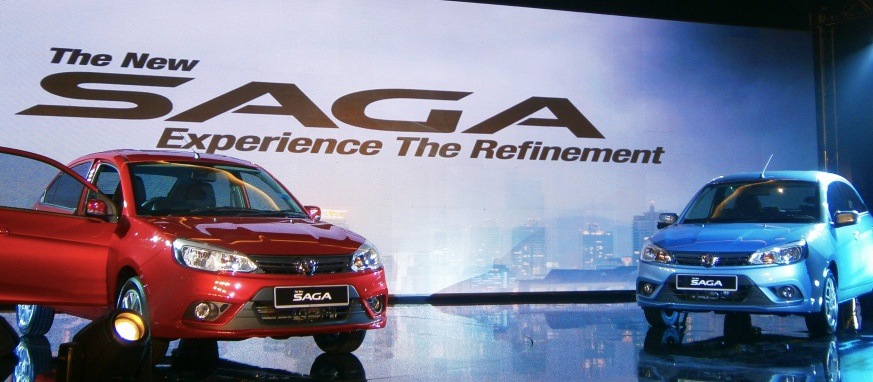
The Proton Saga III 1.3, producing 95 horsepower, represents a significant iteration in Proton’s long-running Saga series. Introduced in 2016, this variant occupied the entry-level position within the Saga III lineup, aiming to provide affordable and practical transportation for the Malaysian market and select export regions. Built on the Saga III platform, it offered a refreshed design and updated features compared to its predecessors. This model aimed to balance fuel efficiency with acceptable performance for daily commuting, making it a popular choice for first-time car buyers and families.
Technical Specifications
| Brand | Proton |
| Model | Saga |
| Generation | Saga III |
| Type (Engine) | 1.3 (95 Hp) |
| Start of production | 2016 |
| Powertrain Architecture | Internal Combustion engine |
| Body type | Sedan |
| Seats | 5 |
| Doors | 4 |
| Fuel consumption (combined) | 5.4 l/100 km (43.6 US mpg, 52.3 UK mpg, 18.5 km/l) |
| Fuel Type | Petrol (Gasoline) |
| Weight-to-power ratio | 10.9 kg/Hp, 91.8 Hp/tonne |
| Weight-to-torque ratio | 8.6 kg/Nm, 115.9 Nm/tonne |
| Power | 95 Hp @ 5750 rpm |
| Power per litre | 71.3 Hp/l |
| Torque | 120 Nm @ 4000 rpm (88.51 lb.-ft. @ 4000 rpm) |
| Engine layout | Front, Transverse |
| Engine Model/Code | S4PE |
| Engine displacement | 1332 cm3 (81.28 cu. in.) |
| Number of cylinders | 4 |
| Engine configuration | Inline |
| Cylinder Bore | 76 mm (2.99 in.) |
| Piston Stroke | 73.4 mm (2.89 in.) |
| Compression ratio | 10:1 |
| Number of valves per cylinder | 4 |
| Fuel injection system | Multi-port manifold injection |
| Engine aspiration | Naturally aspirated engine |
| Valvetrain | DOHC-VVT |
| Kerb Weight | 1035 kg (2281.78 lbs.) |
| Trunk (boot) space – minimum | 420 l (14.83 cu. ft.) |
| Length | 4331 mm (170.51 in.) |
| Width | 1689 mm (66.5 in.) |
| Height | 1491 mm (58.7 in.) |
| Wheelbase | 2465 mm (97.05 in.) |
| Ride height (ground clearance) | 150 mm (5.91 in.) |
| Minimum turning circle (turning diameter) | 10.2 m (33.46 ft.) |
| Drivetrain Architecture | The Internal combustion engine (ICE) drives the front wheels of the vehicle. |
| Drive wheel | Front wheel drive |
| Number of gears and type of gearbox | 5 gears, manual transmission |
| Front suspension | Independent, type McPherson with coil spring and anti-roll bar |
| Rear suspension | independent torsion suspension |
| Front brakes | Ventilated discs |
| Rear brakes | Drum |
| Assisting systems | ABS (Anti-lock braking system) |
| Steering type | Steering rack and pinion |
| Power steering | Hydraulic Steering |
| Tires size | 175/70 R13 |
| Wheel rims size | 5J x 13 |
Powertrain & Engine Architecture
The heart of the Saga III 1.3 is the Proton-developed S4PE 1.3-liter inline-four cylinder engine. This engine utilizes a multi-point fuel injection system and a double overhead camshaft (DOHC) configuration with variable valve timing (VVT). The S4PE engine is a relatively simple design, prioritizing reliability and fuel economy over outright performance. The 10:1 compression ratio contributes to its efficiency. The engine’s 95 horsepower output at 5750 rpm and 120 Nm (88.51 lb-ft) of torque at 4000 rpm are modest, but sufficient for typical urban and highway driving. The engine is transversely mounted, driving the front wheels. The standard transmission for this variant was a five-speed manual gearbox, chosen for its cost-effectiveness and contribution to fuel savings.
Driving Characteristics
The Saga III 1.3 with the five-speed manual transmission offers a predictable, if not particularly exciting, driving experience. Acceleration is adequate for merging onto highways and overtaking slower traffic, but it’s not a quick car. The gear ratios are tuned for fuel efficiency, meaning the engine needs to be revved somewhat to maintain speed on inclines. The manual gearbox provides a direct connection to the engine, allowing drivers to maximize the available power. Compared to potential higher-spec Saga III models with larger engines, the 1.3 feels noticeably less powerful. However, the lighter weight of the 1.3 variant helps to mitigate some of the performance deficit. The steering is light and easy to use, making it well-suited for city driving.
Equipment & Trim Levels
The Saga III 1.3 typically came with a basic but functional equipment list. Standard features included power windows, central locking, and an air conditioning system. Interior upholstery was typically cloth, with a simple dashboard layout. Safety features included dual airbags and ABS (Anti-lock Braking System). Optional extras, depending on the market and package selected, could include a radio/CD player, upgraded speakers, and alloy wheels. The overall interior design prioritized practicality and durability over luxury.
Chassis & Braking
The Saga III utilizes a McPherson strut suspension setup at the front, providing a comfortable ride quality. The rear suspension employs an independent torsion beam, which is a cost-effective solution that offers a reasonable balance between ride comfort and handling. The front brakes are ventilated discs, providing adequate stopping power, while the rear brakes are drums. The use of drum brakes on the rear was a cost-saving measure common in this segment. The steering system is a rack and pinion setup with hydraulic power assistance, offering light and easy steering feel.
Market Reception & Comparison
The Proton Saga III 1.3 was generally well-received in its target market as an affordable and reliable family sedan. Critics praised its fuel efficiency and practicality, but noted its lack of outright performance. Compared to other entry-level sedans available in Malaysia and surrounding regions, the Saga III 1.3 offered a competitive price point and a reasonable level of equipment. Its fuel economy of 5.4 l/100km was a key selling point, particularly in a market sensitive to fuel prices. The manual transmission variant was favored by those prioritizing fuel efficiency and driver engagement.
Legacy
The Proton Saga III 1.3 remains a common sight on Malaysian roads today. The S4PE engine, while not known for its sophistication, has proven to be relatively durable and reliable with proper maintenance. Parts availability is generally good, and repair costs are relatively low. In the used car market, the Saga III 1.3 represents a budget-friendly option for those seeking a dependable and economical mode of transportation. While it may not offer the performance or features of more modern vehicles, its simplicity and affordability continue to make it a popular choice.