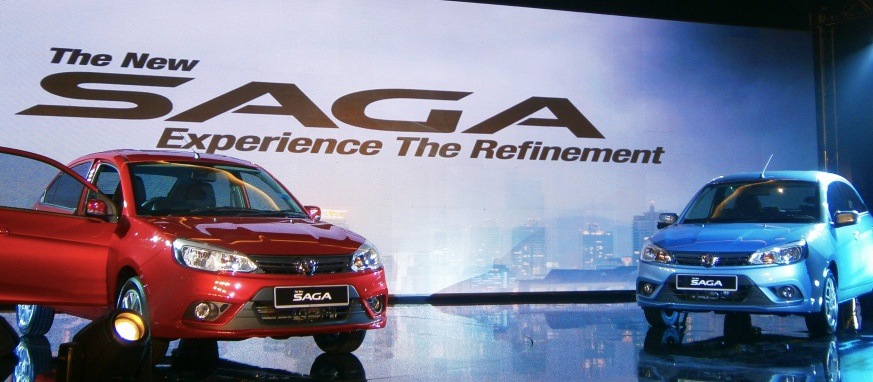
The Proton Saga III 1.3 (95 hp) Automatic, launched in 2016, represents a significant iteration in Proton’s long-running Saga model line. Positioned as an entry-level variant within the third-generation Saga (introduced as the Iriz’s sedan sibling), this model aimed to provide affordable and practical transportation for the Malaysian market and select export regions. It utilized Proton’s S4PE engine paired with a Continuously Variable Transmission (CVT), a first for the Saga, marking a shift towards improved fuel efficiency and ease of driving. The Saga III, built on a modified platform derived from the Proton Iriz hatchback, sought to address criticisms of previous Saga generations regarding build quality and refinement.
Technical Specifications
| Brand | Proton |
| Model | Saga |
| Generation | Saga III |
| Type (Engine) | 1.3 (95 Hp) Automatic |
| Start of production | 2016 |
| Powertrain Architecture | Internal Combustion engine |
| Body type | Sedan |
| Seats | 5 |
| Doors | 4 |
| Fuel consumption (combined) | 5.6 l/100 km (42 US mpg, 50.4 UK mpg, 17.9 km/l) |
| Fuel Type | Petrol (Gasoline) |
| Weight-to-power ratio | 11.1 kg/Hp, 90 Hp/tonne |
| Weight-to-torque ratio | 8.8 kg/Nm, 113.7 Nm/tonne |
| Power | 95 Hp @ 5750 rpm |
| Power per litre | 71.3 Hp/l |
| Torque | 120 Nm @ 4000 rpm (88.51 lb.-ft. @ 4000 rpm) |
| Engine layout | Front, Transverse |
| Engine Model/Code | S4PE |
| Engine displacement | 1332 cm3 (81.28 cu. in.) |
| Number of cylinders | 4 |
| Engine configuration | Inline |
| Cylinder Bore | 76 mm (2.99 in.) |
| Piston Stroke | 73.4 mm (2.89 in.) |
| Compression ratio | 10:1 |
| Number of valves per cylinder | 4 |
| Fuel injection system | Multi-port manifold injection |
| Engine aspiration | Naturally aspirated engine |
| Valvetrain | DOHC-VVT |
| Kerb Weight | 1055-1075 kg (2325.88 – 2369.97 lbs.) |
| Trunk (boot) space | 420 l (14.83 cu. ft.) |
| Length | 4331 mm (170.51 in.) |
| Width | 1689 mm (66.5 in.) |
| Height | 1491 mm (58.7 in.) |
| Wheelbase | 2465 mm (97.05 in.) |
| Ride height (ground clearance) | 150 mm (5.91 in.) |
| Minimum turning circle | 10.2 m (33.46 ft.) |
| Drivetrain Architecture | ICE drives front wheels |
| Drive wheel | Front wheel drive |
| Number of gears & gearbox type | automatic transmission CVT |
| Front suspension | Independent, McPherson with coil spring and anti-roll bar |
| Rear suspension | independent torsion suspension |
| Front brakes | Ventilated discs |
| Rear brakes | Drum |
| Assisting systems | ABS (Anti-lock braking system) |
| Steering type | Steering rack and pinion |
| Power steering | Hydraulic Steering |
| Tires size | 175/70 R13; 185/60 R14; 185/55 R15 |
| Wheel rims size | 5J x 13; 5J x 14; 5.5J x 15 |
Powertrain & Engine Architecture
The heart of the Saga III 1.3 Automatic is Proton’s S4PE engine, a 1.3-liter inline-four cylinder petrol engine. This engine, while relatively simple in design, features a double overhead camshaft (DOHC) valvetrain with variable valve timing (VVT) to optimize performance and fuel efficiency. The S4PE utilizes multi-point fuel injection, delivering fuel directly to the intake ports. The engine produces 95 horsepower at 5750 rpm and 120 Nm (88.51 lb-ft) of torque at 4000 rpm. A key feature of this variant is the adoption of a Continuously Variable Transmission (CVT) in place of a traditional automatic gearbox. This CVT, sourced from Punch Powertrain, offers seamless gear changes and contributes to improved fuel economy. The CVT’s operation differs significantly from conventional automatics, lacking fixed gear ratios and instead utilizing a belt-and-pulley system to provide a continuously variable drive ratio.
Driving Characteristics
The 1.3L engine and CVT combination in the Saga III Automatic delivers a comfortable, if not particularly exhilarating, driving experience. Acceleration is adequate for everyday driving, but the CVT’s tendency to hold the engine at higher RPMs during acceleration can result in a noticeable droning sound. Compared to the available 1.6L manual transmission versions, the 1.3 Automatic is noticeably slower, particularly when overtaking. The CVT’s gear ratios are optimized for fuel efficiency, prioritizing smooth operation over outright performance. The steering is light and easy, making it suitable for urban environments, but lacks the feedback desired by more enthusiastic drivers. The suspension provides a reasonably comfortable ride, absorbing most road imperfections without excessive body roll.
Equipment & Trim Levels
The Saga III 1.3 Automatic typically came equipped with basic amenities, reflecting its entry-level positioning. Standard features included air conditioning, power windows, central locking, and an audio system with USB connectivity. Safety features such as dual airbags and ABS were also standard. Higher trim levels, such as the Premium variant, added features like alloy wheels, a multi-function steering wheel, and upgraded interior trim. Interior upholstery was typically fabric, with a simple and functional dashboard layout. Optional extras included a reverse parking sensor and a security alarm.
Chassis & Braking
The Saga III utilizes a McPherson strut front suspension with coil springs and an anti-roll bar, providing a balance between ride comfort and handling. The rear suspension employs an independent torsion beam setup, a cost-effective solution that offers reasonable stability. Braking duties are handled by ventilated discs at the front and drum brakes at the rear. ABS (Anti-lock Braking System) is standard, enhancing braking performance and safety. The steering system is a rack and pinion type with hydraulic power assistance, providing light and easy steering feel.
Market Reception & Comparison
The Proton Saga III 1.3 Automatic was generally well-received in the Malaysian market as an affordable and practical family sedan. Critics praised its improved fuel efficiency compared to previous Saga models, thanks to the CVT transmission. However, the engine’s lack of power and the CVT’s sometimes intrusive operation were common criticisms. Compared to the 1.6L variants, the 1.3 Automatic offered lower running costs but sacrificed performance. The 1.6L manual transmission was favored by drivers seeking a more engaging driving experience. In terms of reliability, the S4PE engine proved to be generally dependable, although the CVT transmission required regular maintenance to ensure optimal performance.
Legacy
The Proton Saga III 1.3 Automatic played a crucial role in Proton’s efforts to modernize its product lineup and appeal to a wider range of customers. The introduction of the CVT transmission was a significant step forward, demonstrating Proton’s willingness to adopt new technologies. In the used car market, the Saga III 1.3 Automatic remains a popular choice for budget-conscious buyers seeking a reliable and fuel-efficient sedan. While not known for its performance, its affordability and practicality have ensured its continued relevance. The S4PE engine, while not a powerhouse, has proven to be relatively durable, and parts availability remains good. The Saga III, and particularly this 1.3 Automatic variant, represents a pivotal moment in Proton’s history, bridging the gap between its older, less refined models and its more modern offerings.