
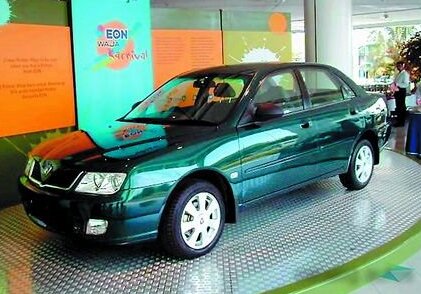
The Proton Waja 1.6 i 16V, produced from 2000 to 2006, represents a significant step in Proton’s development as Malaysia’s national automotive manufacturer. Positioned as a family sedan, the Waja aimed to provide a domestically produced alternative to imported models, particularly within the Southeast Asian market. It was the first Proton model to be designed entirely in-house, moving away from reliance on Mitsubishi designs. The Waja was built on a dedicated platform, marking a departure from previous Proton models that often shared underpinnings with Mitsubishi vehicles. This 1.6L variant served as a core offering within the Waja lineup, balancing affordability with reasonable performance and features.
Technical Specifications
| Brand | Proton |
| Model | Waja |
| Type (Engine) | 1.6 i 16V (103 Hp) |
| Start of production | 2000 year |
| End of production | 2006 year |
| Powertrain Architecture | Internal Combustion engine |
| Body type | Sedan |
| Seats | 5 |
| Doors | 4 |
| Fuel Type | Petrol (Gasoline) |
| Acceleration 0 – 100 km/h | 12 sec |
| Acceleration 0 – 62 mph | 12 sec |
| Acceleration 0 – 60 mph | 11.4 sec |
| Maximum speed | 186 km/h (115.58 mph) |
| Weight-to-power ratio | 11.4 kg/Hp, 87.7 Hp/tonne |
| Weight-to-torque ratio | 8.4 kg/Nm, 119.1 Nm/tonne |
| Power | 103 Hp @ 6000 rpm |
| Power per litre | 65 Hp/l |
| Torque | 140 Nm @ 2750 rpm (103.26 lb.-ft. @ 2750 rpm) |
| Engine layout | Front, Transverse |
| Engine displacement | 1584 cm3 (96.66 cu. in.) |
| Number of cylinders | 4 |
| Engine configuration | Inline |
| Number of valves per cylinder | 4 |
| Fuel injection system | Multi-port manifold injection |
| Engine aspiration | Naturally aspirated engine |
| Valvetrain | DOHC |
| Kerb Weight | 1175 kg (2590.43 lbs) |
| Fuel tank capacity | 60 l (15.85 US gal | 13.2 UK gal) |
| Length | 4465 mm (175.79 in) |
| Width | 1740 mm (68.5 in) |
| Height | 1420 mm (55.91 in) |
| Wheelbase | 2600 mm (102.36 in) |
| Front track | 1475 mm (58.07 in) |
| Rear track | 1470 mm (57.87 in) |
| Drivetrain Architecture | The Internal combustion engine (ICE) drives the front wheels of the vehicle. |
| Drive wheel | Front wheel drive |
| Number of gears and type of gearbox | 5 gears, manual transmission |
| Front suspension | Spring Strut |
| Rear suspension | Coil spring |
| Front brakes | Ventilated discs |
| Rear brakes | Disc |
| Assisting systems | ABS (Anti-lock braking system) |
| Steering type | Steering rack and pinion |
| Power steering | Hydraulic Steering |
| Tires size | 195/55 R15 H |
| Wheel rims size | 15 |
Powertrain & Engine Architecture
The heart of the Waja 1.6 i 16V is the 4G18 engine, a 1.6-liter inline-four cylinder gasoline engine. This engine, while developed by Proton, draws heavily on Mitsubishi’s expertise, reflecting the historical technical partnership between the two companies. The engine utilizes a multi-point fuel injection system, delivering fuel directly to each intake port for improved combustion efficiency. The 16-valve DOHC (Double Overhead Camshaft) configuration enhances volumetric efficiency, contributing to the engine’s power output. The 4G18 engine is naturally aspirated, meaning it doesn’t rely on turbocharging or supercharging for increased power. The engine’s 103 horsepower at 6000 rpm and 140 Nm (103.26 lb-ft) of torque at 2750 rpm provided adequate, though not exceptional, performance for everyday driving. The Waja 1.6 i 16V was exclusively offered with a 5-speed manual transmission, providing drivers with direct control over gear selection.
Driving Characteristics
The Waja 1.6 i 16V offered a comfortable, if not particularly sporty, driving experience. The 5-speed manual transmission allowed for reasonable acceleration, with a 0-60 mph time of around 11.4 seconds. The engine’s torque curve provided sufficient pull for everyday overtaking maneuvers, but it did require the driver to downshift for more spirited acceleration. Compared to the later 1.8L variants, the 1.6L engine felt less responsive, particularly at higher speeds. The gear ratios were tuned for fuel efficiency and smooth cruising rather than outright performance. The Waja’s suspension, featuring a spring strut front setup and a coil spring rear, provided a compliant ride, absorbing bumps and imperfections in the road surface effectively. However, it wasn’t particularly adept at handling sharp corners, exhibiting noticeable body roll.
Equipment & Trim Levels
The Waja 1.6 i 16V typically came equipped with basic amenities expected of a family sedan in its price range. Standard features included power windows, central locking, and an AM/FM radio. Air conditioning was also a standard inclusion, crucial for the hot and humid climate of Malaysia and surrounding regions. Interior upholstery was typically cloth, available in a range of colors. Optional extras included power steering (often standard on later models), alloy wheels, and a more advanced audio system. The dashboard layout was functional and straightforward, prioritizing ease of use over aesthetic flair. The Waja 1.6 i 16V represented the entry point into the Waja range, with higher trim levels offering additional features and a more refined interior.
Chassis & Braking
The Waja’s chassis was a dedicated platform designed specifically for the model. The front suspension utilized a MacPherson strut setup, while the rear employed a coil spring arrangement. This configuration provided a balance between ride comfort and handling stability. Braking duties were handled by ventilated discs at the front and solid discs at the rear, providing adequate stopping power for the vehicle’s weight and performance. An Anti-lock Braking System (ABS) was included as a standard safety feature, enhancing braking performance and control, particularly on slippery surfaces. The steering system employed a rack and pinion setup with hydraulic power assistance, offering precise steering feel and reducing driver effort.
Market Reception & Comparison
The Proton Waja 1.6 i 16V was generally well-received in the Malaysian market as a locally produced alternative to imported sedans. Critics praised its spacious interior, comfortable ride, and affordability. However, some reviewers noted its lack of refinement compared to more established Japanese and European competitors. Compared to the later 1.8L Waja variants, the 1.6L model offered better fuel economy but lacked the same level of performance. The 1.6L was also seen as a more sensible choice for budget-conscious buyers, while the 1.8L appealed to those seeking a more engaging driving experience. Reliability was generally considered good, although some owners reported minor issues with the electrical system.
Legacy
The Proton Waja 1.6 i 16V holds a significant place in Proton’s history as the first fully in-house designed model. While it may not be remembered for groundbreaking performance or technology, it represented a crucial step in Proton’s development as an independent automotive manufacturer. Today, the Waja 1.6 i 16V is a relatively affordable used car option in Malaysia and surrounding regions. The 4G18 engine is known for its durability and relatively simple maintenance requirements, making it a reliable choice for those seeking a practical and economical sedan. Parts availability remains reasonable, although some components may be becoming increasingly difficult to source as the model ages. The Waja 1.6 i 16V remains a testament to Proton’s early ambitions and its commitment to providing affordable transportation to the Malaysian public.
