
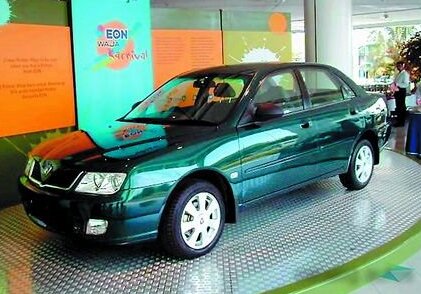
The Proton Waja 1.8i 16V, produced from 2000 to 2006, represents a significant step in Proton’s development as Malaysia’s national car manufacturer. Positioned as a mid-range offering within the Waja lineup, this variant aimed to provide a balance between performance and affordability. The Waja, internally designated as the Waja, was built on Proton’s own platform, representing a move towards greater independence in vehicle design and engineering. It served as a key model for Proton in the domestic market, competing with established Japanese and Korean sedans.
Technical Specifications
| Brand | Proton |
| Model | Waja |
| Type (Engine) | 1.8 i 16V (120 Hp) |
| Start of production | 2000 |
| End of production | 2006 |
| Powertrain Architecture | Internal Combustion engine |
| Body type | Sedan |
| Seats | 5 |
| Doors | 4 |
| Fuel Type | Petrol (Gasoline) |
| Acceleration 0 – 100 km/h | 13 sec |
| Acceleration 0 – 62 mph | 13 sec |
| Acceleration 0 – 60 mph | 12.4 sec |
| Maximum speed | 186 km/h (115.58 mph) |
| Weight-to-power ratio | 10.1 kg/Hp, 99.2 Hp/tonne |
| Weight-to-torque ratio | 7.3 kg/Nm, 136.4 Nm/tonne |
| Power | 120 Hp @ 5750 rpm |
| Power per litre | 67.3 Hp/l |
| Torque | 165 Nm @ 3750 rpm (121.7 lb.-ft. @ 3750 rpm) |
| Engine layout | Front, Transverse |
| Engine displacement | 1784 cm3 (108.87 cu. in.) |
| Number of cylinders | 4 |
| Engine configuration | Inline |
| Cylinder Bore | 82.7 mm (3.26 in.) |
| Piston Stroke | 83 mm (3.27 in.) |
| Compression ratio | 10:1 |
| Number of valves per cylinder | 4 |
| Fuel injection system | Multi-port manifold injection |
| Engine aspiration | Naturally aspirated engine |
| Valvetrain | DOHC |
| Kerb Weight | 1210 kg (2667.59 lbs.) |
| Trunk (boot) space – minimum | 440 l (15.54 cu. ft.) |
| Fuel tank capacity | 60 l (15.85 US gal | 13.2 UK gal) |
| Length | 4465 mm (175.79 in.) |
| Width | 1740 mm (68.5 in.) |
| Height | 1420 mm (55.91 in.) |
| Wheelbase | 2600 mm (102.36 in.) |
| Front track | 1475 mm (58.07 in.) |
| Rear (Back) track | 1470 mm (57.87 in.) |
| Drivetrain Architecture | The Internal combustion engine (ICE) drives the front wheels of the vehicle. |
| Drive wheel | Front wheel drive |
| Number of gears and type of gearbox | 4 gears, automatic transmission |
| Front suspension | Spring Strut |
| Rear suspension | Coil spring |
| Front brakes | Ventilated discs |
| Rear brakes | Disc |
| Assisting systems | ABS (Anti-lock braking system) |
| Steering type | Steering rack and pinion |
| Power steering | Hydraulic Steering |
| Tires size | 205/55 R16 |
| Wheel rims size | 16 |
Powertrain & Engine Architecture
The heart of the Waja 1.8i is Proton’s 4G63-based 1.8-liter inline-four engine. While derived from the Mitsubishi 4G63, Proton made modifications to the engine to suit its needs. This engine featured a multi-port fuel injection system and a double overhead camshaft (DOHC) valvetrain, contributing to its relatively efficient operation. The engine produced 120 horsepower at 5750 rpm and 165 Nm (121.7 lb-ft) of torque at 3750 rpm. The engine’s 10:1 compression ratio was a standard figure for naturally aspirated engines of the time. Paired with this engine was a four-speed automatic transmission, a common choice for drivers prioritizing convenience over outright performance. This transmission was designed to provide smooth shifts, but it wasn’t known for its sportiness or quick responsiveness.
Driving Characteristics
The Waja 1.8i Automatic offered a comfortable, if not particularly exhilarating, driving experience. Acceleration from 0 to 60 mph took around 12.4 seconds, and top speed was approximately 115.58 mph. The four-speed automatic transmission, while smooth, resulted in noticeable gear changes and didn’t allow the engine to remain in its optimal power band for extended periods. Compared to the five-speed manual version, the automatic suffered a slight performance penalty. The automatic transmission’s gear ratios were geared more towards fuel efficiency than rapid acceleration. The power delivery was linear, but the engine lacked the punch of higher-output variants. The Waja 1.8i Automatic was best suited for everyday commuting and relaxed highway cruising.
Equipment & Trim Levels
The 1.8i variant typically came equipped with features such as power windows, power steering, central locking, and an aftermarket audio system. Air conditioning was standard. Interior upholstery was typically cloth, with a relatively simple dashboard layout. Optional extras included alloy wheels, a sunroof, and upgraded audio systems. The trim level generally sat in the middle of the Waja range, offering more features than the base 1.6-liter model but lacking the premium appointments of any potential higher-spec versions. Safety features were relatively basic for the time, typically including ABS (Anti-lock Braking System) as a key safety component.
Chassis & Braking
The Waja utilized a front-wheel-drive layout with a MacPherson strut suspension in the front and a coil spring suspension in the rear. The front brakes were ventilated discs, providing adequate stopping power, while the rear brakes were solid discs. The suspension setup was tuned for comfort, resulting in a relatively soft ride quality. The Waja’s chassis was designed to provide a stable and predictable handling experience, but it wasn’t particularly sporty. Stabilizer bars were included to reduce body roll during cornering, but the overall handling characteristics were geared towards everyday usability rather than performance driving.
Market Reception & Comparison
The Proton Waja 1.8i Automatic was generally well-received in the Malaysian market. Critics praised its comfortable ride, spacious interior, and relatively affordable price. However, the automatic transmission was often criticized for its lack of responsiveness and its impact on fuel economy. Compared to the 1.6-liter version, the 1.8i offered noticeably more power and torque, making it a more suitable choice for drivers who frequently carried passengers or drove on highways. Compared to competitors from Japan and Korea, the Waja offered a compelling value proposition, but it often lagged behind in terms of refinement and build quality. Fuel economy was reasonable for the time, but not class-leading.
Legacy
The Proton Waja 1.8i Automatic remains a relatively common sight on Malaysian roads today. The 4G63-based engine is known for its durability and relatively simple maintenance requirements, although age-related issues such as oil leaks and worn suspension components are common. Parts availability is generally good, and the Waja’s relatively straightforward mechanical design makes it a popular choice for amateur mechanics. In the used car market, the Waja 1.8i Automatic typically commands a modest price, making it an affordable option for budget-conscious buyers. While it may not offer the performance or refinement of more modern vehicles, the Waja 1.8i Automatic represents a significant milestone in Proton’s history and remains a fondly remembered car for many Malaysian drivers.
