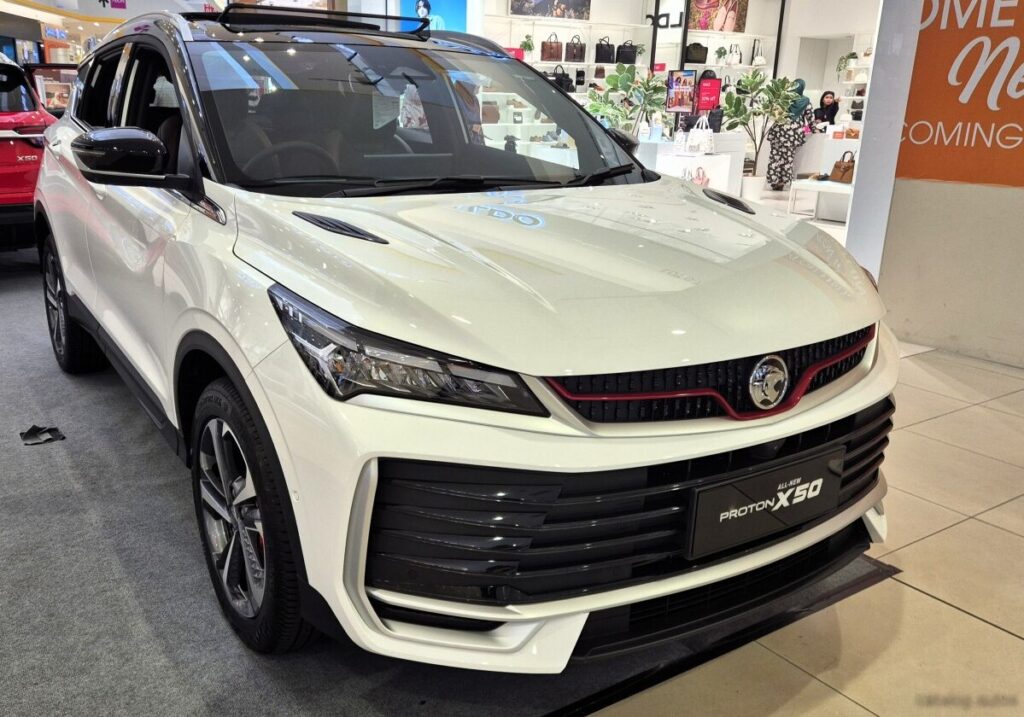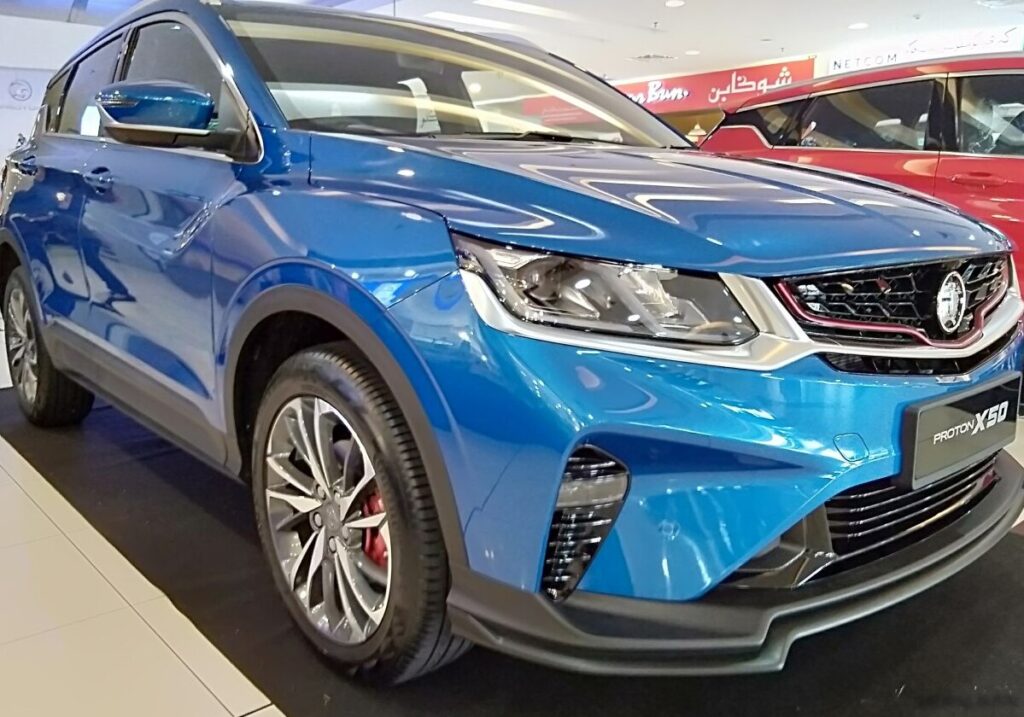
The Proton X50 1.5T PFI (150 Hp) DCT is a subcompact crossover SUV produced by the Malaysian automaker Proton from 2020 to 2025. It represents Proton’s entry into the competitive B-segment SUV market, aimed at younger buyers and families seeking an affordable and feature-rich vehicle. The X50 is built upon a heavily modified Geely Binyue platform, reflecting Proton’s strategic partnership with Geely. This variant, equipped with the 1.5-liter turbocharged engine and a 7-speed dual-clutch transmission (DCT), served as a key model in Proton’s lineup, offering a balance between performance, fuel efficiency, and modern technology.
Technical Specifications
| Brand | Proton |
| Model | X50 |
| Generation | X50 |
| Type (Engine) | 1.5T PFI (150 Hp) DCT |
| Start of production | 2020 |
| End of production | 2025 |
| Powertrain Architecture | Internal Combustion engine |
| Body type | SUV |
| Seats | 5 |
| Doors | 5 |
| Fuel Type | Petrol (Gasoline) |
| Weight-to-power ratio | 8.8 kg/Hp, 113.2 Hp/tonne |
| Weight-to-torque ratio | 5.9 kg/Nm, 170.6 Nm/tonne |
| Power | 150 Hp @ 5500 rpm |
| Power per litre | 101.6 Hp/l |
| Torque | 226 Nm @ 1500-4000 rpm (166.69 lb.-ft. @ 1500-4000 rpm) |
| Engine layout | Front, Transverse |
| Engine Model/Code | JLH-3G15TD |
| Engine displacement | 1477 cm3 (90.13 cu. in.) |
| Number of cylinders | 3 |
| Engine configuration | Inline |
| Cylinder Bore | 82 mm (3.23 in.) |
| Piston Stroke | 93.2 mm (3.67 in.) |
| Compression ratio | 10.5:1 |
| Number of valves per cylinder | 4 |
| Fuel injection system | Multi-port manifold injection |
| Engine aspiration | Turbocharger, Intercooler |
| Valvetrain | DOHC |
| Engine oil capacity | 5 l (5.28 US qt | 4.4 UK qt) |
| Coolant | 6.83 l (7.22 US qt | 6.01 UK qt) |
| Kerb Weight | 1325-1350 kg (2921.12 – 2976.24 lbs.) |
| Length | 4330 mm (170.47 in.) |
| Width | 1800 mm (70.87 in.) |
| Height | 1609 mm (63.35 in.) |
| Wheelbase | 2600 mm (102.36 in.) |
| Minimum turning circle | 10.8 m (35.43 ft.) |
| Drivetrain Architecture | ICE, Front wheel drive |
| Number of gears and type of gearbox | 7 gears, automatic transmission DCT |
| Front suspension | Independent, McPherson with coil spring and anti-roll bar |
| Rear suspension | Torsion |
| Front brakes | Ventilated discs |
| Rear brakes | Disc |
| Assisting systems | ABS (Anti-lock braking system) |
| Steering type | Steering rack and pinion |
| Power steering | Electric Steering |
| Tires size | 215/60 R17; 215/55 R18 |
Powertrain & Engine Architecture
The Proton X50 1.5T PFI utilizes the JLH-3G15TD engine, a 1.5-liter inline-3 cylinder turbocharged petrol engine. This engine is a product of Geely’s development and was adapted for Proton’s use. The “PFI” designation indicates port fuel injection, meaning fuel is injected into the intake manifold rather than directly into the combustion chamber. This system, while simpler than direct injection, offers good fuel economy and reduced carbon buildup. The turbocharger, coupled with an intercooler, provides a boost in power and torque, mitigating the inherent limitations of a smaller displacement engine. The engine features a double overhead camshaft (DOHC) valvetrain, optimizing airflow for improved performance. The 7-speed dual-clutch transmission (DCT) is a crucial component, offering quick and smooth gear changes compared to a traditional automatic transmission. The DCT contributes to both performance and fuel efficiency.
Driving Characteristics
The 150 hp and 226 Nm (166.69 lb-ft) of torque delivered by the 1.5T PFI engine provide adequate performance for daily driving and urban commutes. While not a sports car, the X50 offers brisk acceleration, particularly in the lower and mid-range thanks to the turbocharger. The DCT transmission contributes to a responsive driving experience, with quick shifts and minimal power loss. Compared to potential higher-output variants (which were not widely available), this configuration prioritizes fuel economy and affordability. The gear ratios are tuned for everyday usability, with a focus on maximizing efficiency rather than outright speed. The front-wheel-drive layout provides predictable handling, but it can exhibit some torque steer under hard acceleration.
Equipment & Trim Levels
The Proton X50 1.5T PFI DCT was offered in several trim levels, typically including Standard, Premium, and possibly a higher-spec variant depending on the market. Standard features generally included power windows, power side mirrors, a touchscreen infotainment system with Bluetooth connectivity, and basic safety features like ABS and airbags. Higher trims added features such as leather upholstery, a larger touchscreen display, a reverse camera, parking sensors, and advanced driver-assistance systems (ADAS) like lane departure warning and automatic emergency braking. Interior upholstery was typically fabric on the base models, upgrading to leatherette or full leather on higher trims. Dashboard configurations were consistent across trims, with variations in trim accents and feature availability.
Chassis & Braking
The Proton X50 utilizes a McPherson strut suspension setup at the front, providing a comfortable ride and decent handling characteristics. The rear suspension employs a torsion beam, a cost-effective solution that offers adequate stability for a vehicle in this class. Braking duties are handled by ventilated discs at the front and solid discs at the rear. The inclusion of ABS (Anti-lock Braking System) is standard, enhancing safety during emergency braking situations. Steering is rack and pinion with electric power assistance, providing a light and responsive feel. Tire sizes varied depending on the trim level, with 17-inch and 18-inch alloy wheels being common options.
Market Reception & Comparison
The Proton X50 1.5T PFI DCT was generally well-received in the Malaysian market, offering a compelling package of features, performance, and affordability. Critics praised its modern design, comfortable interior, and responsive powertrain. However, some reviews noted the engine could feel strained at higher speeds and that the ride quality, while generally good, could be a bit firm on rough roads. Compared to other B-segment SUVs available in Malaysia, such as the Perodua Ativa and Honda HR-V, the X50 offered a competitive level of equipment and performance at a similar price point. Fuel economy was generally considered to be good for its class, averaging around 6.5-7.5 liters per 100 kilometers (approximately 36-40 mpg) in mixed driving conditions.
Legacy
The Proton X50 1.5T PFI DCT played a significant role in revitalizing Proton’s brand image and increasing its market share in Malaysia. The JLH-3G15TD engine and 7-speed DCT transmission have proven to be relatively reliable, with few widespread reports of major mechanical issues. In the used car market, the X50 continues to be a popular choice, offering good value for money and a modern driving experience. Regular maintenance, including timely oil changes and adherence to the manufacturer’s recommended service intervals, is crucial for ensuring the long-term reliability of this powertrain. The X50’s success paved the way for Proton to further expand its SUV lineup and compete more effectively in the broader automotive market.