
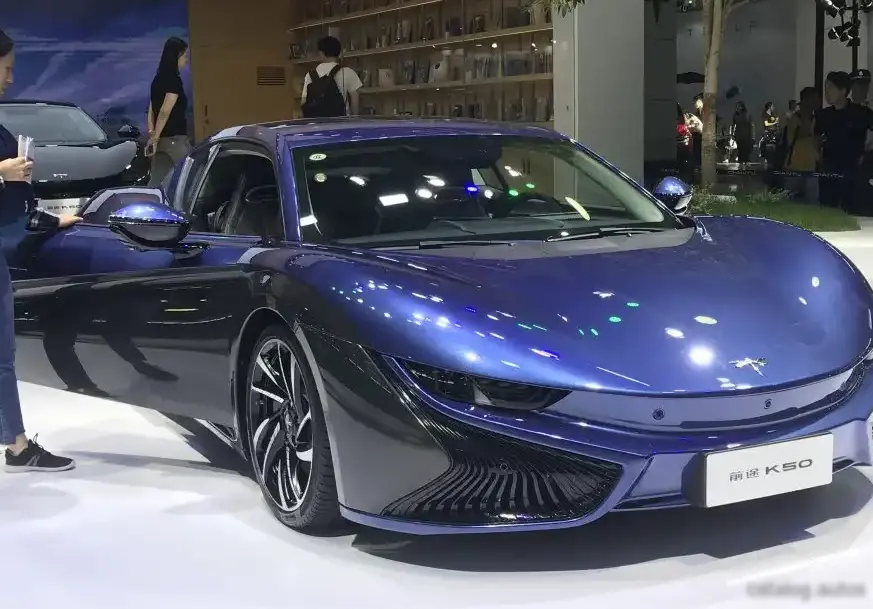
The Qiantu K50, launched in 2018, represents a significant entry into the burgeoning Chinese electric sports car market. Produced by Qiantu Motor, a relatively new automotive manufacturer, the K50 is a two-seat, all-wheel-drive electric coupe designed to offer a blend of performance and style. It aimed to compete with established sports car brands while leveraging the advantages of a fully electric powertrain. The 78.84 kWh variant, producing 430 horsepower, was the initial and primary configuration offered, establishing the K50’s performance credentials from the outset. Production continued for a limited time, with the K50 facing challenges in scaling up production and establishing a robust sales network.
Technical Specifications
| Brand | Qiantu |
| Model | K50 |
| Generation | K50 |
| Type (Engine) | 78.84 kWh (430 Hp) AWD |
| Start of production | 2018 |
| Powertrain Architecture | BEV (Electric Vehicle) |
| Body type | Coupe |
| Seats | 2 |
| Doors | 2 |
| Fuel Type | Electricity |
| Acceleration 0 – 60 mph | 4.4 sec |
| Maximum speed | 200 km/h (124.27 mph) |
| Weight-to-power ratio | 4.6 kg/Hp, 219.4 Hp/tonne |
| Weight-to-torque ratio | 2.9 kg/Nm, 346.9 Nm/tonne |
| Gross battery capacity | 78.84 kWh |
| Battery technology | Lithium-ion (Li-Ion) |
| Battery location | In the central tunnel, Behind the back wall of the passenger cabin |
| All-electric range (NEDC) | 380 km (236.12 mi) |
| Average Energy consumption (NEDC) | 20 kWh/100 km (32.19 kWh/100 mi, 105 MPGe, 5 km/kWh, 3.1 mi/kWh) |
| Electric motor power (each) | 215 Hp |
| Electric motor Torque (each) | 340 Nm (250.77 lb.-ft.) |
| Maximum revolutions of the electric motor | 12000 rpm |
| Electric motor location | Front axle (Transverse), Rear axle (Transverse) |
| System power | 430 Hp |
| System torque | 680 Nm (501.54 lb.-ft.) |
| Kerb Weight | 1960 kg (4321.06 lbs.) |
| Trunk (boot) space – minimum | 65 l (2.3 cu. ft.) |
| Length | 4634 mm (182.44 in.) |
| Width | 2069 mm (81.46 in.) |
| Height | 1253 mm (49.33 in.) |
| Wheelbase | 2650 mm (104.33 in.) |
| Front track | 1798 mm (70.79 in.) |
| Rear (Back) track | 1791 mm (70.51 in.) |
| Ride height (ground clearance) | 103 mm (4.06 in.) |
| Minimum turning circle | 12 m (39.37 ft.) |
| Drivetrain Architecture | One electric motor drives the front wheels, one electric motor drives the rear wheels. |
| Drive wheel | All wheel drive (4×4) |
| Number of gears and type of gearbox | 1 gears, automatic transmission |
| Front suspension | Double wishbone, Transverse stabilizer |
| Rear suspension | Double wishbone, Transverse stabilizer |
| Front brakes | Ventilated discs, 345×30 mm |
| Rear brakes | Ventilated discs, 365×28 mm |
| Assisting systems | ABS (Anti-lock braking system) |
| Steering type | Steering rack and pinion |
| Power steering | Electric Steering |
| Tires size | Front wheel tires: 235/35 R19, Rear wheel tires: 265/35 R19 |
| Wheel rims size | Front wheel rims: 8J x 19, Rear wheel rims: 9.5J x 19 |
Powertrain & Engine Architecture
The Qiantu K50 utilizes a dual-motor, all-wheel-drive (AWD) powertrain. Each motor delivers 215 horsepower, combining for a total system output of 430 horsepower and 680 Nm (501.54 lb.-ft.) of torque. The motors are transversely mounted, one driving the front wheels and the other the rear. The 78.84 kWh lithium-ion battery pack is strategically positioned within the central tunnel and behind the rear seats, contributing to a relatively low center of gravity. The battery employs a liquid cooling system to maintain optimal operating temperatures. The K50 features a single-speed automatic transmission, typical of most electric vehicles, simplifying the drivetrain and maximizing efficiency. The electric motors themselves are permanent magnet synchronous motors, known for their high efficiency and power density.
Driving Characteristics
The K50’s dual-motor setup provides instant torque and responsive acceleration. The 0-60 mph sprint is achieved in approximately 4.4 seconds, placing it firmly in sports car territory. The all-wheel-drive system enhances traction and stability, particularly during acceleration and cornering. While the single-speed transmission lacks the gear changes of a traditional internal combustion engine vehicle, it delivers smooth and linear power delivery. The low center of gravity, thanks to the battery placement, contributes to agile handling. Compared to potential future, higher-performance variants, the 430 hp model offers a balanced blend of performance and efficiency, making it suitable for both spirited driving and everyday use.
Equipment & Trim Levels
The Qiantu K50, in its initial configuration, was relatively well-equipped. Standard features included a digital instrument cluster, a touchscreen infotainment system, leather upholstery, and climate control. The interior design aimed for a modern and minimalist aesthetic. Optional extras included upgraded audio systems, advanced driver-assistance systems (ADAS), and customized interior trim options. The K50’s focus was on providing a premium experience, with a strong emphasis on technology and comfort. Given the limited production run, trim levels were not extensively diversified, with most vehicles featuring a similar level of standard equipment.
Chassis & Braking
The K50 utilizes a double wishbone suspension setup at both the front and rear, incorporating transverse stabilizers to minimize body roll during cornering. Ventilated disc brakes are employed on all four wheels, providing ample stopping power. The front brakes measure 345×30 mm, while the rear brakes are slightly larger at 365×28 mm. An anti-lock braking system (ABS) is standard. The steering system is a rack and pinion type with electric power assistance. The relatively low curb weight of 1960 kg (4321.06 lbs.) contributes to the K50’s agile handling characteristics. Tire sizes are 235/35 R19 at the front and 265/35 R19 at the rear, providing a good balance of grip and rolling resistance.
Market Reception & Comparison
The Qiantu K50 received mixed reviews upon its launch. Critics praised its striking design, impressive performance, and advanced technology. However, concerns were raised regarding the brand’s lack of established reputation, limited production capacity, and the relatively small size of its dealer network. Compared to other electric vehicles in its price range, the K50 offered a more focused sports car experience, prioritizing performance over practicality. Its range of 380 km (236.12 mi) on the NEDC cycle was competitive but not class-leading. The K50’s energy consumption of 20 kWh/100 km (105 MPGe) was also within the expected range for a vehicle of its size and performance.
Legacy
The Qiantu K50, while not a mainstream success, represents an important milestone in the development of the Chinese electric vehicle industry. It demonstrated the potential for Chinese manufacturers to produce high-performance, technologically advanced electric sports cars. The K50’s limited production run has made it a relatively rare and sought-after vehicle in the used car market. The long-term reliability of the K50’s powertrain remains to be fully assessed, but early reports suggest that the electric motors and battery pack are proving to be durable. The K50’s legacy lies in its pioneering spirit and its contribution to the growing global electric vehicle landscape.
