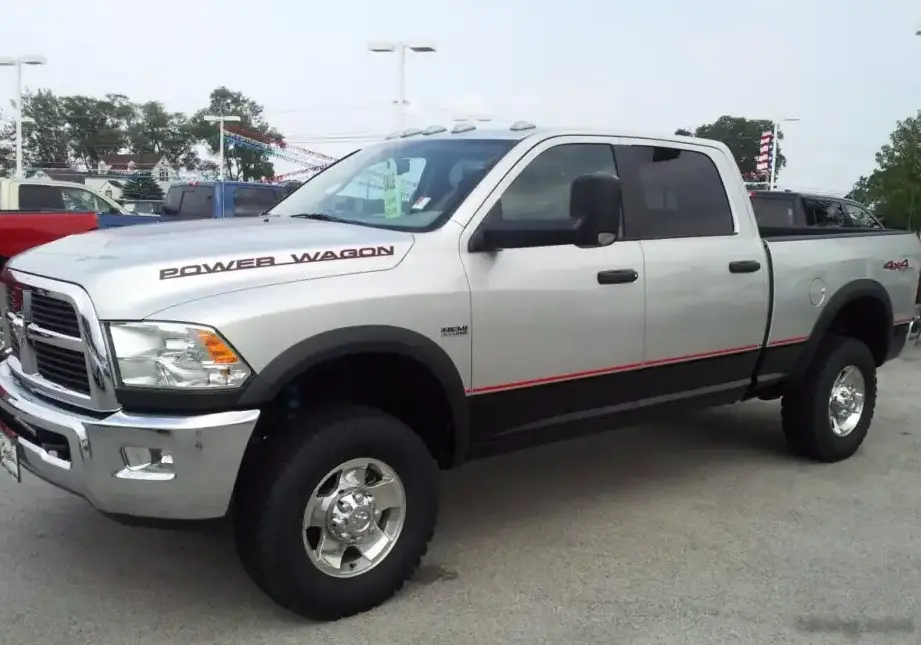
The RAM 1500 Regular Cab Long (DS) equipped with the 4.7-liter V8 engine producing 310 horsepower and paired with a four-speed automatic transmission was a mainstay of the full-size pickup truck market in North America from 2010 to 2012. This configuration represented a balance between capability and affordability within the broader 1500 lineup, catering to buyers who needed a robust work truck without the premium price tag of higher trim levels or more powerful engines. It was part of the second generation of the redesigned Dodge Ram (later RAM) 1500, known for its improved ride quality and interior refinement compared to its predecessors.
Technical Specifications
| Brand | RAM |
| Model | 1500 |
| Generation | 1500 Regular Cab Long (DS) |
| Type (Engine) | 4.7 V8 (310 Hp) 4×4 Automatic |
| Start of production | 2010 |
| End of production | 2012 |
| Powertrain Architecture | Internal Combustion engine |
| Body type | Pick-up |
| Seats | 2-3 |
| Doors | 2 |
| Fuel consumption (urban) | 16.7 l/100 km (14.1 US mpg) |
| Fuel consumption (extra urban) | 11.4 l/100 km (20.6 US mpg) |
| Fuel Type | Petrol (Gasoline) |
| Weight-to-power ratio | 7.4 kg/Hp |
| Weight-to-torque ratio | 5.1 kg/Nm |
| Power | 310 Hp @ 5650 rpm |
| Power per litre | 65.9 Hp/l |
| Torque | 447 Nm @ 3950 rpm (329.69 lb.-ft. @ 3950 rpm) |
| Maximum engine speed | 6000 rpm |
| Engine layout | Front, Longitudinal |
| Engine Model/Code | EVE |
| Engine displacement | 4701 cm3 (286.87 cu. in.) |
| Number of cylinders | 8 |
| Engine configuration | V-engine |
| Cylinder Bore | 93 mm (3.66 in.) |
| Piston Stroke | 86.5 mm (3.41 in.) |
| Compression ratio | 9.8:1 |
| Number of valves per cylinder | 2 |
| Fuel injection system | Multi-port manifold injection |
| Engine aspiration | Naturally aspirated engine |
| Valvetrain | SOHC |
| Engine oil capacity | 5.7 l (6.02 US qt | 5.02 UK qt) |
| Coolant | 13 l (13.74 US qt | 11.44 UK qt) |
| Kerb Weight | 2291 kg (5050.79 lbs.) |
| Max. weight | 2994 kg (6600.64 lbs.) |
| Max load | 703 kg (1549.85 lbs.) |
| Trunk (boot) space – maximum | 2115 l (74.69 cu. ft.) |
| Fuel tank capacity | 121 l (31.96 US gal | 26.62 UK gal) |
| Permitted trailer load with brakes (12%) | 2858 kg (6300.81 lbs.) |
| Length | 5866 mm (230.94 in.) |
| Width including mirrors | 2016 mm (79.37 in.) |
| Height | 1906 mm (75.04 in.) |
| Wheelbase | 3569 mm (140.51 in.) |
| Front track | 1732 mm (68.19 in.) |
| Rear (Back) track | 1714 mm (67.48 in.) |
| Drag coefficient (Cd) | 0.36 |
| Minimum turning circle (turning diameter) | 13.7 m (44.95 ft.) |
| Approach angle | 20.5° |
| Departure angle | 24.4° |
| Ramp-over (brakeover) angle | 16.6° |
| Drive wheel | All wheel drive (4×4) |
| Number of gears and type of gearbox | 5 gears, automatic transmission |
| Front suspension | Double wishbone |
| Rear suspension | Independent multi-link suspension |
| Front brakes | Ventilated discs |
| Rear brakes | Disc |
| Assisting systems | ABS (Anti-lock braking system) |
| Tires size | 265/70 R17 |
| Wheel rims size | 7.0J x 17 |
Powertrain & Engine Architecture
The heart of this RAM 1500 variant was the 4.7-liter (286.87 cubic inch) V8 engine, internally designated as the EVE engine code. This engine was a member of Chrysler’s third-generation small-block V8 family. It featured a cast iron block with aluminum cylinder heads, a single overhead camshaft (SOHC) valvetrain operating two valves per cylinder, and multi-port fuel injection. The 9.8:1 compression ratio was a compromise between performance and the ability to run on regular unleaded gasoline. The engine produced 310 horsepower at 5650 rpm and 329.69 lb-ft of torque at 3950 rpm. The four-speed automatic transmission (typically the 42RE) was chosen for its durability and cost-effectiveness, prioritizing functionality over outright performance. While not the most advanced transmission available at the time, it was well-suited to the engine’s torque characteristics and the truck’s intended use.
Driving Characteristics
The 4.7L V8 with the four-speed automatic delivered adequate, but not exhilarating, performance. Acceleration was reasonable for everyday driving and towing, but it lacked the punch of the optional 5.7-liter HEMI V8. The automatic transmission’s gear ratios were optimized for towing and hauling, resulting in a relatively conservative shift pattern. This meant that the engine often operated at higher RPMs during acceleration, contributing to noticeable fuel consumption. Compared to the manual transmission versions of the 1500, the automatic offered less driver control and a slightly reduced fuel economy. However, it provided a more relaxed driving experience, particularly in stop-and-go traffic.
Equipment & Trim Levels
The Regular Cab Long (DS) 4.7L Automatic typically fell into the base or mid-range trim levels of the RAM 1500 lineup. Standard features generally included air conditioning, a basic audio system, vinyl upholstery, and manual windows and locks. Optional extras could include power windows and locks, cruise control, an upgraded audio system, and a towing package. The interior was functional and durable, designed to withstand the rigors of work truck use. The DS designation indicated a specific package or configuration, often relating to the bed length and standard equipment.
Chassis & Braking
The RAM 1500 featured a body-on-frame construction, providing a robust platform for hauling and towing. The front suspension utilized a double wishbone design, while the rear suspension employed an independent multi-link setup. This combination aimed to deliver a comfortable ride while maintaining good handling characteristics. Braking duties were handled by ventilated discs at the front and discs at the rear, with ABS (Anti-lock Braking System) as standard equipment. The braking system was adequate for the truck’s weight and intended use, but it wasn’t particularly sporty or refined.
Market Reception & Comparison
Critics generally viewed the 4.7L V8/automatic combination as a sensible choice for buyers prioritizing value and practicality. While it didn’t offer the performance of the HEMI V8, it provided sufficient power for most tasks and delivered better fuel economy. Compared to the 3.7L V6 option, the 4.7L offered a significant increase in both power and towing capacity. Reliability was generally good, although some owners reported issues with the automatic transmission over the long term. Fuel economy was a common complaint, with the 14.1 US mpg (urban) and 20.6 US mpg (extra urban) figures being typical for a full-size pickup truck of this era.
Legacy
The 4.7L V8 engine, while eventually superseded by the more modern HEMI engines, proved to be a durable and reliable powerplant. The combination with the four-speed automatic transmission, while not technologically advanced, was a workhorse that provided years of service for many owners. In the used car market, these RAM 1500s are often sought after by buyers looking for an affordable and capable pickup truck. Maintenance costs are generally reasonable, and parts availability is good. However, potential buyers should be aware of the possibility of transmission issues and should thoroughly inspect the vehicle before purchase.