
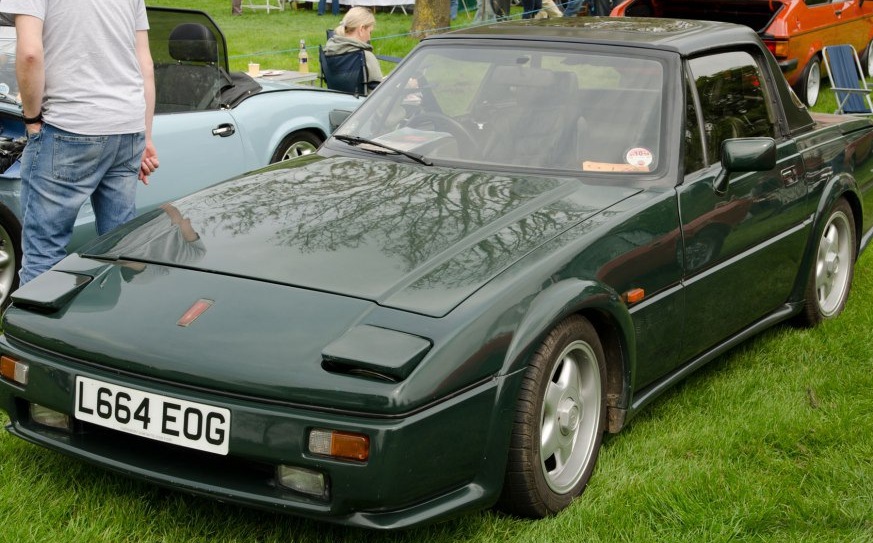
The Reliant Scimitar Sabre 1.8 i Turbo, produced between 1992 and 1995, represented a final evolution of the iconic Scimitar line. Positioned as a sporting grand tourer, the Sabre aimed to blend British style with respectable performance. This particular variant, equipped with the 1.8-liter turbocharged engine and a five-speed manual transmission, occupied a middle ground within the Sabre range, offering a balance between affordability and driving excitement. It was built upon the existing Scimitar chassis, a steel spaceframe construction clad in fiberglass body panels, a design philosophy that had defined the model for decades. The Sabre was Reliant’s attempt to modernize the Scimitar for the 1990s, but ultimately, financial difficulties led to the company’s demise shortly after production ended.
Technical Specifications
| Brand | Reliant |
| Model | Scimitar Sabre |
| Generation | Scimitar Sabre |
| Type (Engine) | 1.8 i Turbo (135 Hp) |
| Start of production | 1992 |
| End of production | 1995 |
| Powertrain Architecture | Internal Combustion engine |
| Body type | Cabriolet |
| Seats | 2 |
| Doors | 2 |
| Fuel consumption (urban) | 10.8 l/100 km (21.8 US mpg) |
| Fuel consumption (extra urban) | 6.7 l/100 km (35.1 US mpg) |
| Fuel consumption (combined) | 8.6 l/100 km (27.4 US mpg) |
| Fuel Type | Petrol (Gasoline) |
| Acceleration 0 – 100 km/h | 7.9 sec |
| Acceleration 0 – 62 mph | 7.9 sec |
| Acceleration 0 – 60 mph | 7.5 sec |
| Maximum speed | 205 km/h (127.38 mph) |
| Weight-to-power ratio | 6.2 kg/Hp |
| Weight-to-torque ratio | 4.4 kg/Nm |
| Power | 135 Hp @ 6000 rpm |
| Torque | 191 Nm @ 4000 rpm (140.87 lb.-ft. @ 4000 rpm) |
| Engine displacement | 1809 cm3 (110.39 cu. in.) |
| Number of cylinders | 4 |
| Engine configuration | Inline |
| Cylinder Bore | 83 mm (3.27 in.) |
| Piston Stroke | 83.6 mm (3.29 in.) |
| Compression ratio | 8:1 |
| Number of valves per cylinder | 2 |
| Fuel injection system | Multi-port manifold injection |
| Engine aspiration | Turbocharger |
| Kerb Weight | 840 kg (1851.88 lbs.) |
| Max. weight | 1120 kg (2469.18 lbs.) |
| Max load | 280 kg (617.29 lbs.) |
| Trunk (boot) space | 190 l (6.71 cu. ft.) |
| Fuel tank capacity | 45 l (11.89 US gal) |
| Length | 3890 mm (153.15 in.) |
| Width | 1580 mm (62.2 in.) |
| Height | 1240 mm (48.82 in.) |
| Wheelbase | 2135 mm (84.06 in.) |
| Front track | 1300 mm (51.18 in.) |
| Rear track | 1320 mm (51.97 in.) |
| Minimum turning circle | 9 m (29.53 ft.) |
| Drivetrain Architecture | Rear wheel drive |
| Number of gears | 5 gears, manual transmission |
| Front suspension | Spring Strut |
| Rear suspension | Spring Strut |
| Front brakes | Disc |
| Rear brakes | Drum |
| Assisting systems | ABS (Anti-lock braking system) |
| Tires size | 195/50 R15 |
| Wheel rims size | 15 |
Powertrain & Engine Architecture
The heart of the Scimitar Sabre 1.8 i Turbo was the Ford-derived 1.8-liter inline-four cylinder engine, designated as the Zetec. This engine, however, wasn’t used in its standard form. Reliant opted for a turbocharged version, boosting output to 135 horsepower at 6000 rpm and 191 Nm (140.87 lb-ft) of torque at 4000 rpm. The engine utilized multi-port fuel injection and a relatively conservative 8:1 compression ratio to accommodate the turbocharger. The turbocharger itself was a Garrett unit, providing a noticeable increase in power over the naturally aspirated versions of the Scimitar. The five-speed manual transmission, also sourced from Ford, was well-matched to the engine’s characteristics, offering smooth shifts and a reasonable spread of gears. The gearbox was rear-wheel drive, a defining characteristic of the Scimitar lineage.
Driving Characteristics
The 1.8 i Turbo offered a significant step up in performance compared to the lower-powered Scimitar variants. Acceleration to 60 mph was achieved in around 7.5 seconds, and the car felt lively and responsive on the road. The turbocharger did introduce a degree of turbo lag, meaning there was a slight delay between pressing the accelerator and feeling the full surge of power. However, once the turbo spooled up, the engine delivered a strong and usable amount of torque throughout the rev range. The rear-wheel-drive layout contributed to a balanced feel, although the relatively soft suspension setup meant that the car wasn’t particularly sporty in the handling department. It was more of a comfortable and capable grand tourer than a sharp sports car. The gear ratios were well-chosen for both cruising and spirited driving, allowing the engine to remain in its power band.
Equipment & Trim Levels
The Scimitar Sabre 1.8 i Turbo was generally well-equipped for its time. Standard features included central locking, electric windows, and a basic stereo system. The interior was typically trimmed with cloth upholstery, although leather was available as an option. The dashboard layout was functional and straightforward, with clearly marked gauges and controls. Optional extras included a sunroof, upgraded stereo systems, and alloy wheels. The Sabre aimed for a level of refinement that was above the base models, but it didn’t quite reach the luxury levels of some of its competitors.
Chassis & Braking
The Scimitar Sabre retained the traditional Scimitar chassis – a steel spaceframe covered in fiberglass body panels. This construction method provided a good balance of strength and lightness. The suspension consisted of independent spring struts at the front and rear. The braking system featured disc brakes at the front and drum brakes at the rear. Anti-lock braking (ABS) was standard, providing improved stopping power and control in slippery conditions. The suspension was tuned for comfort rather than outright handling prowess, resulting in a relatively soft ride. Stabilizer bars were fitted to both the front and rear axles to help reduce body roll.
Market Reception & Comparison
The Scimitar Sabre 1.8 i Turbo was generally well-received by automotive critics, who praised its stylish design, comfortable ride, and respectable performance. However, some critics noted the turbo lag and the somewhat dated interior. Compared to the naturally aspirated Scimitar variants, the 1.8 i Turbo offered a significant performance boost, but it also came with a higher price tag. Compared to rivals like the Mazda MX-5 or BMW Z3, the Scimitar offered a more spacious interior and a more comfortable ride, but it lacked the same level of sporting agility. Fuel economy was reasonable for a turbocharged car of its era, averaging around 27.4 US mpg in combined driving.
Legacy
The Reliant Scimitar Sabre 1.8 i Turbo represents the final chapter in the Scimitar story. While the car itself was well-regarded, the financial difficulties of Reliant ultimately led to the end of production. Today, the Scimitar Sabre 1.8 i Turbo is a relatively rare and sought-after classic car. The turbocharged engine and manual transmission combination makes it a particularly desirable variant. The Zetec engine is generally considered to be reliable, but as with any classic car, regular maintenance is essential. Parts availability can be a challenge, but a dedicated network of Scimitar owners and specialists exists to provide support. The Scimitar Sabre 1.8 i Turbo remains a unique and stylish reminder of a bygone era of British motoring.
