
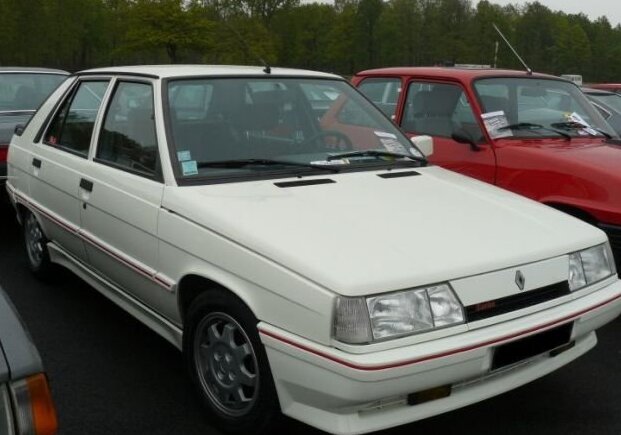
The Renault 11, produced between 1984 and 1988, represented a significant step forward for Renault in the small family car segment. The B/C37 series, encompassing both 3-door and 5-door body styles, aimed to provide a practical and affordable vehicle for European consumers. Within this generation, the 1.7 (B/C37F) variant, equipped with the F3N engine producing 75 horsepower, occupied a middle ground in the lineup, offering a balance between performance and economy. It served as a more substantial offering than the base 1.4L models, while remaining more accessible than the higher-performance 1.6L options.
Technical Specifications
| Brand | Renault |
| Model | 11 |
| Generation | 11 (B/C37) |
| Type (Engine) | 1.7 (B/C37F) (75 Hp) |
| Start of production | 1984 |
| End of production | 1988 |
| Powertrain Architecture | Internal Combustion engine |
| Body type | Hatchback |
| Seats | 5 |
| Doors | 3-5 |
| Fuel Type | Petrol (Gasoline) |
| Power | 75 Hp |
| Engine Model/Code | F3N |
| Engine aspiration | Naturally aspirated engine |
| Engine oil capacity | 5.5 l (5.81 US qt | 4.84 UK qt) |
| Coolant capacity | 6.5 l (6.87 US qt | 5.72 UK qt) |
| Fuel tank capacity | 47 l (12.42 US gal | 10.34 UK gal) |
Powertrain & Engine Architecture
The heart of the Renault 11 1.7 was the F3N engine, a 1.7-liter inline-four cylinder gasoline engine. This engine was a relatively simple design, utilizing a single overhead camshaft (SOHC) valvetrain operating two valves per cylinder. Fuel delivery was managed by a Bosch mechanical fuel injection system, a common setup for the era. While not as sophisticated as later multi-point injection systems, it provided a reasonable balance of fuel efficiency and performance. The F3N engine was known for its durability, though it wasn’t particularly powerful. The engine’s block was cast iron, contributing to its robustness, while the cylinder head was aluminum. The 1.7L engine produced 75 horsepower at approximately 5,500 rpm and 109 lb-ft of torque at 3,000 rpm. The engine was typically paired with a four-speed manual transmission, but a three-speed automatic transmission was also offered, though less common. The automatic transmission, while providing convenience, did noticeably impact acceleration and fuel economy.
Driving Characteristics
The Renault 11 1.7, particularly when equipped with the automatic transmission, offered a comfortable but unhurried driving experience. Acceleration was adequate for everyday driving, but overtaking maneuvers required careful planning. The three-speed automatic transmission had relatively wide gear ratios, meaning the engine often felt strained during quick acceleration. The manual transmission version offered a more engaging driving experience and slightly improved performance. The suspension, consisting of MacPherson struts in the front and a torsion beam rear axle, provided a reasonably comfortable ride, absorbing bumps and imperfections in the road surface effectively. Steering was light and easy, making it well-suited for urban driving. Compared to the 1.4L models, the 1.7L offered a noticeable improvement in responsiveness, especially when fully loaded with passengers or cargo. However, the 1.6L versions, available in some markets, provided a significantly more spirited driving experience.
Equipment & Trim Levels
The Renault 11 1.7 typically came equipped with a fairly basic level of standard features. Interior upholstery was generally cloth, with a simple dashboard layout. Features like a radio, heater, and basic instrumentation were standard. Higher trim levels, often denoted by names like “TL” or “GTE”, added features such as upgraded upholstery, central locking, electric windows, and a sunroof. Optional extras included alloy wheels, a more sophisticated radio/cassette player, and metallic paint. The 1.7L trim often served as a base for adding these optional extras, allowing buyers to customize their vehicle to a certain extent. The interior space was reasonable for a car of its size, offering adequate headroom and legroom for both front and rear passengers.
Chassis & Braking
The Renault 11 1.7 utilized a relatively conventional chassis design for the time. The front suspension featured MacPherson struts, providing a good balance of ride comfort and handling. The rear suspension employed a torsion beam axle, which was cost-effective and provided adequate stability. Braking systems varied depending on the trim level and market. Lower-spec models typically featured drum brakes on the rear wheels, while higher-spec models often had disc brakes all around. The braking performance was adequate for everyday driving, but not particularly sporty. Steering was rack and pinion, providing reasonably precise control. The car’s relatively light weight helped to compensate for the modest braking power.
Market Reception & Comparison
The Renault 11 1.7 was generally well-received by automotive critics as a practical and affordable family car. It was praised for its comfortable ride, reasonable fuel economy, and durable engine. However, it was also criticized for its relatively uninspired styling and modest performance, especially when equipped with the automatic transmission. Compared to rivals like the Peugeot 205 and the Citroën AX, the Renault 11 was often seen as being slightly less refined and engaging to drive. However, it offered a competitive price point and a reputation for reliability. Fuel economy was a strong point, with the 1.7L engine achieving around 35-40 mpg in mixed driving conditions. The 1.6L versions offered better performance but at the cost of slightly reduced fuel economy.
Legacy
The Renault 11, and specifically the 1.7 variant, has become a relatively sought-after classic car among enthusiasts. The F3N engine is known for its robustness and relatively simple mechanics, making it relatively easy to maintain. However, finding parts can sometimes be a challenge, as production ceased over three decades ago. Well-maintained examples of the 1.7 are increasingly rare, and prices have been steadily rising in recent years. The car represents a significant piece of automotive history, embodying the design and engineering philosophies of the 1980s. While not a performance icon, the Renault 11 1.7 remains a testament to Renault’s commitment to providing affordable and reliable transportation for the masses.
