
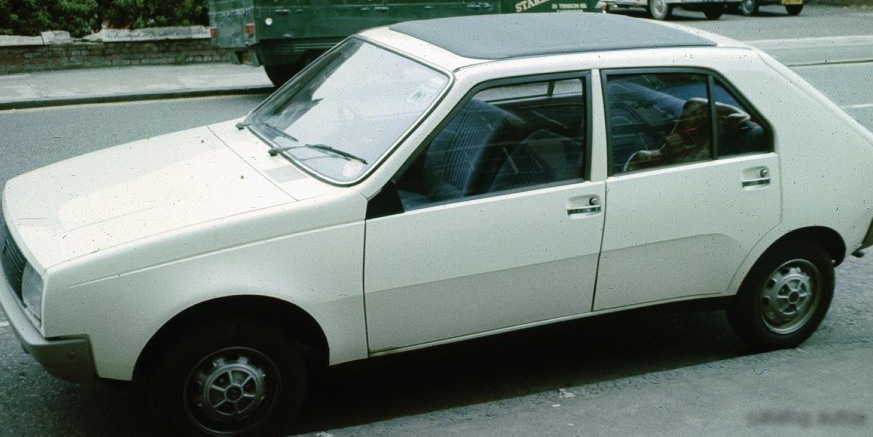
The Renault 14 (121) 1.2 (1210), producing 57 horsepower, was a mainstay of the Renault lineup from 1976 to 1980. Positioned as the entry-level model within the broader Renault 14 range, it offered affordable transportation in the compact hatchback segment. This variant played a significant role in Renault’s strategy to provide a modern, practical, and economical vehicle to a wider European audience. It was a direct competitor to vehicles like the Peugeot 104 and Citroën Visa, aiming for a balance between fuel efficiency and everyday usability.
Technical Specifications
| Brand | Renault |
| Model | 14 |
| Generation | 14 (121) |
| Type (Engine) | 1.2 (1210) (57 Hp) |
| Start of production | 1976 |
| End of production | 1980 |
| Powertrain Architecture | Internal Combustion engine |
| Body type | Hatchback |
| Seats | 5 |
| Doors | 5 |
| Fuel Type | Petrol (Gasoline) |
| Acceleration 0 – 100 km/h | 15.7 sec |
| Acceleration 0 – 62 mph | 15.7 sec |
| Acceleration 0 – 60 mph | 14.9 sec |
| Maximum speed | 143 km/h (88.86 mph) |
| Power | 57 Hp |
| Engine Model/Code | XZ5 |
| Engine aspiration | Naturally aspirated engine |
| Engine oil capacity | 4 l (4.23 US qt | 3.52 UK qt) |
| Coolant capacity | 6 l (6.34 US qt | 5.28 UK qt) |
| Fuel tank capacity | 38.0 l (10.04 US gal | 8.36 UK gal) |
Powertrain & Engine Architecture
The Renault 14 1.2 (1210) was powered by the XZ5 engine, a 1108cc inline-four cylinder petrol engine. This engine featured a relatively simple, yet robust design. It employed a single overhead camshaft (SOHC) valvetrain operating two valves per cylinder. Fuel delivery was managed by a single downdraft carburetor, a common setup for vehicles of this era. The carburetor provided adequate, if not particularly refined, fuel atomization. The engine’s block was cast iron, contributing to its durability, while the cylinder head was aluminum. The engine produced 57 horsepower at approximately 5300 rpm and 69 lb-ft of torque at 3000 rpm. The engine was typically paired with a four-speed manual transmission, but a three-speed automatic transmission was also available, though less common. The automatic transmission was a conventional hydraulic unit, offering smooth, but not particularly quick, shifts.
Driving Characteristics
The 1.2-liter Renault 14, particularly when equipped with the three-speed automatic transmission, was not known for its blistering performance. Acceleration was leisurely, with 0-60 mph taking around 14.9 seconds. The automatic transmission’s gear ratios were geared towards fuel economy rather than spirited driving. The engine felt strained when attempting rapid acceleration, and overtaking required careful planning. However, in typical urban driving conditions, the 1.2L engine proved adequate. The automatic transmission provided a comfortable and convenient driving experience, especially for drivers unfamiliar with manual transmissions. The suspension, consisting of independent front suspension with torsion bars and a twist-beam rear axle, provided a reasonably comfortable ride, absorbing bumps and imperfections in the road surface effectively. Steering was light and easy, making it maneuverable in city traffic.
Equipment & Trim Levels
The 1.2L Renault 14 served as the base model, and as such, came with a relatively sparse equipment list. Standard features typically included cloth upholstery, vinyl floor covering, and basic instrumentation consisting of a speedometer, fuel gauge, and temperature gauge. The dashboard was constructed from durable plastic, prioritizing functionality over aesthetics. Optional extras included a radio, heated rear window, and upgraded upholstery. Higher trim levels, such as the TL and TS, offered more luxurious appointments, including upgraded interior trim, additional instrumentation, and alloy wheels. The base 1.2L model was generally characterized by its utilitarian interior, focusing on providing a practical and affordable transportation solution.
Chassis & Braking
The Renault 14 featured a monocoque chassis construction, providing a good balance of strength and weight. The front suspension utilized independent torsion bar springs, offering a comfortable ride and predictable handling. The rear suspension employed a simple twist-beam axle, which was cost-effective and provided adequate stability. Braking was initially accomplished with drum brakes on all four wheels. Later models, particularly those produced after 1978, often featured front disc brakes, improving stopping performance. The braking system was hydraulic, providing adequate stopping power for the vehicle’s weight and performance capabilities. Stabilizer bars were not typically fitted to the base 1.2L model, contributing to a slightly more pronounced body roll during cornering.
Market Reception & Comparison
The Renault 14 1.2L was generally well-received as an affordable and practical family car. Critics praised its fuel efficiency and comfortable ride, but noted its lack of performance, especially when equipped with the automatic transmission. Compared to the more powerful Renault 14 TL and TS models, the 1.2L offered significantly less performance. The TL, with its 1.4-liter engine, provided a noticeable improvement in acceleration and overall drivability. The TS, featuring a 1.6-liter engine, was the performance-oriented variant, offering a more engaging driving experience. However, the 1.2L model remained popular with buyers seeking a budget-friendly and economical vehicle. Fuel economy was a key selling point, averaging around 35-40 mpg in real-world driving conditions.
Legacy
The Renault 14 1.2L, while not a performance icon, proved to be a reliable and durable vehicle. The XZ5 engine, despite its relatively simple design, was known for its longevity, provided it was properly maintained. Today, the Renault 14 1.2L is a relatively rare sight on the roads, but it remains a popular choice among classic car enthusiasts seeking an affordable and charming vintage vehicle. Parts availability can be challenging, but many components are still available through specialist suppliers. The automatic transmission variants, while less desirable to some enthusiasts, offer a unique and comfortable driving experience, representing a snapshot of automotive technology from the late 1970s. The car’s enduring appeal lies in its simplicity, practicality, and nostalgic charm.
