
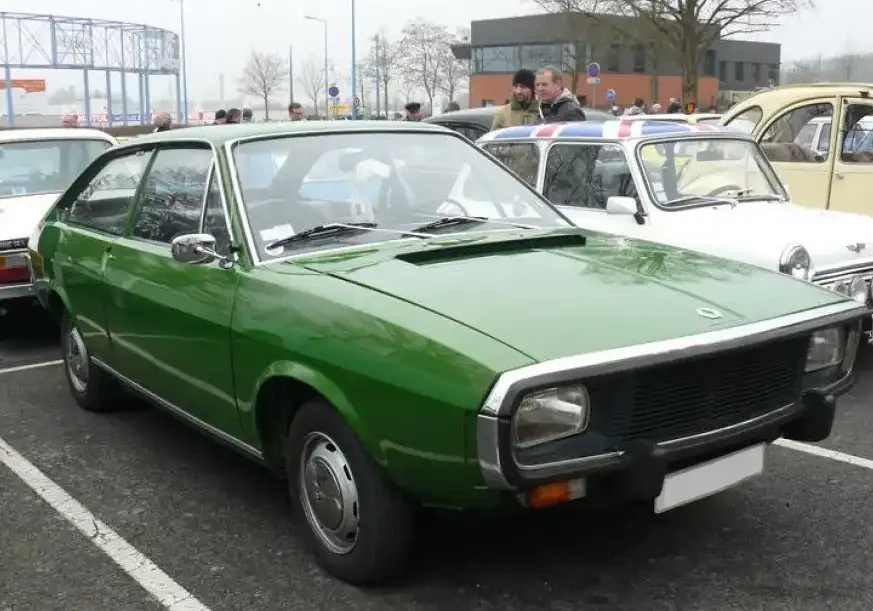
The Renault 15, produced between July 1971 and August 1979, was a compact coupe positioned as a stylish and relatively affordable offering within the Renault lineup. It represented a departure from Renault’s more utilitarian offerings, aiming for a more youthful and design-conscious buyer. The 1.3-liter (60 hp) variant, powered by the 810 engine, served as the entry point to the 15 model range, offering a balance of economy and usability. It was a key model in Renault’s strategy to broaden its appeal beyond its traditional customer base, particularly in Europe where compact coupes were gaining popularity.
Technical Specifications
| Brand | Renault |
| Model | 15 |
| Generation | 15 |
| Type (Engine) | 1.3 (60 Hp) |
| Start of Production | July, 1971 |
| End of Production | August, 1979 |
| Powertrain Architecture | Internal Combustion Engine |
| Body Type | Coupe |
| Seats | 5 |
| Doors | 3 |
| Fuel Type | Petrol (Gasoline) |
| Maximum Speed | 150 km/h (93.21 mph) |
| Power | 60 Hp |
| Engine Model/Code | 810 |
| Engine Aspiration | Naturally Aspirated |
| Engine Oil Capacity | 3.3 l (3.49 US qt | 2.9 UK qt) |
| Coolant Capacity | 5 l (5.28 US qt | 4.4 UK qt) |
| Fuel Tank Capacity | 55.0 l (14.53 US gal | 12.1 UK gal) |
Powertrain & Engine Architecture
The Renault 15 1.3 was equipped with the Renault 810 engine, a 1,300cc inline-four cylinder petrol engine. This engine was a relatively simple design, featuring a single overhead camshaft (SOHC) and a two-barrel Solex carburetor. The 810 engine was known for its robustness and ease of maintenance, characteristics valued in the early 1970s. While not a powerhouse, the engine produced 60 horsepower at approximately 6,000 rpm, and around 77 lb-ft of torque. The engine utilized a conventional wet sump lubrication system and a distributor-based ignition. The transmission was a four-speed manual, as an automatic transmission wasn’t offered on this specific variant. The engine’s design prioritized fuel economy and reliability over outright performance, reflecting the automotive landscape of the time.
Driving Characteristics
The 1.3-liter Renault 15 offered a modest driving experience. Acceleration was adequate for everyday driving, but it wasn’t particularly quick. The four-speed manual transmission was well-matched to the engine’s powerband, allowing for reasonable progress. The gear ratios were spaced to maximize fuel efficiency, rather than providing exhilarating acceleration. Compared to the later, more powerful 1.6-liter versions of the Renault 15, the 1.3 felt noticeably slower, especially when fully loaded or climbing hills. Handling was generally considered good for a car of its era, with a relatively compliant suspension providing a comfortable ride. However, it wasn’t a sporty car, and body roll was evident during cornering. The steering was light and easy, making it maneuverable in urban environments.
Equipment & Trim Levels
The 1.3-liter Renault 15 was typically the base model, and as such, came with a relatively limited set of standard features. Interior upholstery was typically cloth, available in a range of period-correct colors. The dashboard was functional and straightforward, featuring basic instrumentation including a speedometer, fuel gauge, and temperature gauge. A heater was standard, but air conditioning was generally an optional extra. Other optional extras included a radio, upgraded interior trim, and tinted glass. The exterior trim was relatively simple, with chrome bumpers and basic hubcaps. The focus was on providing a functional and affordable coupe, rather than a luxury vehicle.
Chassis & Braking
The Renault 15 utilized a relatively conventional chassis design for the early 1970s. It featured an independent front suspension with MacPherson struts and a torsion beam rear suspension. This setup provided a reasonable balance of ride comfort and handling. The braking system consisted of disc brakes on the front wheels and drum brakes on the rear wheels. The brakes were adequate for the car’s weight and performance, but they lacked the stopping power of more modern systems. Steering was rack and pinion, providing precise and responsive control. The car’s relatively light weight (around 2,100 lbs) helped to offset the limitations of the braking and suspension systems.
Market Reception & Comparison
The Renault 15 1.3 was generally well-received as an affordable and stylish coupe. Critics praised its attractive design and comfortable ride. However, the 1.3-liter engine was often criticized for its lack of power, particularly when compared to competitors offering larger engines. Compared to the 1.6-liter Renault 15, the 1.3 offered significantly lower performance, but it was also more fuel-efficient. The 1.3 was aimed at buyers who prioritized economy and practicality over outright performance. It competed with other compact coupes such as the Ford Capri and the Opel Manta, but it offered a more distinctive and arguably more stylish design. Fuel economy was a strong point, averaging around 35-40 mpg in typical driving conditions.
Legacy
The Renault 15, particularly the 1.3-liter variant, has become a popular classic car among enthusiasts. The 810 engine is known for its reliability and ease of maintenance, making it a relatively affordable classic to own and operate. Parts availability is generally good, although some trim-specific items can be difficult to find. Today, the Renault 15 1.3 is valued for its retro styling and its representation of a bygone era of automotive design. Well-maintained examples are increasingly sought after by collectors and enthusiasts, and prices have been steadily rising in recent years. While not a high-performance machine, the 1.3-liter Renault 15 remains a charming and enjoyable classic car that offers a unique driving experience.
