
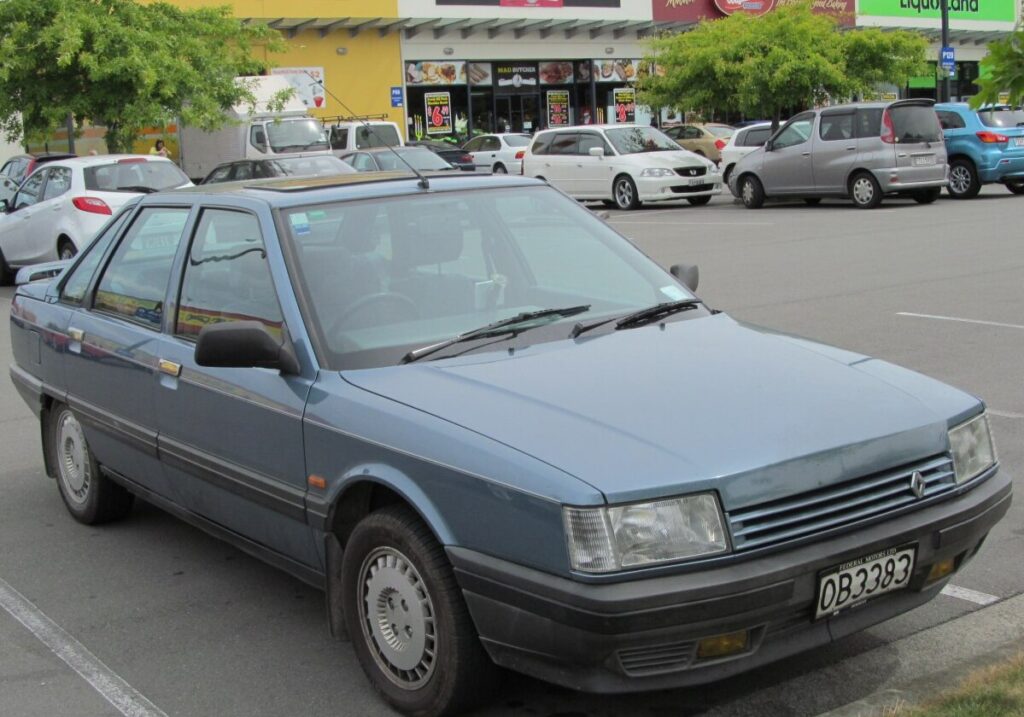
The Renault 21 1.7 i, produced between 1989 and 1993, represented an entry-level offering within the broader Renault 21 (B48) range. Positioned as a practical and affordable family sedan, it served as a key model for Renault in the European market, particularly in France and surrounding countries. The B48 generation Renault 21 was a significant update to the previous F30 series, offering improved styling, comfort, and technology. The 1.7 i variant, with its modest 75 horsepower, was aimed at buyers prioritizing fuel efficiency and low running costs over outright performance. It occupied the lower end of the lineup, below the more powerful 2.0-liter and turbocharged variants.
Technical Specifications
| Brand | Renault |
| Model | 21 |
| Generation | 21 (B48) |
| Type (Engine) | 1.7 i (75 Hp) |
| Start of production | 1989 |
| End of production | 1993 |
| Powertrain Architecture | Internal Combustion engine |
| Body type | Sedan |
| Seats | 5 |
| Doors | 4 |
| Fuel consumption (urban) | 10.3 l/100 km (22.8 US mpg) |
| Fuel consumption (extra urban) | 6.2 l/100 km (37.9 US mpg) |
| Fuel consumption (combined) | 7.7 l/100 km (30.5 US mpg) |
| Fuel Type | Petrol (Gasoline) |
| Acceleration 0 – 100 km/h | 12.5 sec |
| Acceleration 0 – 62 mph | 12.5 sec |
| Acceleration 0 – 60 mph | 11.9 sec |
| Maximum speed | 172 km/h (106.88 mph) |
| Weight-to-power ratio | 13.1 kg/Hp |
| Weight-to-torque ratio | 7.6 kg/Nm |
| Power | 75 Hp @ 5000 rpm |
| Torque | 129 Nm @ 3250 rpm (95.15 lb.-ft. @ 3250 rpm) |
| Engine layout | Front, Transverse |
| Engine Model/Code | F3N 726 |
| Engine displacement | 1721 cm3 (105.02 cu. in.) |
| Number of cylinders | 4 |
| Engine configuration | Inline |
| Cylinder Bore | 81 mm (3.19 in.) |
| Piston Stroke | 83.5 mm (3.29 in.) |
| Compression ratio | 9.2:1 |
| Number of valves per cylinder | 2 |
| Fuel injection system | Single-point injection |
| Engine aspiration | Naturally aspirated |
| Valvetrain | OHC |
| Engine oil capacity | 5.3 l (5.6 US qt | 4.66 UK qt) |
| Coolant capacity | 6 l (6.34 US qt | 5.28 UK qt) |
| Kerb Weight | 985 kg (2171.55 lbs.) |
| Max. weight | 1430 kg (3152.61 lbs.) |
| Max load | 445 kg (981.06 lbs.) |
| Trunk (boot) space | 490 l (17.3 cu. ft.) |
| Fuel tank capacity | 66 l (17.44 US gal | 14.52 UK gal) |
| Length | 4530 mm (178.35 in.) |
| Width | 1730 mm (68.11 in.) |
| Height | 1415 mm (55.71 in.) |
| Wheelbase | 2660 mm (104.72 in.) |
| Front track | 1430 mm (56.3 in.) |
| Rear track | 1400 mm (55.12 in.) |
| Drivetrain Architecture | Front wheel drive |
| Number of gears | 5 gears, manual transmission |
| Front suspension | Spring Strut |
| Rear suspension | Torsion |
| Front brakes | Ventilated discs |
| Rear brakes | Drum |
| Assisting systems | ABS (Anti-lock braking system) |
| Steering type | Steering rack and pinion |
| Power steering | Hydraulic |
| Tires size | 175/70 R13 |
| Wheel rims size | 13 |
Introduction
The Renault 21 1.7 i, launched in 1989, was a core component of Renault’s mid-size sedan offering. Built on the B48 platform (shared with the Peugeot 405), it represented a step forward in design and refinement compared to its predecessor. The 1.7-liter engine was a key element in making the Renault 21 accessible to a wider range of buyers. This variant was particularly popular in Europe, where fuel economy and affordability were significant purchasing factors. It was offered alongside more powerful engine options, including a 2.0-liter inline-four and a turbocharged 2.0-liter, catering to different performance and budget preferences.
Powertrain & Engine Architecture
The heart of the Renault 21 1.7 i is the F3N 726 engine, a 1721cc inline-four cylinder unit. This engine utilizes a single-point fuel injection system, a relatively simple and cost-effective technology for the time. The engine features an overhead camshaft (OHC) valvetrain with two valves per cylinder. While not a particularly high-tech engine by modern standards, it was known for its reliability and reasonable fuel efficiency. The 1.7-liter engine produced 75 horsepower at 5000 rpm and 129 Nm (95.15 lb-ft) of torque at 3250 rpm. The engine’s relatively low compression ratio of 9.2:1 allowed it to run on lower octane fuel, further contributing to its affordability. The engine was transversely mounted in the front of the vehicle, driving the front wheels. The transmission was a five-speed manual, offering a balance between fuel economy and drivability.
Driving Characteristics
The Renault 21 1.7 i offered a comfortable, if not particularly exciting, driving experience. Acceleration from 0 to 100 km/h (0-62 mph) took around 12.5 seconds, and top speed was approximately 172 km/h (106.88 mph). The five-speed manual transmission was well-matched to the engine’s characteristics, providing adequate gearing for both city driving and highway cruising. Compared to the higher-output 2.0-liter versions, the 1.7 i felt noticeably slower, particularly when accelerating or overtaking. However, the lower engine weight contributed to better handling and a more nimble feel. The gear ratios were optimized for fuel efficiency, resulting in a relatively relaxed driving experience at cruising speeds. The power delivery was linear, but lacked the punch of the larger engines.
Equipment & Trim Levels
The Renault 21 1.7 i typically came with a fairly basic level of equipment, reflecting its position as the entry-level model. Standard features generally included cloth upholstery, a basic instrument cluster, and manual windows and door locks. Power steering was often included, but air conditioning and central locking were typically optional extras. Higher trim levels, such as the “Si” or “RT” variants, offered additional features like upgraded upholstery, alloy wheels, and a more comprehensive instrument panel. Optional extras could include a sunroof, upgraded audio system, and metallic paint.
Chassis & Braking
The Renault 21 1.7 i utilized a relatively simple chassis design. The front suspension consisted of MacPherson strut springs, while the rear suspension employed a torsion beam setup. This configuration provided a comfortable ride, but wasn’t particularly sporty. The braking system featured ventilated discs on the front wheels and drum brakes on the rear. ABS (Anti-lock Braking System) was available as an option, enhancing safety. The steering was a rack and pinion system with hydraulic power assistance, providing light and easy steering feel. The tires were typically 175/70 R13, offering a good balance between comfort and grip.
Market Reception & Comparison
The Renault 21 1.7 i was generally well-received by critics as a practical and affordable family sedan. It was praised for its comfortable ride, reasonable fuel economy, and reliable engine. However, it was often criticized for its lack of performance compared to the more powerful variants. Compared to competitors like the Peugeot 405 and Citroën BX, the Renault 21 1.7 i offered a similar level of practicality and affordability. Fuel economy was comparable to other 1.7-liter engines of the time, and reliability was generally good. The 1.7 i was a popular choice for buyers who prioritized value for money over outright performance.
Legacy
The Renault 21 1.7 i has become a relatively affordable classic car in the used market. The F3N engine is known for its durability, and with proper maintenance, can provide many years of reliable service. Parts availability is generally good, although some specific trim pieces may be difficult to find. While not a particularly sought-after model by collectors, the 1.7 i remains a popular choice for those seeking a classic French sedan that is both practical and affordable. Its simple design and robust engine make it a relatively easy car to maintain and repair, ensuring its continued presence on the roads today.
