
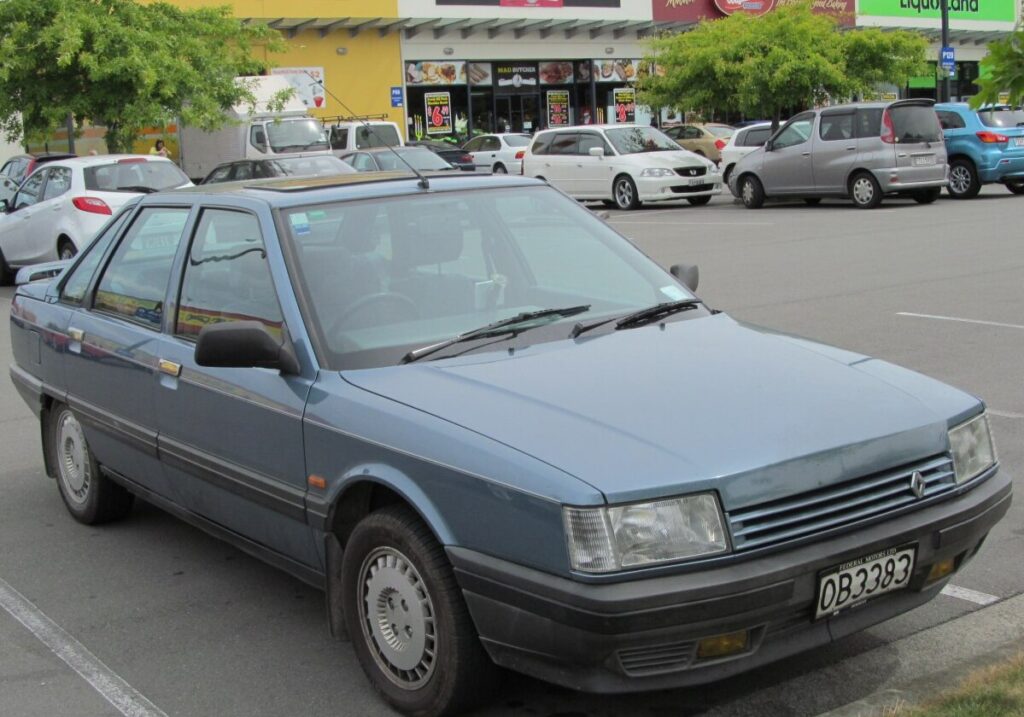
The Renault 21 1.7 i, produced between 1989 and 1993, represented a core offering within the B48 generation of Renault’s popular family sedan. Positioned as a mid-range trim, it aimed to balance affordability with reasonable performance and comfort. The 21, launched as a replacement for the Renault 18, was designed to compete in the increasingly competitive large family car segment in Europe. This 1.7-liter variant, typically paired with a manual transmission, also saw production with an automatic gearbox, offering a more relaxed driving experience geared towards urban commuters and drivers prioritizing ease of use. The B48 platform, shared with the Peugeot 605, underscored Renault’s commitment to modern engineering and design during this period.
Technical Specifications
| Brand | Renault |
| Model | 21 |
| Generation | 21 (B48) |
| Type (Engine) | 1.7 i (95 Hp) |
| Start of production | 1989 |
| End of production | 1993 |
| Powertrain Architecture | Internal Combustion engine |
| Body type | Sedan |
| Seats | 5 |
| Doors | 4 |
| Fuel consumption (urban) | 10.5 l/100 km (22.4 US mpg, 26.9 UK mpg, 9.5 km/l) |
| Fuel consumption (extra urban) | 5.9 l/100 km (39.9 US mpg, 47.9 UK mpg, 16.9 km/l) |
| Fuel consumption (combined) | 7.5 l/100 km (31.4 US mpg, 37.7 UK mpg, 13.3 km/l) |
| Fuel Type | Petrol (Gasoline) |
| Acceleration 0 – 100 km/h | 10.7 sec |
| Acceleration 0 – 62 mph | 10.7 sec |
| Acceleration 0 – 60 mph | 10.2 sec |
| Maximum speed | 185 km/h (114.95 mph) |
| Weight-to-power ratio | 10.4 kg/Hp |
| Weight-to-torque ratio | 6.9 kg/Nm |
| Power | 95 Hp @ 5200 rpm |
| Power per litre | 55.2 Hp/l |
| Torque | 143 Nm @ 3000 rpm (105.47 lb.-ft. @ 3000 rpm) |
| Engine layout | Front, Transverse |
| Engine Model/Code | F3N 722, F3N 723 |
| Engine displacement | 1721 cm3 (105.02 cu. in.) |
| Number of cylinders | 4 |
| Engine configuration | Inline |
| Cylinder Bore | 81 mm (3.19 in.) |
| Piston Stroke | 83.5 mm (3.29 in.) |
| Compression ratio | 9.5:1 |
| Number of valves per cylinder | 2 |
| Fuel injection system | Multi-port manifold injection |
| Engine aspiration | Naturally aspirated engine |
| Valvetrain | OHC |
| Engine oil capacity | 5.3 l (5.6 US qt | 4.66 UK qt) |
| Coolant | 6 l (6.34 US qt | 5.28 UK qt) |
| Kerb Weight | 990 kg (2182.58 lbs.) |
| Max. weight | 1485 kg (3273.86 lbs.) |
| Max load | 495 kg (1091.29 lbs.) |
| Trunk (boot) space – minimum | 490 l (17.3 cu. ft.) |
| Fuel tank capacity | 66 l (17.44 US gal | 14.52 UK gal) |
| Length | 4530 mm (178.35 in.) |
| Width | 1730 mm (68.11 in.) |
| Height | 1415 mm (55.71 in.) |
| Wheelbase | 2660 mm (104.72 in.) |
| Front track | 1430 mm (56.3 in.) |
| Rear (Back) track | 1400 mm (55.12 in.) |
| Drivetrain Architecture | The Internal combustion engine (ICE) drives the front wheels of the vehicle. |
| Drive wheel | Front wheel drive |
| Number of gears | 5 |
| Type of gearbox | Manual transmission |
| Front suspension | Spring Strut |
| Rear suspension | Torsion |
| Front brakes | Ventilated discs |
| Rear brakes | Drum |
| Assisting systems | ABS (Anti-lock braking system) |
| Steering type | Steering rack and pinion |
| Power steering | Hydraulic Steering |
| Tires size | 175/70 R13 |
| Wheel rims size | 13 |
Powertrain & Engine Architecture
The Renault 21 1.7 i utilized the F3N engine family, specifically the F3N 722 or F3N 723 variants. This was a naturally aspirated, inline-four cylinder engine with a displacement of 1721cc. It featured a single overhead camshaft (OHC) valvetrain operating two valves per cylinder. Fuel delivery was managed by a multi-port fuel injection system, a significant upgrade over the carbureted engines found in earlier Renault models. This system contributed to improved fuel efficiency and smoother power delivery. The engine’s 9.5:1 compression ratio was a compromise between performance and the fuel quality available in European markets. The automatic transmission option, while not as common as the manual, was typically a four-speed unit designed for comfortable cruising rather than sporty acceleration.
Driving Characteristics
The 1.7-liter engine, producing 95 horsepower, provided adequate, but not exhilarating, performance. Acceleration from 0 to 60 mph took around 10.2 seconds, and top speed was approximately 115 mph. Compared to the more powerful 2.0-liter and V6 versions of the Renault 21, the 1.7 i felt noticeably less responsive, particularly when fully loaded or tackling steep inclines. The automatic transmission, while offering convenience, further diminished acceleration due to its less direct power transfer. However, the 1.7 i excelled in urban driving and on the highway, offering a relaxed and fuel-efficient experience. The gear ratios in the automatic transmission were optimized for comfortable cruising, and the engine’s torque curve provided sufficient power for everyday driving situations.
Equipment & Trim Levels
The 1.7 i trim typically included features such as power steering, central locking, and a basic stereo system. Interior upholstery was usually cloth, with options for upgraded materials available. Dashboard configuration was relatively straightforward, prioritizing functionality over luxury. Optional extras included air conditioning, electric windows, and a sunroof. The 1.7 i often served as a base for adding these options, allowing buyers to customize their vehicle to their preferences. Compared to higher-spec models, the 1.7 i generally lacked features like leather upholstery, alloy wheels, and more advanced audio systems.
Chassis & Braking
The Renault 21 B48 utilized a front-wheel-drive layout with independent front suspension employing MacPherson struts and a torsion beam rear suspension. This setup provided a reasonable balance between ride comfort and handling. The 1.7 i models typically featured ventilated disc brakes on the front wheels and drum brakes on the rear. ABS (Anti-lock Braking System) was often included as standard equipment, enhancing safety. Stabilizer bars were fitted to both the front and rear axles to reduce body roll during cornering. The suspension tuning was geared towards comfort, resulting in a softer ride compared to sportier models.
Market Reception & Comparison
The Renault 21 1.7 i was generally well-received as a practical and affordable family car. Critics praised its comfortable ride, spacious interior, and fuel efficiency. However, the engine’s performance was often cited as a drawback, particularly when compared to competitors offering more powerful engines. Compared to the 2.0-liter and V6 versions of the 21, the 1.7 i offered significantly lower running costs but at the expense of performance. The automatic transmission version was favored by drivers seeking convenience, but it further reduced acceleration and fuel economy compared to the manual.
Legacy
The Renault 21 1.7 i, while not the most powerful or prestigious variant of the B48 generation, remains a relatively reliable and affordable classic car. The F3N engine is known for its durability, and parts availability is generally good. Today, these cars are often sought after by enthusiasts looking for a simple, reliable, and affordable classic French sedan. The automatic transmission models, while less common, are appreciated by those seeking a comfortable and easy-to-drive vintage vehicle. The 1.7 i represents a sweet spot in the Renault 21 lineup, offering a balance of practicality, affordability, and reliability that continues to appeal to car enthusiasts today.
