
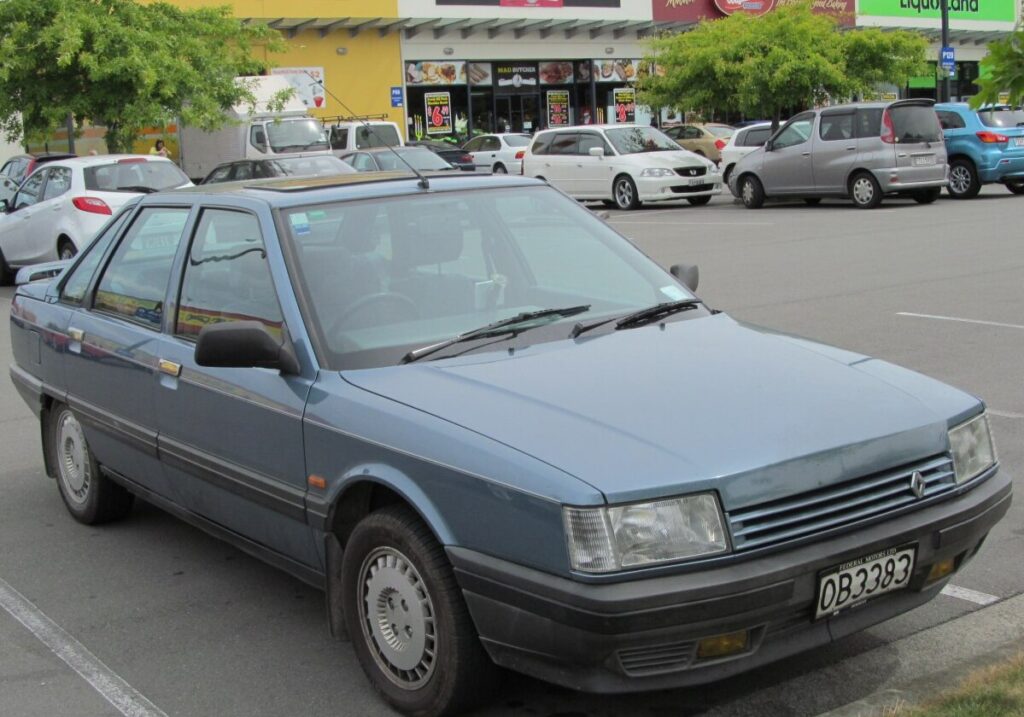
The Renault 21 1.7 i Automatic, produced between 1989 and 1993, represented a comfortable and practical offering within the B48 generation of Renault’s popular mid-size sedan. Positioned as a mid-range trim, it aimed to provide a balance between affordability, reasonable performance, and the convenience of an automatic transmission. The 21, overall, was Renault’s replacement for the successful Renault 18, and the B48 series was a significant step forward in terms of design, comfort, and technology for the French automaker. This particular variant played a role in appealing to buyers seeking a no-nonsense family car with a focus on ease of driving.
Technical Specifications
| Brand | Renault |
| Model | 21 |
| Generation | 21 (B48) |
| Type (Engine) | 1.7 i (95 Hp) Automatic |
| Start of production | 1989 |
| End of production | 1993 |
| Powertrain Architecture | Internal Combustion engine |
| Body type | Sedan |
| Seats | 5 |
| Doors | 4 |
| Fuel consumption (urban) | 11 l/100 km (21.4 US mpg) |
| Fuel consumption (extra urban) | 6.1 l/100 km (38.6 US mpg) |
| Fuel consumption (combined) | 7.7 l/100 km (30.5 US mpg) |
| Fuel Type | Petrol (Gasoline) |
| Acceleration 0 – 100 km/h | 13.8 sec |
| Acceleration 0 – 62 mph | 13.8 sec |
| Acceleration 0 – 60 mph | 13.1 sec |
| Maximum speed | 176 km/h (109.36 mph) |
| Weight-to-power ratio | 10.4 kg/Hp |
| Weight-to-torque ratio | 6.9 kg/Nm |
| Power | 95 Hp @ 5200 rpm |
| Torque | 143 Nm @ 3000 rpm (105.47 lb.-ft. @ 3000 rpm) |
| Engine layout | Front, Transverse |
| Engine Model/Code | F3N 722, F3N 723 |
| Engine displacement | 1721 cm3 (105.02 cu. in.) |
| Number of cylinders | 4 |
| Engine configuration | Inline |
| Cylinder Bore | 81 mm (3.19 in.) |
| Piston Stroke | 83.5 mm (3.29 in.) |
| Compression ratio | 9.5:1 |
| Number of valves per cylinder | 2 |
| Fuel injection system | Multi-port manifold injection |
| Engine aspiration | Naturally aspirated engine |
| Valvetrain | OHC |
| Engine oil capacity | 5.3 l (5.6 US qt | 4.66 UK qt) |
| Coolant capacity | 6 l (6.34 US qt | 5.28 UK qt) |
| Kerb Weight | 990 kg (2182.58 lbs.) |
| Max. weight | 1485 kg (3273.86 lbs.) |
| Max load | 495 kg (1091.29 lbs.) |
| Trunk (boot) space – minimum | 490 l (17.3 cu. ft.) |
| Fuel tank capacity | 66 l (17.44 US gal | 14.52 UK gal) |
| Length | 4530 mm (178.35 in.) |
| Width | 1730 mm (68.11 in.) |
| Height | 1415 mm (55.71 in.) |
| Wheelbase | 2660 mm (104.72 in.) |
| Front track | 1430 mm (56.3 in.) |
| Rear (Back) track | 1400 mm (55.12 in.) |
| Drivetrain Architecture | Front wheel drive |
| Number of gears and type of gearbox | 4 gears, automatic transmission |
| Front suspension | Spring Strut |
| Rear suspension | Torsion |
| Front brakes | Ventilated discs |
| Rear brakes | Drum |
| Assisting systems | ABS (Anti-lock braking system) |
| Steering type | Steering rack and pinion |
| Power steering | Hydraulic Steering |
| Tires size | 175/70 R13 |
| Wheel rims size | 13 |
Powertrain & Engine Architecture
The Renault 21 1.7 i Automatic was powered by the F3N 722 or F3N 723 engine, a 1.7-liter inline-four cylinder gasoline engine. This engine featured a single overhead camshaft (OHC) valvetrain with two valves per cylinder. Fuel delivery was handled by a multi-port fuel injection system, a relatively modern feature for the time, contributing to improved fuel efficiency and smoother operation compared to carbureted engines. The engine produced 95 horsepower at 5200 rpm and 143 Nm (105.47 lb-ft) of torque at 3000 rpm. The automatic transmission was a conventional four-speed unit, designed for comfortable cruising rather than sporty performance. It was a hydraulic automatic, lacking the electronic controls found in later transmissions.
Driving Characteristics
The 1.7L automatic powertrain delivered a comfortable, if not particularly exhilarating, driving experience. Acceleration from 0-60 mph took around 13.1 seconds, and top speed was approximately 109 mph. The automatic transmission prioritized smooth shifts and ease of use, making it well-suited for city driving and long highway journeys. Compared to the manual transmission versions of the 21 1.7, the automatic suffered a slight performance penalty due to the transmission’s inherent efficiency losses. Higher-spec models, such as those equipped with the 2.0-liter engine, offered significantly more power and a more engaging driving experience. The gear ratios were tuned for fuel economy and relaxed cruising, meaning the engine could feel strained when attempting brisk acceleration or climbing hills.
Equipment & Trim Levels
The 1.7 i Automatic trim typically included features such as power steering, central locking, and electric front windows. Interior upholstery was generally cloth, with a relatively simple dashboard layout. Optional extras included a sunroof, upgraded audio systems, and alloy wheels. The trim level sat in the middle of the Renault 21 range, offering more comfort and convenience features than the base models but lacking the luxury appointments of the higher-spec versions. Air conditioning was often an optional extra, and its presence significantly increased the car’s appeal in warmer climates.
Chassis & Braking
The Renault 21 1.7 i Automatic utilized a front-wheel-drive layout with a MacPherson strut suspension at the front and a torsion beam suspension at the rear. Braking was provided by ventilated discs on the front wheels and drum brakes on the rear. Anti-lock braking system (ABS) was often included as standard equipment, enhancing safety. The suspension setup prioritized ride comfort over sporty handling, providing a smooth and compliant ride on most road surfaces. The relatively light weight of the 1.7-liter engine helped to maintain a reasonable weight distribution, contributing to predictable handling characteristics.
Market Reception & Comparison
The Renault 21 1.7 i Automatic was generally well-received by critics as a practical and comfortable family car. It offered a good balance of features and affordability, making it a popular choice in the European market. Fuel economy was considered respectable for its time, averaging around 30.5 US mpg in combined driving. Compared to other trims in the lineup, the 1.7L automatic was often seen as a sensible choice for buyers who prioritized ease of driving and fuel efficiency over outright performance. Competitors included the Peugeot 405, Citroën BX, and Ford Sierra, all of which offered similar levels of comfort and practicality.
Legacy
The Renault 21 1.7 i Automatic, while not a particularly sought-after classic today, remains a relatively reliable and affordable used car. The F3N engine is known for its durability, and the automatic transmission, while not particularly sophisticated, is generally robust. However, age-related issues such as corrosion and wear and tear on suspension components are common. Parts availability can be a challenge in some regions, but many components are still available through specialist suppliers. The car represents a significant era in Renault’s history, showcasing the automaker’s commitment to providing comfortable and practical transportation for the masses.
