
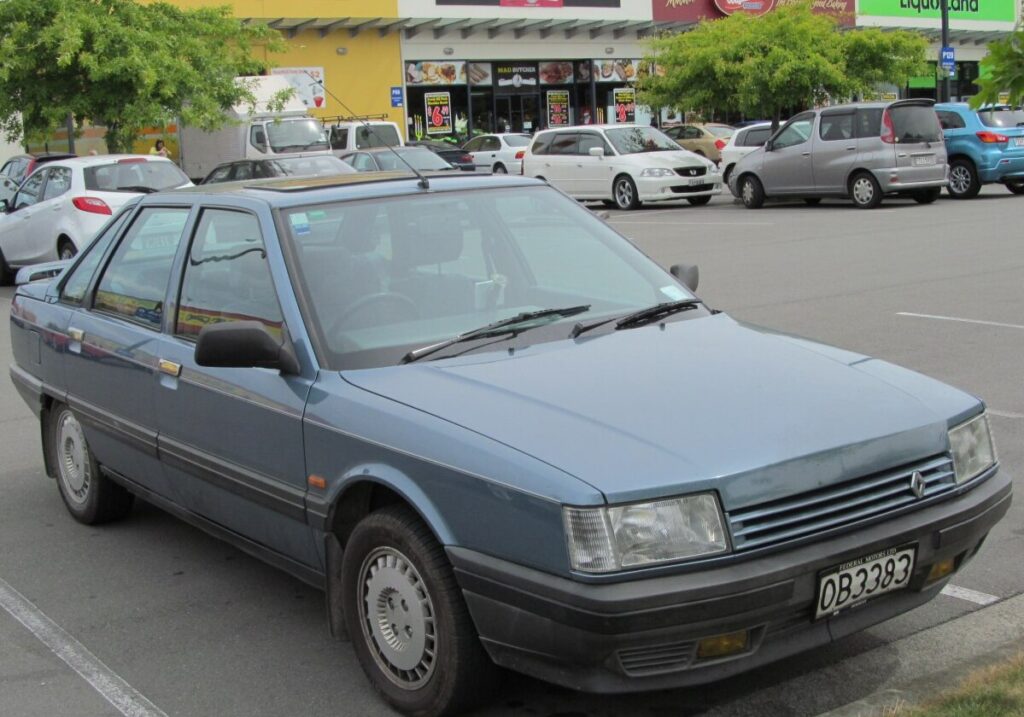
The Renault 21 2.0i 12V, produced between 1989 and 1993, represented a significant step up in performance and refinement for the B48 generation of Renault’s large family sedan. Positioned as a mid-range offering within the 21 lineup, it bridged the gap between the more economical base models and the flagship Turbo variants. This model was primarily aimed at the European market, offering a blend of practicality, comfort, and respectable performance for family motoring and long-distance travel. The 2.0i 12V was a key component of Renault’s strategy to offer a modern, well-equipped sedan that could compete with rivals like the Peugeot 405 and Citroën BX.
Technical Specifications
| Brand | Renault |
| Model | 21 |
| Generation | 21 (B48) |
| Type (Engine) | 2.0 i 12V (140 Hp) |
| Start of production | 1989 |
| End of production | 1993 |
| Powertrain Architecture | Internal Combustion engine |
| Body type | Sedan |
| Seats | 5 |
| Doors | 4 |
| Fuel consumption (urban) | 12.4 l/100 km (19 US mpg, 22.8 UK mpg) |
| Fuel consumption (extra urban) | 6.8 l/100 km (34.6 US mpg, 41.5 UK mpg) |
| Fuel consumption (combined) | 8.4 l/100 km (28 US mpg, 33.6 UK mpg) |
| Fuel Type | Petrol (Gasoline) |
| Acceleration 0 – 100 km/h | 9.6 sec |
| Acceleration 0 – 62 mph | 9.6 sec |
| Acceleration 0 – 60 mph | 9.1 sec |
| Maximum speed | 203 km/h (126.14 mph) |
| Weight-to-power ratio | 8.1 kg/Hp |
| Weight-to-torque ratio | 6.5 kg/Nm |
| Power | 140 Hp @ 6000 rpm |
| Torque | 176 Nm @ 4300 rpm (129.81 lb.-ft. @ 4300 rpm) |
| Engine layout | Front, Longitudinal |
| Engine Model/Code | J7R |
| Engine displacement | 1995 cm3 (121.74 cu. in.) |
| Number of cylinders | 4 |
| Engine configuration | Inline |
| Cylinder Bore | 88 mm (3.46 in.) |
| Piston Stroke | 82 mm (3.23 in.) |
| Compression ratio | 9.3:1 |
| Number of valves per cylinder | 3 |
| Fuel injection system | Multi-port manifold injection |
| Engine aspiration | Naturally aspirated engine |
| Valvetrain | OHC |
| Engine oil capacity | 5.5 l (5.81 US qt | 4.84 UK qt) |
| Coolant capacity | 6.8 l (7.19 US qt | 5.98 UK qt) |
| Kerb Weight | 1140 kg (2513.27 lbs.) |
| Max. weight | 1605 kg (3538.42 lbs.) |
| Max load | 465 kg (1025.15 lbs.) |
| Trunk (boot) space – minimum | 490 l (17.3 cu. ft.) |
| Fuel tank capacity | 66 l (17.44 US gal | 14.52 UK gal) |
| Length | 4530 mm (178.35 in.) |
| Width | 1730 mm (68.11 in.) |
| Height | 1415 mm (55.71 in.) |
| Wheelbase | 2660 mm (104.72 in.) |
| Front track | 1430 mm (56.3 in.) |
| Rear track | 1400 mm (55.12 in.) |
| Drivetrain Architecture | Front wheel drive |
| Number of gears | 5 |
| Gearbox type | Manual transmission |
| Front suspension | Spring Strut |
| Rear suspension | Torsion |
| Front brakes | Ventilated discs |
| Rear brakes | Drum |
| Assisting systems | ABS (Anti-lock braking system) |
| Steering type | Steering rack and pinion |
| Power steering | Hydraulic Steering |
| Tires size | 175/70 R13 |
| Wheel rims size | 13 |
Powertrain & Engine Architecture
The heart of the Renault 21 2.0i 12V was the J7R engine, a 1995cc inline-four cylinder unit. This engine featured a 12-valve configuration (three valves per cylinder – two intake, one exhaust) operated by an overhead camshaft (OHC). The J7R benefitted from Bosch multi-point fuel injection, a significant upgrade over earlier carburetor-equipped models, contributing to improved fuel efficiency and smoother power delivery. The engine’s 9.3:1 compression ratio was a compromise between performance and the fuel quality available in European markets. The engine was mounted longitudinally in the front of the vehicle, driving the front wheels. The five-speed manual transmission was the standard offering, providing a good balance between acceleration and cruising ability. The gear ratios were fairly conventional for the period, prioritizing usability over outright performance.
Driving Characteristics
The 2.0i 12V offered a noticeable improvement in performance compared to the lower-displacement Renault 21 models. With 140 horsepower and 176 Nm (130 lb-ft) of torque, it provided brisk acceleration, achieving 0-60 mph in around 9.1 seconds and a top speed of 126 mph. While not a sports sedan, it was capable of comfortably handling highway speeds and overtaking maneuvers. The manual transmission allowed for greater driver control, and the engine’s torque curve provided adequate pulling power throughout the rev range. Compared to the Renault 21 Turbo, which boasted significantly more power, the 2.0i 12V felt less stressed and more refined, making it a more suitable choice for everyday driving. The 2.0L engine was also more forgiving than the turbo variants, requiring less frequent premium fuel.
Equipment & Trim Levels
The 2.0i 12V typically came equipped with a reasonable level of standard features. These included central locking, electric front windows, and a basic stereo system. Higher trim levels, often denoted by names like “Si” or “RT,” added features such as alloy wheels, upgraded interior trim (often velour upholstery), a sunroof, and more sophisticated audio systems. Optional extras included air conditioning, a trip computer, and upgraded suspension components. The interior design was functional and relatively spacious, offering comfortable seating for five adults. The dashboard layout was typical of the late 1980s/early 1990s, with a clear instrument cluster and logically placed controls.
Chassis & Braking
The Renault 21 2.0i 12V utilized a relatively simple chassis design. Front suspension consisted of MacPherson struts, while the rear employed a torsion beam setup. This configuration provided a good balance between ride comfort and handling. Braking was handled by ventilated discs at the front and drum brakes at the rear. Anti-lock braking system (ABS) was often included as standard equipment or an optional extra, enhancing safety. The steering was rack and pinion, providing precise and responsive control. The 175/70 R13 tires offered adequate grip for everyday driving conditions.
Market Reception & Comparison
The Renault 21 2.0i 12V was generally well-received by automotive critics. It was praised for its comfortable ride, spacious interior, and respectable performance. However, some critics noted that the styling was somewhat conservative compared to rivals. In terms of fuel economy, the 2.0i 12V offered a reasonable compromise between performance and efficiency, achieving around 28 mpg on the combined cycle. Compared to the 1.7L and diesel variants, the 2.0i 12V offered significantly more power, but at the cost of slightly higher fuel consumption. The Turbo models provided even greater performance, but were more expensive and less fuel-efficient.
Legacy
The Renault 21 2.0i 12V has proven to be a relatively reliable vehicle, with the J7R engine being known for its durability. However, like all cars of this era, it is susceptible to age-related issues such as corrosion and wear and tear on rubber components. Today, the Renault 21 2.0i 12V is becoming increasingly sought after by classic car enthusiasts, particularly those who appreciate its blend of practicality, comfort, and understated style. Parts availability can be a challenge, but a dedicated community of owners and specialists exists to support the preservation of these vehicles. The 2.0i 12V represents a significant chapter in Renault’s history, showcasing the company’s commitment to producing well-engineered and comfortable family cars.
