
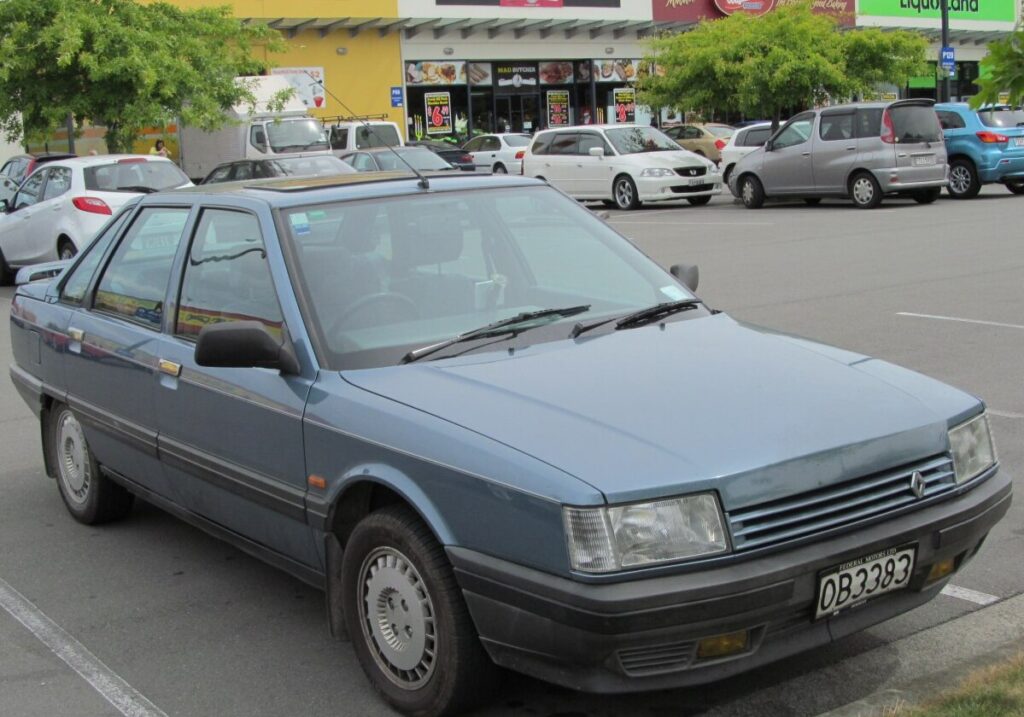
The Renault 21 2.0i Turbo 4×4, produced between 1989 and 1994, represented a performance-oriented variant of Renault’s large family sedan. Falling within the B48 generation of the Renault 21, this model aimed to offer a blend of practicality, comfort, and spirited driving, particularly appealing to those seeking all-weather capability. It occupied a premium position within the 21 lineup, positioned above the naturally aspirated engine options and serving as a flagship for performance before the introduction of the more focused Renault 21 Turbo Quadra. The 21 was Renault’s response to competitors like the Peugeot 405 and Citroën BX, aiming to provide a modern and comfortable driving experience.
Technical Specifications
| Brand | Renault |
| Model | 21 |
| Generation | 21 (B48) |
| Type (Engine) | 2.0 i Turbo (162 Hp) 4×4 |
| Start of production | 1989 |
| End of production | 1994 |
| Powertrain Architecture | Internal Combustion engine |
| Body type | Sedan |
| Seats | 5 |
| Doors | 4 |
| Fuel consumption (urban) | 12 l/100 km (19.6 US mpg) |
| Fuel consumption (extra urban) | 7.4 l/100 km (31.8 US mpg) |
| Fuel consumption (combined) | 8.9 l/100 km (26.4 US mpg) |
| Fuel Type | Petrol (Gasoline) |
| Acceleration 0 – 100 km/h | 8.6 sec |
| Acceleration 0 – 62 mph | 8.6 sec |
| Acceleration 0 – 60 mph | 8.2 sec |
| Maximum speed | 217 km/h (134.84 mph) |
| Weight-to-power ratio | 8.3 kg/Hp |
| Weight-to-torque ratio | 5.2 kg/Nm |
| Power | 162 Hp @ 5500 rpm |
| Torque | 260 Nm @ 3000 rpm (191.77 lb.-ft. @ 3000 rpm) |
| Engine layout | Front, Transverse |
| Engine Model/Code | J7R 756 |
| Engine displacement | 1995 cm3 (121.74 cu. in.) |
| Number of cylinders | 4 |
| Engine configuration | Inline |
| Cylinder Bore | 88 mm (3.46 in.) |
| Piston Stroke | 82 mm (3.23 in.) |
| Compression ratio | 8.5:1 |
| Number of valves per cylinder | 2 |
| Fuel injection system | Multi-port manifold injection |
| Engine aspiration | Turbocharger |
| Valvetrain | OHC |
| Engine oil capacity | 6.5 l (6.87 US qt | 5.72 UK qt) |
| Coolant capacity | 6.2 l (6.55 US qt | 5.46 UK qt) |
| Kerb Weight | 1350 kg (2976.24 lbs.) |
| Max. weight | 1800 kg (3968.32 lbs.) |
| Max load | 450 kg (992.08 lbs.) |
| Trunk (boot) space – minimum | 460 l (16.24 cu. ft.) |
| Fuel tank capacity | 62 l (16.38 US gal | 13.64 UK gal) |
| Length | 4530 mm (178.35 in.) |
| Width | 1730 mm (68.11 in.) |
| Height | 1415 mm (55.71 in.) |
| Wheelbase | 2660 mm (104.72 in.) |
| Front track | 1430 mm (56.3 in.) |
| Rear track | 1400 mm (55.12 in.) |
| Drive wheel | All wheel drive (4×4) |
| Number of gears | 5 gears, manual transmission |
| Front suspension | Spring Strut |
| Rear suspension | Torsion |
| Front brakes | Ventilated discs |
| Rear brakes | Disc |
| Assisting systems | ABS (Anti-lock braking system) |
| Steering type | Steering rack and pinion |
| Power steering | Hydraulic Steering |
| Tires size | 195/55 R15 |
| Wheel rims size | 15 |
Powertrain & Engine Architecture
The heart of the Renault 21 2.0i Turbo 4×4 is the J7R 756 engine, a 1995cc inline-four cylinder powerplant. This engine utilizes a single overhead camshaft (OHC) valvetrain with two valves per cylinder. Crucially, it’s equipped with a Garrett turbocharger and multi-port fuel injection, allowing it to produce 162 horsepower at 5500 rpm and 260 Nm (191.77 lb-ft) of torque at 3000 rpm. The 8.5:1 compression ratio was a compromise between performance and reliability, allowing the engine to run on readily available gasoline. The engine’s transverse mounting within the front-wheel-drive-based chassis contributed to a more compact engine bay. The five-speed manual transmission was the only gearbox option offered with this engine and 4×4 configuration, providing precise control over the engine’s power delivery.
Driving Characteristics
The 2.0i Turbo 4×4 offered a noticeable performance upgrade over the standard Renault 21 models. Acceleration to 60 mph was achieved in approximately 8.2 seconds, and it boasted a top speed of 134.84 mph. The turbocharger provided a distinct surge of power, particularly in the mid-range, making overtaking maneuvers effortless. The all-wheel-drive system enhanced traction, especially on slippery surfaces, providing a more confident driving experience in adverse weather conditions. However, the turbo lag was noticeable, requiring drivers to anticipate power delivery. The gear ratios were well-matched to the engine’s characteristics, providing good acceleration in each gear. Compared to the naturally aspirated 2.0-liter engine, the turbo version offered significantly more power and torque, but at the expense of slightly increased fuel consumption.
Equipment & Trim Levels
The Renault 21 2.0i Turbo 4×4 was generally well-equipped, reflecting its position as a premium variant. Standard features typically included central locking, electric windows, power steering, and an anti-lock braking system (ABS). Interior upholstery was usually a comfortable cloth, with options for leather available. The dashboard featured a comprehensive instrument cluster with gauges for engine temperature, fuel level, and speedometer. Optional extras could include a sunroof, upgraded audio system, and alloy wheels. The interior design prioritized comfort and ergonomics, offering a spacious cabin for both driver and passengers.
Chassis & Braking
The Renault 21 2.0i Turbo 4×4 utilized a spring strut front suspension and a torsion beam rear suspension. This setup provided a good balance between ride comfort and handling. The all-wheel-drive system added weight, but also improved stability and traction. The braking system consisted of ventilated discs on the front wheels and solid discs on the rear, providing adequate stopping power. The hydraulic power steering offered light and precise steering control. The 4×4 system itself was a driver-selectable system, allowing the driver to engage or disengage all-wheel drive as needed.
Market Reception & Comparison
The Renault 21 2.0i Turbo 4×4 was generally well-received by automotive critics, who praised its performance, handling, and all-weather capability. However, some critics noted the turbo lag and the relatively high fuel consumption. Compared to other trims in the Renault 21 lineup, the Turbo 4×4 offered a significant performance advantage, but it also came with a higher price tag. It competed with other turbocharged and all-wheel-drive sedans of the era, such as the Peugeot 405 T16 and the Citroën BX 19 GTI 4×4. In terms of reliability, the J7R engine was generally considered robust, but the turbocharger and all-wheel-drive system added complexity, potentially increasing maintenance costs.
Legacy
The Renault 21 2.0i Turbo 4×4 remains a sought-after model among Renault enthusiasts. While not as common as the standard 21 models, it represents a high-performance and capable variant of a popular family sedan. The J7R engine, while aging, is known for its durability when properly maintained. Today, finding a well-preserved example can be challenging, but these cars offer a unique blend of classic French styling, turbocharged performance, and all-wheel-drive practicality. The 21 Turbo 4×4 serves as a reminder of Renault’s commitment to innovation and performance in the late 1980s and early 1990s.
