
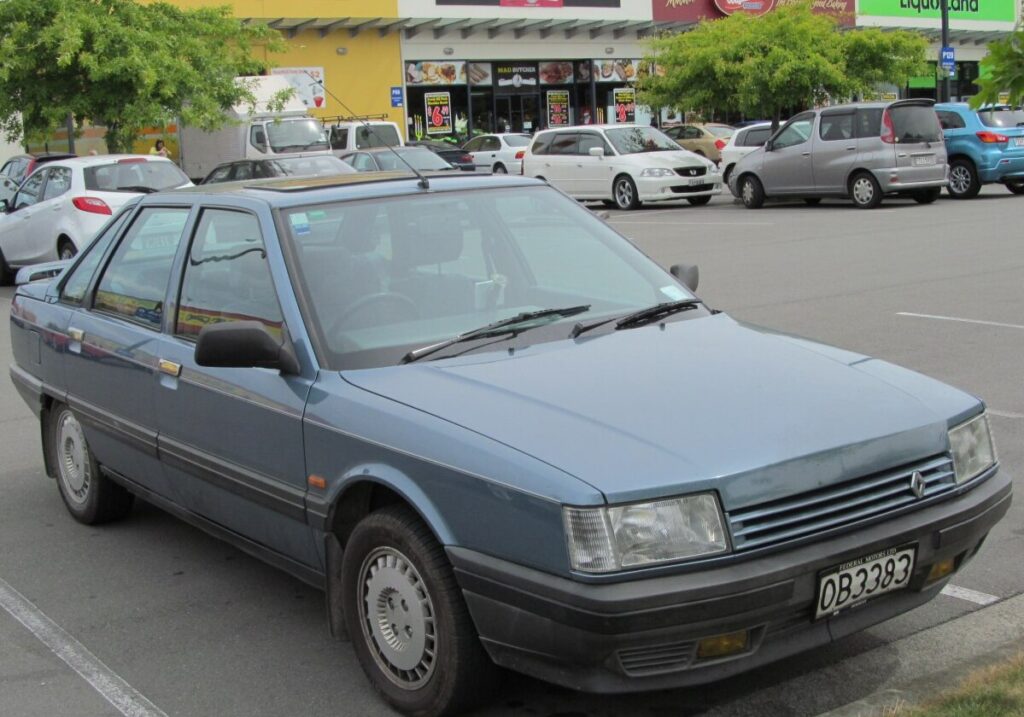
The Renault 21 2.0i Turbo, produced between 1989 and 1994, represented the performance pinnacle of the B48 generation Renault 21 lineup. Positioned as the flagship model, it offered a significant step up in power and driving experience compared to the more common 1.7 and 2.0-liter naturally aspirated versions. The 21, launched in 1986, was Renault’s replacement for the successful Renault 18, aiming to provide a more modern and spacious family sedan. The B48 series, specifically, was a key offering in the European mid-size market, competing with vehicles like the Ford Sierra, Opel Vectra, and Peugeot 405. The 2.0i Turbo variant was particularly aimed at drivers seeking a blend of comfort and spirited performance.
Technical Specifications
| Brand | Renault |
| Model | 21 |
| Generation | 21 (B48) |
| Type (Engine) | 2.0 i Turbo (175 Hp) |
| Start of production | 1989 |
| End of production | 1994 |
| Powertrain Architecture | Internal Combustion engine |
| Body type | Sedan |
| Seats | 5 |
| Doors | 4 |
| Fuel consumption (urban) | 11.3 l/100 km (20.8 US mpg) |
| Fuel consumption (extra urban) | 6.9 l/100 km (34.1 US mpg) |
| Fuel consumption (combined) | 8.3 l/100 km (28.3 US mpg) |
| Fuel Type | Petrol (Gasoline) |
| Acceleration 0 – 100 km/h | 7.4 sec |
| Acceleration 0 – 62 mph | 7.4 sec |
| Acceleration 0 – 60 mph | 7 sec |
| Maximum speed | 227 km/h (141.05 mph) |
| Weight-to-power ratio | 6.9 kg/Hp |
| Weight-to-torque ratio | 4.5 kg/Nm |
| Power | 175 Hp @ 5200 rpm |
| Power per litre | 87.7 Hp/l |
| Torque | 270 Nm @ 3000 rpm (199.14 lb.-ft. @ 3000 rpm) |
| Engine layout | Front, Transverse |
| Engine Model/Code | J7R 752 |
| Engine displacement | 1995 cm3 (121.74 cu. in.) |
| Number of cylinders | 4 |
| Engine configuration | Inline |
| Cylinder Bore | 88 mm (3.46 in.) |
| Piston Stroke | 82 mm (3.23 in.) |
| Compression ratio | 8.1:1 |
| Number of valves per cylinder | 2 |
| Fuel injection system | Multi-port manifold injection |
| Engine aspiration | Turbocharger |
| Valvetrain | OHC |
| Engine oil capacity | 6.5 l (6.87 US qt | 5.72 UK qt) |
| Coolant capacity | 6.2 l (6.55 US qt | 5.46 UK qt) |
| Kerb Weight | 1215 kg (2678.62 lbs.) |
| Trunk (boot) space (minimum) | 490 l (17.3 cu. ft.) |
| Fuel tank capacity | 66 l (17.44 US gal | 14.52 UK gal) |
| Length | 4530 mm (178.35 in.) |
| Width | 1730 mm (68.11 in.) |
| Height | 1415 mm (55.71 in.) |
| Wheelbase | 2660 mm (104.72 in.) |
| Front track | 1430 mm (56.3 in.) |
| Rear track | 1400 mm (55.12 in.) |
| Drivetrain Architecture | Front wheel drive |
| Number of gears | 5 |
| Gearbox type | Manual transmission |
| Front suspension | Independent type McPherson |
| Rear suspension | Torsion |
| Front brakes | Ventilated discs |
| Rear brakes | Disc |
| Assisting systems | ABS (Anti-lock braking system) |
| Steering type | Steering rack and pinion |
| Power steering | Hydraulic |
| Tires size | 195/55 R15 |
| Wheel rims size | 15 |
Powertrain & Engine Architecture
The heart of the Renault 21 2.0i Turbo was the J7R 752 engine, a 1995cc inline-four cylinder unit. This engine featured a single overhead camshaft (OHC) valvetrain with two valves per cylinder. Crucially, it was equipped with a Garrett turbocharger and multi-port fuel injection, allowing it to produce 175 horsepower at 5200 rpm and 270 Nm (199 lb-ft) of torque at 3000 rpm. The 8.1:1 compression ratio was a compromise between performance and reliability, necessary for a turbocharged engine running on the available fuel grades of the time. The engine’s transverse mounting and front-wheel drive configuration were typical for European cars of this era. The five-speed manual transmission was the only gearbox option offered with this engine, designed to handle the increased power output.
Driving Characteristics
The 2.0i Turbo offered a noticeably more engaging driving experience than its naturally aspirated siblings. Acceleration to 60 mph was achieved in around 7 seconds, and it boasted a top speed of 141 mph. The turbocharger provided a surge of power in the mid-range, making overtaking maneuvers effortless. While the gear ratios were well-matched for performance, the turbo lag was noticeable, requiring drivers to anticipate and plan their acceleration. Compared to the 1.7L or 2.0L versions, the 2.0i Turbo demanded more attentive driving, but rewarded the driver with a significantly more dynamic experience. The suspension, while comfortable, was tuned to handle the increased power, offering a reasonable level of body control.
Equipment & Trim Levels
The 2.0i Turbo typically came with a higher level of standard equipment than lower-spec Renault 21 models. This included central locking, electric windows, power steering, and an upgraded interior trim. Upholstery was generally cloth, but leather options were available. Air conditioning was a common optional extra. The dashboard featured a comprehensive instrument cluster, including a boost gauge to monitor turbocharger performance. Higher trim levels often included alloy wheels and a more sophisticated audio system.
Chassis & Braking
The Renault 21 2.0i Turbo utilized an independent McPherson strut suspension at the front and a torsion beam suspension at the rear. This setup provided a good balance between ride comfort and handling. The braking system consisted of ventilated discs at the front and solid discs at the rear, supplemented by an anti-lock braking system (ABS) as standard. The ABS system improved braking performance and stability, particularly in adverse conditions. The steering was rack and pinion with hydraulic assistance, providing precise and responsive control.
Market Reception & Comparison
The Renault 21 2.0i Turbo was generally well-received by automotive critics, who praised its performance and comfortable ride. However, some noted the turbo lag and the relatively high fuel consumption compared to the naturally aspirated models. Compared to rivals like the Ford Sierra 2.0i Turbo and Opel Vectra 2.0 Turbo, the Renault 21 offered a more refined interior and a slightly more comfortable ride, but perhaps lacked the ultimate performance of some competitors. Fuel economy was rated at around 28.3 US mpg combined, which was typical for a turbocharged car of that era.
Legacy
The Renault 21 2.0i Turbo remains a sought-after model among enthusiasts today. The J7R engine, while not without its quirks, is generally considered to be a robust and reliable unit when properly maintained. Finding well-preserved examples can be challenging, as many have succumbed to rust or neglect. However, the 2.0i Turbo offers a unique blend of 1980s/90s French styling, turbocharged performance, and relative affordability, making it an appealing classic car for those seeking a distinctive and engaging driving experience. Parts availability can be an issue, but a dedicated community of owners and specialists exists to support the continued preservation of these vehicles.
