
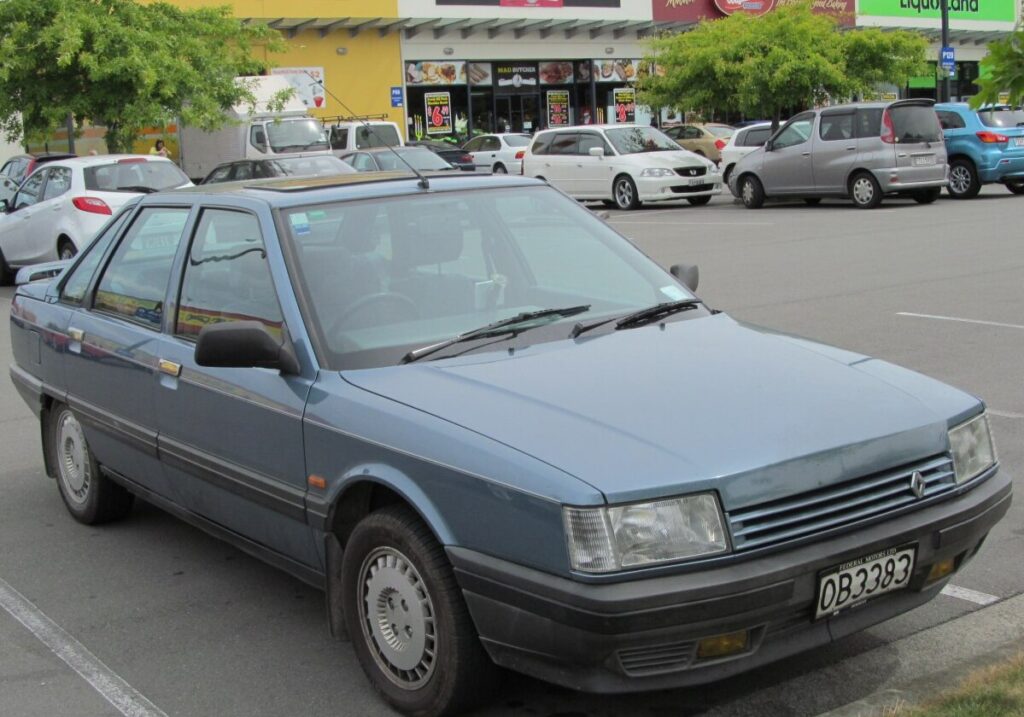
The Renault 21 2.1 D, produced between 1989 and 1994, represented a practical and economical offering within the broader Renault 21 (B48) range. Positioned as a fuel-efficient alternative to the gasoline-powered variants, the 2.1 D catered to drivers prioritizing low running costs and durability. This model was primarily sold in European markets, where diesel engines enjoyed significant popularity due to favorable taxation and fuel prices. It served as a workhorse for families and individuals needing a reliable and spacious sedan.
Technical Specifications
| Brand | Renault |
| Model | 21 |
| Generation | 21 (B48) |
| Type (Engine) | 2.1 D (70 Hp) |
| Start of production | 1989 |
| End of production | 1994 |
| Powertrain Architecture | Internal Combustion engine |
| Body type | Sedan |
| Seats | 5 |
| Doors | 4 |
| Fuel consumption (urban) | 7.5 l/100 km (31.4 US mpg) |
| Fuel consumption (extra urban) | 4.7 l/100 km (50 US mpg) |
| Fuel consumption (combined) | 6.2 l/100 km (37.9 US mpg) |
| Fuel Type | Diesel |
| Acceleration 0 – 100 km/h | 15.1 sec |
| Acceleration 0 – 62 mph | 15.1 sec |
| Acceleration 0 – 60 mph | 14.3 sec |
| Maximum speed | 170 km/h (105.63 mph) |
| Weight-to-power ratio | 15.7 kg/Hp |
| Weight-to-torque ratio | 8.1 kg/Nm |
| Power | 70 Hp @ 4500 rpm |
| Power per litre | 33.8 Hp/l |
| Torque | 136 Nm @ 2250 rpm (100.31 lb.-ft. @ 2250 rpm) |
| Engine layout | Front, Transverse |
| Engine Model/Code | J8S |
| Engine displacement | 2068 cm3 (126.2 cu. in.) |
| Number of cylinders | 4 |
| Engine configuration | Inline |
| Cylinder Bore | 86 mm (3.39 in.) |
| Piston Stroke | 89 mm (3.5 in.) |
| Compression ratio | 21.5:1 |
| Number of valves per cylinder | 2 |
| Fuel injection system | Precombustion chamber injection |
| Engine aspiration | Naturally aspirated engine |
| Valvetrain | OHC |
| Engine oil capacity | 6.1 l (6.45 US qt | 5.37 UK qt) |
| Coolant capacity | 7.1 l (7.5 US qt | 6.25 UK qt) |
| Kerb Weight | 1100 kg (2425.08 lbs.) |
| Max. weight | 1570 kg (3461.26 lbs.) |
| Max load | 470 kg (1036.17 lbs.) |
| Trunk (boot) space – minimum | 490 l (17.3 cu. ft.) |
| Fuel tank capacity | 66 l (17.44 US gal | 14.52 UK gal) |
| Length | 4530 mm (178.35 in.) |
| Width | 1730 mm (68.11 in.) |
| Height | 1415 mm (55.71 in.) |
| Wheelbase | 2660 mm (104.72 in.) |
| Front track | 1430 mm (56.3 in.) |
| Rear track | 1400 mm (55.12 in.) |
| Drivetrain Architecture | Front wheel drive |
| Number of gears | 5 |
| Gearbox type | Manual transmission |
| Front suspension | Spring Strut |
| Rear suspension | Torsion |
| Front brakes | Ventilated discs |
| Rear brakes | Drum |
| Assisting systems | ABS (Anti-lock braking system) |
| Steering type | Steering rack and pinion |
| Power steering | Hydraulic Steering |
| Tires size | 185/55 R15 |
| Wheel rims size | 15 |
INTRODUCTION
The Renault 21 2.1 D, launched in 1989, was a key component of the B48 generation Renault 21 lineup. The B48 replaced the Renault 18 and aimed to offer a more modern and spacious family sedan. The 2.1 D variant specifically targeted buyers seeking a cost-effective and reliable vehicle, particularly in regions where diesel fuel was favored. Production continued until 1994, with the model undergoing minor cosmetic and mechanical updates during its lifespan. It was a direct competitor to vehicles like the Peugeot 405 and Citroën BX in the European market.
Powertrain & Engine Architecture
The heart of the Renault 21 2.1 D is the J8S engine, a 2.1-liter inline-four cylinder diesel. This engine utilized a precombustion chamber injection system, a common technology for diesel engines of the era. This system involved injecting fuel into a small precombustion chamber within the cylinder head, which then ignited the main combustion chamber. The J8S engine featured an overhead camshaft (OHC) valvetrain, operating two valves per cylinder. The engine produced 70 horsepower at 4500 rpm and 136 Nm (100.31 lb-ft) of torque at 2250 rpm. The engine’s relatively low compression ratio of 21.5:1 contributed to its durability. The 2.1 D was exclusively offered with a five-speed manual transmission, prioritizing fuel efficiency over outright performance.
Driving Characteristics
The Renault 21 2.1 D’s driving experience was characterized by its focus on practicality and economy. Acceleration was modest, taking approximately 15.1 seconds to reach 100 km/h (62 mph). Top speed was limited to 170 km/h (105.63 mph). The five-speed manual transmission was geared for maximizing fuel efficiency, with relatively long gear ratios. Compared to the gasoline-powered Renault 21 variants, the 2.1 D offered significantly more torque at lower engine speeds, making it easier to drive in everyday traffic. However, it lacked the responsiveness and higher top-end power of its petrol counterparts. The suspension, tuned for comfort, provided a reasonably smooth ride, although it wasn’t particularly sporty.
Equipment & Trim Levels
The Renault 21 2.1 D typically came with a fairly basic level of equipment, reflecting its position as an entry-level or mid-range model. Standard features generally included power steering, central locking, and a basic stereo system. Interior upholstery was typically cloth, and the dashboard featured a functional, if somewhat dated, design. Optional extras included air conditioning, electric windows, and a sunroof. Higher trim levels, if available, might have added features like alloy wheels and upgraded interior trim. The emphasis was on providing a comfortable and practical interior rather than luxurious appointments.
Chassis & Braking
The Renault 21 2.1 D utilized a front-engine, front-wheel-drive layout. The front suspension employed a MacPherson strut design, while the rear suspension featured a torsion beam. This setup provided a good balance between ride comfort and handling. Braking duties were handled by ventilated discs at the front and drum brakes at the rear. An Anti-lock Braking System (ABS) was often included as standard equipment, enhancing safety. The steering system was a rack and pinion type with hydraulic power assistance, providing relatively light and precise steering feel.
Market Reception & Comparison
The Renault 21 2.1 D was generally well-received in the European market as a practical and economical family car. Critics praised its fuel efficiency and durability, but noted its lack of performance compared to gasoline-powered rivals. Compared to the Renault 21 1.7 or 2.0-liter gasoline models, the 2.1 D offered significantly better fuel economy but slower acceleration. Against competitors like the Peugeot 405 Diesel and Citroën BX Diesel, the Renault 21 2.1 D offered a comparable level of performance and economy, with its appeal often coming down to brand preference and styling. Its reliability was considered average for the period, with some owners reporting issues with the fuel injection system over time.
Legacy
The Renault 21 2.1 D, while not a particularly exciting vehicle, proved to be a reliable and economical workhorse for many owners. The J8S diesel engine, while relatively simple in design, was known for its durability. Today, the Renault 21 2.1 D is a relatively rare sight on the roads, but well-maintained examples are sought after by enthusiasts and collectors. Its simple mechanicals make it relatively easy to maintain and repair. The car represents a snapshot of 1990s European automotive engineering, prioritizing practicality and fuel efficiency over outright performance. The 2.1 D’s legacy lies in its ability to provide affordable and dependable transportation for a generation of drivers.
