
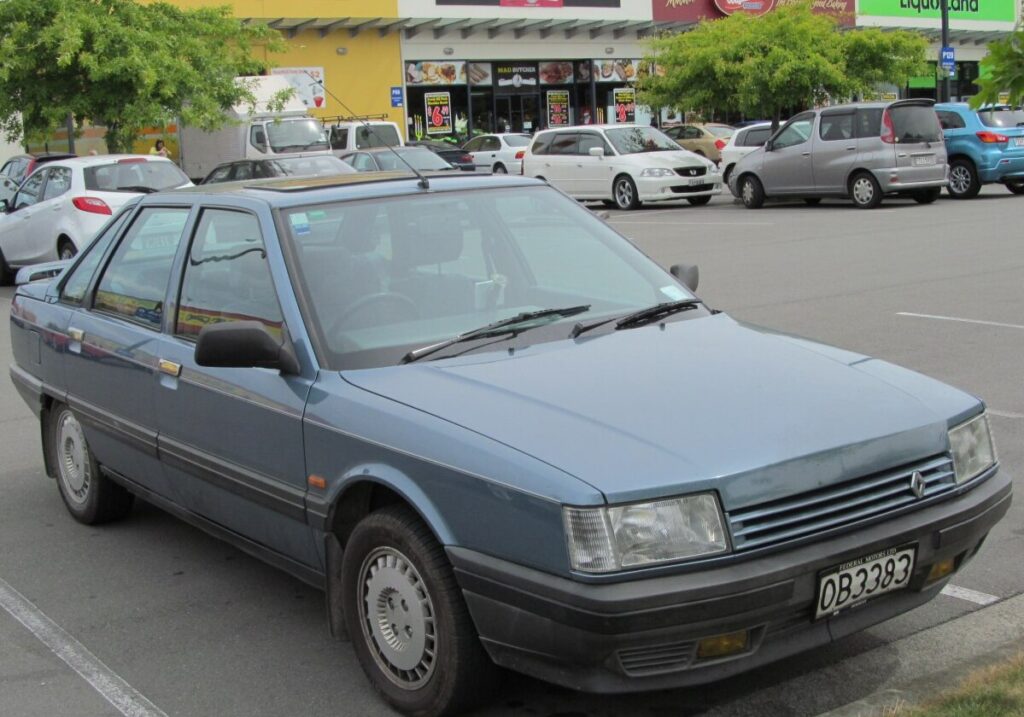
The Renault 21 2.1 D, producing 74 horsepower, was a mainstay of the B48 generation Renault 21 lineup from 1989 to 1993. Positioned as an economical and practical option, it catered to buyers prioritizing fuel efficiency and affordability over outright performance. The B48 series, launched in 1986, represented a significant update to the original Renault 21, offering improved styling, interior comfort, and mechanical refinements. This diesel variant played a crucial role in European markets, where diesel engines were increasingly favored for their lower running costs and suitability for long-distance driving. It was a common sight on French and other European roads, serving as a reliable family sedan.
Technical Specifications
| Brand | Renault |
| Model | 21 |
| Generation | 21 (B48) |
| Type (Engine) | 2.1 D (74 Hp) |
| Start of production | 1989 year |
| End of production | 1993 year |
| Powertrain Architecture | Internal Combustion engine |
| Body type | Sedan |
| Seats | 5 |
| Doors | 4 |
| Fuel consumption (urban) | 7.4 l/100 km (31.8 US mpg, 38.2 UK mpg, 13.5 km/l) |
| Fuel consumption (extra urban) | 4.5 l/100 km (52.3 US mpg, 62.8 UK mpg, 22.2 km/l) |
| Fuel consumption (combined) | 5.9 l/100 km (39.9 US mpg, 47.9 UK mpg, 16.9 km/l) |
| Fuel Type | Diesel |
| Acceleration 0 – 100 km/h | 15.1 sec |
| Acceleration 0 – 62 mph | 15.1 sec |
| Acceleration 0 – 60 mph | 14.3 sec |
| Maximum speed | 170 km/h (105.63 mph) |
| Weight-to-power ratio | 14.9 kg/Hp, 67.3 Hp/tonne |
| Weight-to-torque ratio | 7.9 kg/Nm, 126.4 Nm/tonne |
| Power | 74 Hp @ 4500 rpm |
| Power per litre | 35.8 Hp/l |
| Torque | 139 Nm @ 2250 rpm (102.52 lb.-ft. @ 2250 rpm) |
| Engine layout | Front, Transverse |
| Engine Model/Code | J8S |
| Engine displacement | 2068 cm3 (126.2 cu. in.) |
| Number of cylinders | 4 |
| Engine configuration | Inline |
| Cylinder Bore | 86 mm (3.39 in.) |
| Piston Stroke | 89 mm (3.5 in.) |
| Compression ratio | 21.5:1 |
| Number of valves per cylinder | 2 |
| Fuel injection system | Precombustion chamber injection |
| Engine aspiration | Naturally aspirated engine |
| Valvetrain | OHC |
| Engine oil capacity | 6.1 l (6.45 US qt | 5.37 UK qt) |
| Coolant capacity | 7.1 l (7.5 US qt | 6.25 UK qt) |
| Kerb Weight | 1100 kg (2425.08 lbs.) |
| Max. weight | 1570 kg (3461.26 lbs.) |
| Max load | 470 kg (1036.17 lbs.) |
| Trunk (boot) space – minimum | 490 l (17.3 cu. ft.) |
| Fuel tank capacity | 66 l (17.44 US gal | 14.52 UK gal) |
| Length | 4530 mm (178.35 in.) |
| Width | 1730 mm (68.11 in.) |
| Height | 1415 mm (55.71 in.) |
| Wheelbase | 2660 mm (104.72 in.) |
| Front track | 1430 mm (56.3 in.) |
| Rear (Back) track | 1400 mm (55.12 in.) |
| Drivetrain Architecture | The Internal combustion engine (ICE) drives the front wheels of the vehicle. |
| Drive wheel | Front wheel drive |
| Number of gears and type of gearbox | 5 gears, manual transmission |
| Front suspension | Spring Strut |
| Rear suspension | Torsion |
| Front brakes | Ventilated discs |
| Rear brakes | Drum |
| Assisting systems | ABS (Anti-lock braking system) |
| Steering type | Steering rack and pinion |
| Power steering | Hydraulic Steering |
| Tires size | 175/70 R13 |
| Wheel rims size | 13 |
Powertrain & Engine Architecture
The Renault 21 2.1 D was powered by the J8S engine, a 2.1-liter inline-four diesel. This engine utilized precombustion chamber injection, a common diesel technology of the era. This system involved injecting fuel into a small precombustion chamber connected to the main cylinder, where it was partially ignited before entering the main combustion chamber for complete combustion. This design aided in smoother combustion and reduced engine noise compared to direct injection systems. The engine featured an overhead camshaft (OHC) valvetrain, operating two valves per cylinder. The 2.1-liter diesel produced 74 horsepower at 4500 rpm and 139 Nm (102.52 lb-ft) of torque at 2250 rpm. The engine was transversely mounted in the front of the vehicle, driving the front wheels. The transmission was a five-speed manual, the only option available with this engine.
Driving Characteristics
The 2.1 D variant of the Renault 21 was not designed for sporty driving. Acceleration was leisurely, taking approximately 15.1 seconds to reach 62 mph (100 km/h). The focus was on fuel economy and relaxed cruising. The engine’s torque peak at 2250 rpm provided adequate pulling power for everyday driving, but required frequent downshifts when overtaking or climbing hills. Compared to the gasoline-powered Renault 21 variants, the 2.1 D offered significantly better fuel economy but lacked the responsiveness and higher top speed. The five-speed manual transmission was well-matched to the engine’s characteristics, offering a reasonable spread of gears for efficient operation. The gear ratios were optimized for maximizing fuel economy rather than achieving quick acceleration.
Equipment & Trim Levels
The 2.1 D trim level of the Renault 21 was generally considered the entry-level diesel offering. Standard equipment typically included basic cloth upholstery, a simple dashboard layout, and manual windows and door locks. Power steering was often included, but air conditioning and central locking were usually optional extras. The interior was functional and durable, prioritizing practicality over luxury. Optional extras could include upgraded audio systems, alloy wheels, and metallic paint finishes. The trim level was designed to appeal to budget-conscious buyers who needed a reliable and economical family car.
Chassis & Braking
The Renault 21 2.1 D utilized a relatively simple chassis design. The front suspension consisted of MacPherson strut springs, while the rear suspension employed a torsion beam setup. This configuration provided a comfortable ride, but handling was not particularly sharp. The braking system featured ventilated discs on the front wheels and drum brakes on the rear. An Anti-lock Braking System (ABS) was available as an option, enhancing safety by preventing wheel lockup during hard braking. The steering was rack and pinion, providing reasonable precision, although it lacked the feel of more sophisticated steering systems.
Market Reception & Comparison
The Renault 21 2.1 D was well-received in European markets as a practical and economical family car. Critics praised its fuel efficiency and reliability, but noted its lack of performance. Compared to other diesel-powered sedans of the time, such as the Peugeot 405 and Citroën BX, the Renault 21 2.1 D offered a competitive combination of price, fuel economy, and practicality. The gasoline-powered Renault 21 variants, particularly the 2.0-liter and 2.2-liter models, offered significantly more performance but at the cost of higher fuel consumption and a higher purchase price. The 2.1 D was often chosen by drivers who prioritized running costs over driving excitement.
Legacy
The Renault 21 2.1 D powertrain, while not known for groundbreaking innovation, proved to be remarkably durable and reliable. Many examples remain on the road today, testament to the engine’s robust construction and relatively simple design. In the used car market, these vehicles are often sought after by those looking for an affordable and dependable classic car. Maintenance is generally straightforward, and parts availability remains reasonable. However, potential buyers should be aware of the age-related issues common to older diesel engines, such as injector wear and potential issues with the precombustion chambers. The Renault 21 2.1 D represents a significant chapter in the history of affordable European motoring, offering a practical and economical transportation solution for a generation of drivers.
