
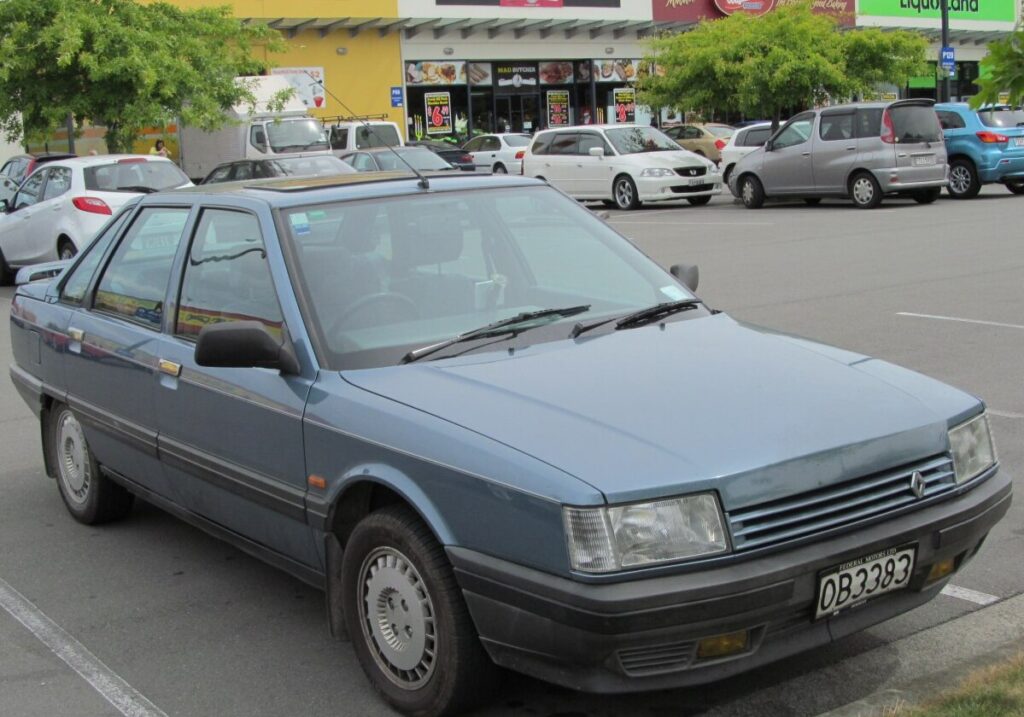
The Renault 21 2.2 i, produced between 1989 and 1993, represented a mid-range offering within the B48 generation of Renault’s popular family sedan. Positioned above the base models with smaller engines, but below the more luxurious and powerful versions, the 2.2 i aimed to provide a balance of performance, comfort, and affordability for European buyers. The B48 series, launched in 1986, was a significant update to the original Renault 21, offering improved styling, interior refinement, and mechanical enhancements. This variant played a key role in maintaining the 21’s market share in a competitive segment dominated by vehicles like the Peugeot 405 and Citroën BX.
Technical Specifications
| Brand | Renault |
| Model | 21 |
| Generation | 21 (B48) |
| Type (Engine) | 2.2 i (110 Hp) |
| Start of production | 1989 |
| End of production | 1993 |
| Powertrain Architecture | Internal Combustion engine |
| Body type | Sedan |
| Seats | 5 |
| Doors | 4 |
| Fuel consumption (urban) | 11.8 l/100 km (19.9 US mpg, 23.9 UK mpg, 8.5 km/l) |
| Fuel consumption (extra urban) | 6.5 l/100 km (36.2 US mpg, 43.5 UK mpg, 15.4 km/l) |
| Fuel consumption (combined) | 7.9 l/100 km (29.8 US mpg, 35.8 UK mpg, 12.7 km/l) |
| Fuel Type | Petrol (Gasoline) |
| Acceleration 0 – 100 km/h | 10.8 sec |
| Acceleration 0 – 62 mph | 10.8 sec |
| Acceleration 0 – 60 mph | 10.3 sec |
| Maximum speed | 192 km/h (119.3 mph) |
| Weight-to-power ratio | 9.8 kg/Hp, 101.9 Hp/tonne |
| Weight-to-torque ratio | 6.4 kg/Nm, 156.5 Nm/tonne |
| Power | 110 Hp @ 5000 rpm |
| Power per litre | 50.8 Hp/l |
| Torque | 169 Nm @ 3500 rpm (124.65 lb.-ft. @ 3500 rpm) |
| Engine layout | Front, Transverse |
| Engine Model/Code | J7T 754, J7T 755 |
| Engine displacement | 2165 cm3 (132.12 cu. in.) |
| Number of cylinders | 4 |
| Engine configuration | Inline |
| Cylinder Bore | 88 mm (3.46 in.) |
| Piston Stroke | 89 mm (3.5 in.) |
| Compression ratio | 9.5:1 |
| Number of valves per cylinder | 2 |
| Fuel injection system | Multi-port manifold injection |
| Engine aspiration | Naturally aspirated engine |
| Valvetrain | OHC |
| Engine oil capacity | 6.5 l (6.87 US qt | 5.72 UK qt) |
| Coolant capacity | 5.7 l (6.02 US qt | 5.02 UK qt) |
| Kerb Weight | 1080 kg (2380.99 lbs.) |
| Max. weight | 1570 kg (3461.26 lbs.) |
| Max load | 490 kg (1080.27 lbs.) |
| Trunk (boot) space – minimum | 490 l (17.3 cu. ft.) |
| Fuel tank capacity | 66 l (17.44 US gal | 14.52 UK gal) |
| Length | 4530 mm (178.35 in.) |
| Width | 1730 mm (68.11 in.) |
| Height | 1415 mm (55.71 in.) |
| Wheelbase | 2660 mm (104.72 in.) |
| Front track | 1430 mm (56.3 in.) |
| Rear (Back) track | 1400 mm (55.12 in.) |
| Drivetrain Architecture | The Internal combustion engine (ICE) drives the front wheels of the vehicle. |
| Drive wheel | Front wheel drive |
| Number of gears and type of gearbox | 5 gears, manual transmission |
| Front suspension | Spring Strut |
| Rear suspension | Torsion |
| Front brakes | Ventilated discs |
| Rear brakes | Drum |
| Assisting systems | ABS (Anti-lock braking system) |
| Steering type | Steering rack and pinion |
| Power steering | Hydraulic Steering |
| Tires size | 185/65 R14 |
| Wheel rims size | 14 |
Powertrain & Engine Architecture
The Renault 21 2.2 i was powered by the J7T engine, specifically the J7T 754 or J7T 755 variants. This was a naturally aspirated, inline-four cylinder engine displacing 2165cc. It featured a single overhead camshaft (OHC) valvetrain with two valves per cylinder. The engine utilized multi-port fuel injection, a relatively modern technology for the time, contributing to improved fuel efficiency and smoother power delivery compared to carbureted engines. The 2.2-liter engine produced 110 horsepower at 5000 rpm and 169 Nm (124.65 lb-ft) of torque at 3500 rpm. The engine’s design prioritized reliability and ease of maintenance, typical of Renault’s engineering philosophy during this period. The manual transmission offered with this model was a five-speed unit, designed to efficiently transfer power to the front wheels.
Driving Characteristics
The 2.2 i variant of the Renault 21 offered a noticeable step up in performance compared to the smaller-engined models. While not a sports sedan, the 110 hp engine provided adequate power for comfortable cruising and overtaking on highways. Acceleration from 0 to 60 mph took around 10.3 seconds, and it could reach a top speed of 119.3 mph. The five-speed manual transmission allowed drivers to keep the engine in its optimal power band, providing a more engaging driving experience than the optional automatic transmission. The gear ratios were well-chosen for everyday driving, offering a balance between acceleration and fuel economy. Compared to the more powerful Renault 21 Turbo, the 2.2 i lacked the outright punch of the turbocharged engine, but it offered a more linear and predictable power delivery.
Equipment & Trim Levels
The Renault 21 2.2 i typically came equipped with a reasonable level of standard features. Interior upholstery was usually cloth, with options for upgraded materials available. The dashboard layout was functional and straightforward, with clear instrumentation. Standard equipment included power steering, central locking, and an AM/FM radio. Optional extras included air conditioning, electric windows, and a sunroof. The trim level often dictated the availability of these options, with higher trims offering more features as standard. The 2.2 i generally occupied a mid-range position in the Renault 21 lineup, offering a good balance of features and price.
Chassis & Braking
The Renault 21 2.2 i utilized a front-wheel-drive layout with a relatively simple suspension setup. The front suspension consisted of MacPherson strut springs, while the rear suspension employed a torsion beam. This configuration provided a comfortable ride quality, suitable for long-distance journeys. Braking duties were handled by ventilated discs at the front and drum brakes at the rear. An anti-lock braking system (ABS) was available as an option, enhancing safety by preventing wheel lockup during hard braking. The steering was rack and pinion, providing precise and responsive handling. The tires were typically 185/65 R14, offering a good compromise between grip and ride comfort.
Market Reception & Comparison
The Renault 21 2.2 i was generally well-received by automotive critics as a practical and comfortable family sedan. It was praised for its spacious interior, comfortable ride, and relatively fuel-efficient engine. However, some critics noted that the styling was somewhat conservative compared to its rivals. Compared to the smaller-engined Renault 21 models, the 2.2 i offered a significant improvement in performance. Compared to the Renault 21 Turbo, it was less powerful but more affordable and easier to drive. Fuel economy was competitive with other vehicles in its class, averaging around 29.8 US mpg on the combined cycle. Reliability was generally good, although some owners reported minor issues with the electrical system.
Legacy
The Renault 21 2.2 i remains a relatively common sight on European roads today, testament to its durability and reliability. The J7T engine is known for its robustness and relatively simple construction, making it relatively easy to maintain. Used examples are typically affordable, making them an attractive option for budget-conscious buyers. While not a particularly collectible model, the Renault 21 2.2 i represents a significant chapter in Renault’s history, offering a glimpse into the design and engineering of the late 1980s and early 1990s. The car’s enduring popularity is a reflection of its practicality, comfort, and overall value.
