
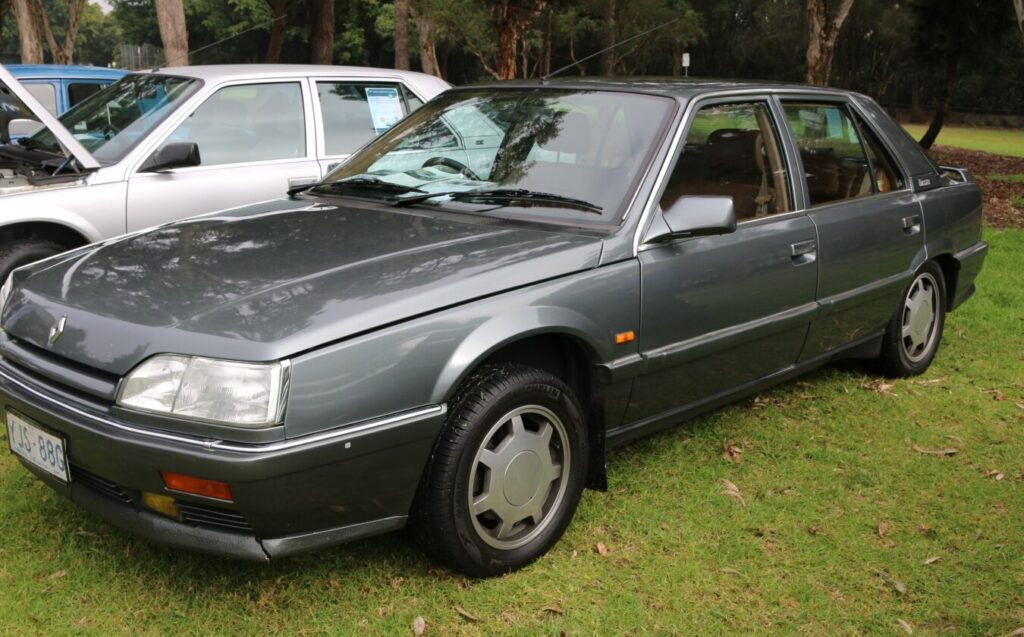
The Renault 25 (B29) 2.0i, produced between 1986 and 1992, represented a significant offering in the large family car segment for Renault. Positioned as a more accessible variant within the 25 range, the 2.0i with its 120 horsepower engine and typically paired with a manual transmission (though automatic options existed) aimed to balance performance with affordability. It was a key model in Renault’s lineup during a period of modernization and expansion, competing with vehicles like the Ford Granada and Peugeot 505 in European markets. The B29 chassis underpinned the entire 25 range, offering a blend of comfort and practicality for family transportation.
Technical Specifications
| Brand | Renault |
| Model | 25 |
| Generation | 25 (B29) |
| Type (Engine) | 2.0 i (120 Hp) |
| Start of production | 1986 |
| End of production | 1992 |
| Powertrain Architecture | Internal Combustion engine |
| Body type | Hatchback |
| Seats | 5 |
| Doors | 5 |
| Fuel consumption (urban) | 10.9 l/100 km (21.6 US mpg) |
| Fuel consumption (extra urban) | 6 l/100 km (39.2 US mpg) |
| Fuel consumption (combined) | 7.4 l/100 km (31.8 US mpg) |
| Fuel Type | Petrol (Gasoline) |
| Acceleration 0 – 100 km/h | 10.7 sec |
| Acceleration 0 – 62 mph | 10.7 sec |
| Acceleration 0 – 60 mph | 10.2 sec |
| Maximum speed | 195 km/h (121.17 mph) |
| Weight-to-power ratio | 9.8 kg/Hp |
| Weight-to-torque ratio | 7 kg/Nm |
| Power | 120 Hp @ 5500 rpm |
| Torque | 168 Nm @ 4500 rpm (123.91 lb.-ft. @ 4500 rpm) |
| Engine layout | Front, Transverse |
| Engine Model/Code | J7R |
| Engine displacement | 1995 cm3 (121.74 cu. in.) |
| Number of cylinders | 4 |
| Engine configuration | Inline |
| Cylinder Bore | 88 mm (3.46 in.) |
| Piston Stroke | 82 mm (3.23 in.) |
| Compression ratio | 10:1 |
| Number of valves per cylinder | 2 |
| Fuel injection system | Multi-port manifold injection |
| Engine aspiration | Naturally aspirated |
| Valvetrain | OHC |
| Engine oil capacity | 5.3 l (5.6 US qt | 4.66 UK qt) |
| Coolant capacity | 7.3 l (7.71 US qt | 6.42 UK qt) |
| Kerb Weight | 1180 kg (2601.45 lbs.) |
| Max. weight | 1690 kg (3725.81 lbs.) |
| Max load | 510 kg (1124.36 lbs.) |
| Trunk (boot) space – minimum | 440 l (15.54 cu. ft.) |
| Trunk (boot) space – maximum | 1240 l (43.79 cu. ft.) |
| Fuel tank capacity | 72 l (19.02 US gal | 15.84 UK gal) |
| Length | 4715 mm (185.63 in.) |
| Width | 1805 mm (71.06 in.) |
| Height | 1415 mm (55.71 in.) |
| Wheelbase | 2725 mm (107.28 in.) |
| Front track | 1495 mm (58.86 in.) |
| Rear track | 1475 mm (58.07 in.) |
| Drivetrain Architecture | Front wheel drive |
| Number of gears | 5 |
| Gearbox type | Manual transmission |
| Front suspension | Coil spring |
| Rear suspension | Coil spring |
| Front brakes | Disc |
| Rear brakes | Drum |
| Assisting systems | ABS (Anti-lock braking system) |
| Steering type | Steering rack and pinion |
| Power steering | Hydraulic |
| Tires size | 185/70 R14 |
| Wheel rims size | 14 |
INTRODUCTION
The Renault 25 2.0i, launched in 1986, was a crucial part of Renault’s strategy to offer a comfortable and relatively affordable large car. Building upon the success of the original Renault 25 introduced in 1984, the 2.0i variant aimed to broaden the model’s appeal. It slotted into the lineup below the more powerful V6 models, offering a balance between performance and fuel economy. The B29 platform, shared with other Renault models of the era, provided a solid foundation for the car’s comfort-oriented design. The 2.0i was primarily marketed towards families and individuals seeking a spacious and well-equipped vehicle for long-distance travel.
Powertrain & Engine Architecture
The heart of the Renault 25 2.0i was the J7R engine, a 1995cc inline-four cylinder gasoline engine. This engine featured a single overhead camshaft (OHC) valvetrain with two valves per cylinder. Fuel delivery was handled by a multi-port fuel injection system, a significant upgrade over earlier carbureted Renault engines, improving efficiency and responsiveness. The J7R engine produced 120 horsepower at 5500 rpm and 168 Nm (124 lb-ft) of torque at 4500 rpm. While not a high-performance engine, it provided adequate power for comfortable cruising and everyday driving. The engine was transversely mounted, driving the front wheels. The most common transmission pairing was a five-speed manual gearbox, although a three-speed automatic transmission was also available, albeit less common. The automatic transmission, while offering convenience, did impact acceleration and fuel economy.
Driving Characteristics
The Renault 25 2.0i offered a comfortable and refined driving experience, prioritizing ride quality over sporty handling. The suspension, featuring coil springs all around, effectively absorbed bumps and irregularities in the road surface. The steering, while hydraulic assisted, lacked the directness of some competitors. With 120 horsepower, the 2.0i wasn’t particularly quick, taking around 10.7 seconds to reach 62 mph (100 km/h). The manual transmission allowed for more driver control and slightly improved acceleration, while the automatic version felt more relaxed but less engaging. The gear ratios were tuned for fuel efficiency and comfortable cruising, rather than outright performance. Compared to the V6 versions, the 2.0i felt noticeably less powerful, especially when fully loaded or tackling steep inclines.
Equipment & Trim Levels
The Renault 25 2.0i typically came with a reasonable level of standard equipment. This included central locking, electric front windows, and a basic stereo system. Interior upholstery was usually cloth, with options for upgraded velour or leather available on higher trim levels. Dashboard design was functional and straightforward, with clear instrumentation. Optional extras included air conditioning, a sunroof, and upgraded sound systems. The 2.0i often served as a base for more luxurious trims, with additional features added as packages. The interior space was generous, offering ample room for five passengers and a sizable trunk.
Chassis & Braking
The Renault 25 B29 chassis featured a front-engine, front-wheel-drive layout. The front suspension utilized independent coil springs, while the rear suspension employed a twist-beam axle with coil springs. Braking was handled by disc brakes on the front wheels and drum brakes on the rear wheels. An Anti-lock Braking System (ABS) was available as an option, enhancing safety and control during emergency braking. The steering system was a rack and pinion setup with hydraulic power assistance. The tires were typically 185/70 R14, providing a good balance between comfort and grip. The rear drum brakes were a cost-saving measure, and while adequate for normal driving, they lacked the stopping power of disc brakes.
Market Reception & Comparison
The Renault 25 2.0i was generally well-received by automotive critics as a comfortable and practical family car. However, it wasn’t considered a particularly exciting or dynamic vehicle. Critics praised its spacious interior, comfortable ride, and reasonable fuel economy. Compared to the V6 models, the 2.0i offered a more affordable entry point into the Renault 25 range, but at the expense of performance. Fuel economy was competitive for its class, averaging around 31.8 US mpg (38.2 UK mpg) on the combined cycle. Reliability was generally good, although some owners reported issues with the electrical system and the automatic transmission. Compared to rivals like the Ford Granada and Peugeot 505, the Renault 25 2.0i offered a more modern design and a more comfortable interior.
Legacy
The Renault 25 2.0i, while not a particularly rare or collectible car today, remains a popular choice among classic car enthusiasts seeking a comfortable and affordable vintage vehicle. The J7R engine is known for its durability and relative simplicity, making it relatively easy to maintain. However, finding parts can be challenging as the car is now over 30 years old. The automatic transmission, if present, is often the first component to require attention. Well-maintained examples of the 2.0i can still provide years of reliable service, offering a nostalgic driving experience and a glimpse into the automotive landscape of the 1980s. The Renault 25, in general, is remembered as a comfortable and spacious family car that helped modernize Renault’s image.
