
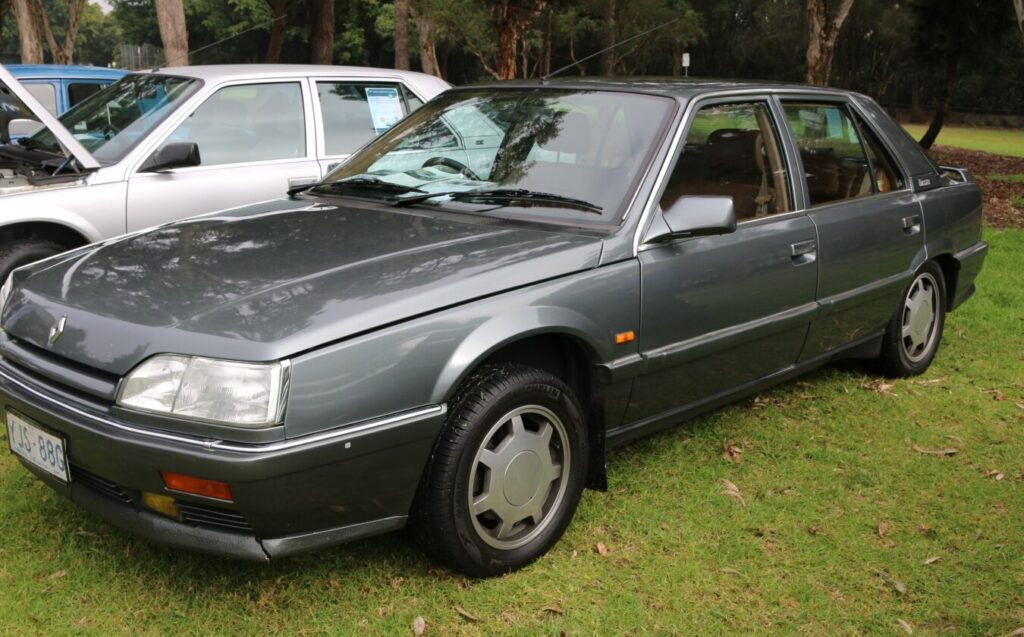
The Renault 25 (B29) 2.1 D, produced between 1988 and 1993, represented a practical and economical offering within the Renault 25 range. Positioned as the diesel variant, it catered to drivers prioritizing fuel efficiency and long-distance comfort over outright performance. The B29 generation Renault 25, launched in 1984, was Renault’s flagship executive car, intended to replace the Renault 30. The 2.1 D model, with its relatively modest 70 horsepower, served as the entry point into the 25 lineup for buyers seeking a larger, more comfortable vehicle without the expense of the gasoline engines.
POWERTRAIN & ENGINE ARCHITECTURE
The Renault 25 2.1 D was powered by the J8S engine, a 2.1-liter inline four-cylinder diesel. This engine utilized precombustion chamber injection, a common diesel technology of the era, to improve combustion efficiency and reduce noise. The J8S engine produced 70 horsepower at 4500 rpm and 136 Nm (100.31 lb-ft) of torque at 2250 rpm. The engine featured an overhead camshaft (OHC) valvetrain with two valves per cylinder. The 2.1 D was exclusively offered with a five-speed manual transmission, designed to maximize fuel economy and provide reasonable acceleration given the engine’s output. The engine’s relatively low compression ratio of 21.5:1 contributed to its durability and ability to run on lower-quality diesel fuel, a consideration for European markets at the time.
DRIVING CHARACTERISTICS
The driving experience in the Renault 25 2.1 D was characterized by its relaxed nature. Acceleration was deliberately unhurried, taking approximately 17.5 seconds to reach 100 km/h (62 mph) and 16.6 seconds to 60 mph. The five-speed manual transmission allowed drivers to keep the engine within its optimal torque band, making it suitable for highway cruising and long journeys. While not a sporty vehicle, the 2.1 D offered a comfortable ride and predictable handling. Compared to the more powerful gasoline-powered Renault 25 variants, the diesel model prioritized fuel economy and low-speed torque over outright speed and responsiveness. The gear ratios were optimized for maximizing fuel efficiency, resulting in a higher final drive ratio compared to the petrol models.
EQUIPMENT & TRIM LEVELS
The Renault 25 2.1 D typically came with a reasonable level of standard equipment, reflecting its position as a mainstream executive car. Standard features generally included power steering, front disc brakes, and a comfortable interior with cloth upholstery. Trim levels varied depending on the market, but generally offered options such as central locking, electric windows, and an upgraded audio system. The dashboard layout was typical of the era, featuring analog gauges and a functional, if somewhat dated, design. Optional extras included a sunroof, air conditioning, and metallic paint finishes. Interior color schemes were generally conservative, with shades of grey and blue being common.
CHASSIS & BRAKING
The Renault 25 2.1 D utilized a coil spring suspension system at both the front and rear, providing a comfortable ride quality. The front brakes were discs, while the rear brakes were drums, a common configuration for vehicles in this class during the late 1980s and early 1990s. Hydraulic power steering was standard, making maneuvering easier, particularly in urban environments. The car’s relatively modest weight of 1190 kg (2623.5 lbs) helped to offset the engine’s limited power output. Tire size was typically 185/70 R14, mounted on 14-inch steel wheels.
MARKET RECEPTION & COMPARISON
The Renault 25 2.1 D was generally well-received by critics as a practical and economical choice within the executive car segment. It was praised for its fuel efficiency, comfortable ride, and spacious interior. However, its relatively slow acceleration and somewhat agricultural diesel engine were points of criticism. Compared to other diesel-powered executive cars of the time, such as the Peugeot 505 and Citroën CX, the Renault 25 2.1 D offered a competitive combination of fuel economy, comfort, and price. Fuel consumption figures were approximately 7.1 l/100 km (33.1 US mpg) combined, making it an attractive option for high-mileage drivers.
LEGACY
The J8S diesel engine proved to be a durable and reliable unit, and many Renault 25 2.1 D models remain on the road today. While parts availability can be a challenge due to the car’s age, the engine’s robust construction and relatively simple design contribute to its longevity. In the used car market, the Renault 25 2.1 D is often sought after by enthusiasts looking for a classic French car with a practical and economical diesel engine. It represents a unique blend of 1980s styling, comfortable ride quality, and fuel-efficient diesel power.
| Brand | Renault |
| Model | 25 |
| Generation | 25 (B29) |
| Type (Engine) | 2.1 D (70 Hp) |
| Start of production | 1988 |
| End of production | 1993 |
| Powertrain Architecture | Internal Combustion engine |
| Body type | Hatchback |
| Seats | 5 |
| Doors | 5 |
| Fuel consumption (urban) | 8.7 l/100 km (27 US mpg) |
| Fuel consumption (extra urban) | 5.2 l/100 km (45.2 US mpg) |
| Fuel consumption (combined) | 7.1 l/100 km (33.1 US mpg) |
| Fuel Type | Diesel |
| Acceleration 0 – 100 km/h | 17.5 sec |
| Acceleration 0 – 60 mph | 16.6 sec |
| Maximum speed | 165 km/h (102.53 mph) |
| Power | 70 Hp @ 4500 rpm |
| Torque | 136 Nm @ 2250 rpm (100.31 lb.-ft. @ 2250 rpm) |
| Engine layout | Front, Transverse |
| Engine Model/Code | J8S |
| Engine displacement | 2068 cm3 (126.2 cu. in.) |
| Number of cylinders | 4 |
| Cylinder Bore | 86 mm (3.39 in.) |
| Piston Stroke | 89 mm (3.5 in.) |
| Compression ratio | 21.5:1 |
| Fuel injection system | Precombustion chamber injection |
| Engine oil capacity | 6 l (6.34 US qt | 5.28 UK qt) |
| Coolant capacity | 7.5 l (7.93 US qt | 6.6 UK qt) |
| Kerb Weight | 1190 kg (2623.5 lbs.) |
| Max. weight | 1650 kg (3637.63 lbs.) |
| Trunk (boot) space (min) | 440 l (15.54 cu. ft.) |
| Trunk (boot) space (max) | 1240 l (43.79 cu. ft.) |
| Fuel tank capacity | 72 l (19.02 US gal | 15.84 UK gal) |
| Length | 4715 mm (185.63 in.) |
| Width | 1805 mm (71.06 in.) |
| Height | 1415 mm (55.71 in.) |
| Wheelbase | 2725 mm (107.28 in.) |
| Number of gears | 5 |
| Gearbox type | Manual transmission |
