
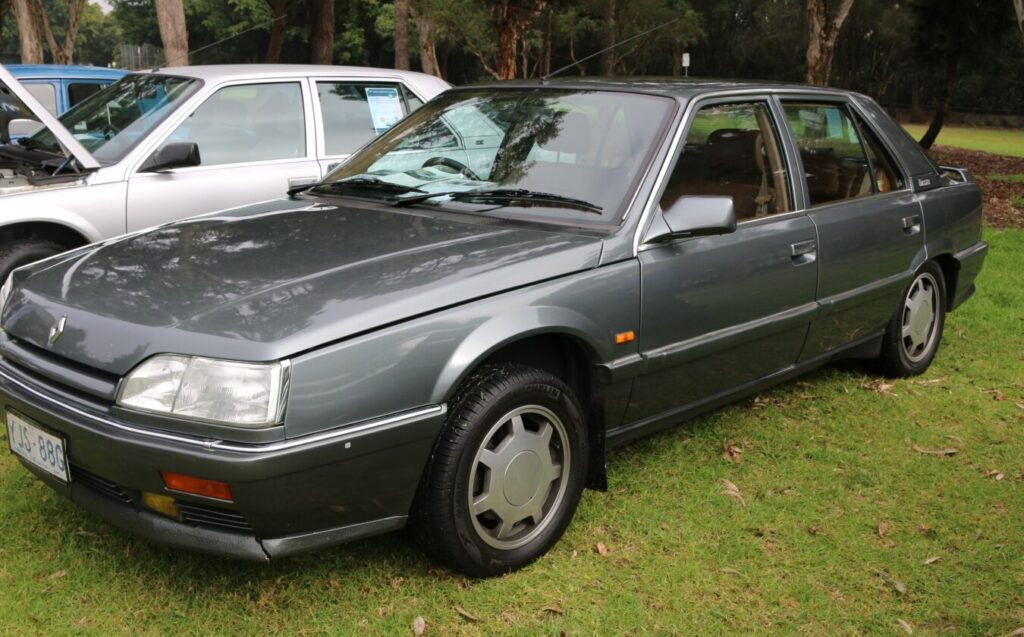
The Renault 25 (B29) 2.85 i V6, produced between 1988 and 1993, represented the top-of-the-line performance variant of Renault’s executive hatchback. Positioned as the flagship model within the B29 generation, which itself was a significant update to the original Renault 25 launched in 1984, the 2.85 i V6 offered a substantial increase in power and refinement compared to the lower-spec 1.8 and 2.0-liter four-cylinder models. The B29 series was built on the Renault 25 platform, known for its spacious interior and comfortable ride, aiming to compete with vehicles like the Ford Granada and Opel/Vauxhall Senator in the European market.
Powertrain & Engine Architecture
The heart of the Renault 25 2.85 i V6 is the Z7W engine, a 2.849-liter (173.86 cubic inches) naturally aspirated V6. This engine is characterized by its 60-degree V-angle configuration, contributing to a relatively compact engine bay footprint. The Z7W utilizes a cast iron block and aluminum cylinder heads, a common construction for the era balancing durability with weight reduction. Fuel delivery is managed by a Bosch multi-port fuel injection system, providing precise fuel metering for improved efficiency and performance. The engine features an overhead camshaft (OHC) valvetrain with two valves per cylinder.
The engine produces 153 horsepower at 5400 rpm and 235 Nm (173.33 lb-ft) of torque at 2500 rpm. While Renault offered both manual and automatic transmissions with the 2.85 i V6, this article focuses on the 5-speed manual transmission variant, which was the more common configuration. The gearbox is a conventional manual unit, designed to handle the V6’s increased power output. The engine oil capacity is 5.5 liters (5.81 US quarts / 4.84 UK quarts), and the coolant capacity is 9.5 liters (10.04 US quarts / 8.36 UK quarts).
Engine Code Specifics
The Z7W engine code is specific to this 2.85-liter V6 configuration. Earlier Renault 25 V6 models used a different engine variant. The Z7W benefitted from incremental improvements over its predecessors, including revised fuel injection mapping and minor adjustments to the valve timing, contributing to its increased power output and improved drivability. The engine’s longitudinal front-engine layout was a key characteristic of the Renault 25, influencing its handling characteristics and weight distribution.
Driving Characteristics
The Renault 25 2.85 i V6 offered a noticeably more engaging driving experience than its four-cylinder counterparts. Acceleration from 0 to 100 km/h (0-62 mph) takes approximately 7.4 seconds, and it can achieve a top speed of 233 km/h (144.78 mph). The V6 engine delivers a smooth and linear power delivery, with ample torque available throughout the rev range. This makes it well-suited for both relaxed cruising and more spirited driving. The 5-speed manual transmission allows the driver to fully exploit the engine’s power, providing precise gear changes and a direct connection to the drivetrain. Compared to the automatic transmission option, the manual version offers improved acceleration and fuel economy. The front-wheel-drive configuration provides good traction in most conditions, although torque steer can be noticeable under hard acceleration.
Equipment & Trim Levels
The 2.85 i V6 was typically equipped with a high level of standard features, reflecting its position as the range-topping model. Interior appointments included comfortable cloth or velour upholstery, often in a distinctive pattern. Power windows, central locking, and a high-quality stereo system were standard. Optional extras included leather upholstery, a sunroof, and upgraded audio systems. The dashboard layout was typically finished with wood trim, adding to the car’s luxurious feel. Safety features included ABS (Anti-lock Braking System), which was becoming increasingly common on executive cars of this era. The exterior styling was generally consistent across the B29 range, but the 2.85 i V6 often featured alloy wheels and subtle badging to distinguish it from the lower-spec models.
Chassis & Braking
The Renault 25 B29 utilized a coil spring suspension system at both the front and rear, providing a comfortable and compliant ride. The front suspension featured independent MacPherson struts, while the rear suspension employed a semi-independent twist beam setup. The braking system consisted of ventilated discs at the front and discs at the rear, providing adequate stopping power for the car’s weight and performance. The steering was a hydraulic power-assisted rack and pinion system, offering precise and responsive steering feel. The standard tire size was 195/60 R15, mounted on 15-inch wheels. The chassis was designed to balance comfort and handling, prioritizing a smooth ride over outright sporty performance.
Market Reception & Comparison
The Renault 25 2.85 i V6 was generally well-received by automotive critics, who praised its smooth engine, comfortable ride, and spacious interior. However, some critics noted that the car’s styling was somewhat dated compared to its rivals. Fuel economy was a common criticism, with combined fuel consumption figures of around 9.3 l/100 km (25.3 US mpg / 30.4 UK mpg). Compared to the 1.8 and 2.0-liter models, the 2.85 i V6 offered significantly improved performance but at the cost of increased fuel consumption and a higher purchase price. In terms of reliability, the Z7W engine was generally considered to be robust, but regular maintenance was essential to prevent issues. The Renault 25 2.85 i V6 offered a compelling alternative to more established executive cars from German manufacturers, providing a unique blend of French flair and practicality.
Technical Specifications
| Brand | Renault |
| Model | 25 |
| Generation | 25 (B29) |
| Type (Engine) | 2.85 i V6 (153 Hp) |
| Start of production | 1988 year |
| End of production | 1993 year |
| Fuel consumption (urban) | 14.5 l/100 km (16.2 US mpg / 19.5 UK mpg) |
| Fuel consumption (extra urban) | 7.4 l/100 km (31.8 US mpg / 38.2 UK mpg) |
| Fuel consumption (combined) | 9.3 l/100 km (25.3 US mpg / 30.4 UK mpg) |
| Fuel Type | Petrol (Gasoline) |
| Acceleration 0 – 100 km/h | 7.4 sec |
| Acceleration 0 – 62 mph | 7.4 sec |
| Acceleration 0 – 60 mph | 7 sec |
| Maximum speed | 233 km/h (144.78 mph) |
| Weight-to-power ratio | 8.5 kg/Hp |
| Weight-to-torque ratio | 5.5 kg/Nm |
| Power | 153 Hp @ 5400 rpm |
| Torque | 235 Nm @ 2500 rpm (173.33 lb.-ft. @ 2500 rpm) |
| Engine layout | Front, Longitudinal |
| Engine Model/Code | Z7W |
| Engine displacement | 2849 cm3 (173.86 cu. in.) |
| Number of cylinders | 6 |
| Engine configuration | V-engine |
| Cylinder Bore | 91 mm (3.58 in.) |
| Piston Stroke | 73 mm (2.87 in.) |
| Compression ratio | 9.5:1 |
| Number of valves per cylinder | 2 |
| Fuel injection system | Multi-port manifold injection |
| Engine aspiration | Naturally aspirated engine |
| Valvetrain | OHC |
| Engine oil capacity | 5.5 l (5.81 US qt | 4.84 UK qt) |
| Coolant | 9.5 l (10.04 US qt | 8.36 UK qt) |
| Kerb Weight | 1300 kg (2866.01 lbs.) |
| Max. weight | 1755 kg (3869.11 lbs.) |
| Max load | 455 kg (1003.1 lbs.) |
| Trunk (boot) space – minimum | 440 l (15.54 cu. ft.) |
| Trunk (boot) space – maximum | 1240 l (43.79 cu. ft.) |
| Fuel tank capacity | 72 l (19.02 US gal | 15.84 UK gal) |
| Length | 4715 mm (185.63 in.) |
| Width | 1805 mm (71.06 in.) |
| Height | 1415 mm (55.71 in.) |
| Wheelbase | 2725 mm (107.28 in.) |
| Front track | 1495 mm (58.86 in.) |
| Rear (Back) track | 1475 mm (58.07 in.) |
| Drivetrain Architecture | Front wheel drive |
| Number of gears and type of gearbox | 5 gears, manual transmission |
| Front suspension | Coil spring |
| Rear suspension | Coil spring |
| Front brakes | Ventilated discs |
| Rear brakes | Disc |
| Assisting systems | ABS (Anti-lock braking system) |
| Steering type | Steering rack and pinion |
| Power steering | Hydraulic Steering |
| Tires size | 195/60 R15 |
| Wheel rims size | 15 |
Legacy
The Renault 25 2.85 i V6, while not a massive sales success, remains a fondly remembered car among enthusiasts. The Z7W engine, when properly maintained, proved to be a durable and reliable unit. Today, well-preserved examples are becoming increasingly sought after by collectors and classic car enthusiasts. The car’s spacious interior, comfortable ride, and distinctive styling continue to appeal to those seeking a unique and characterful classic. Parts availability can be a challenge, but a dedicated community of owners and specialists exists to support the preservation of these vehicles. The Renault 25 2.85 i V6 represents a high point in Renault’s engineering and design capabilities, offering a compelling blend of performance, comfort, and style.
