
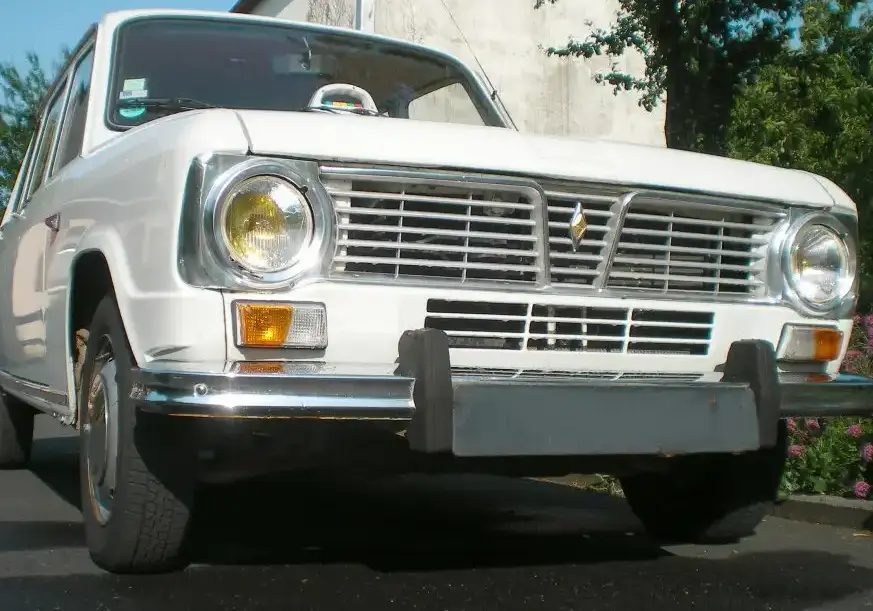
The Renault 6 1.1, produced between 1971 and 1980, represents a significant entry point into the Renault 6 model range. Positioned as the base model, it offered affordable transportation during a period of increasing fuel costs and a growing demand for practical, compact cars in Europe. The Renault 6, as a whole, was a groundbreaking vehicle for Renault, being one of the first cars designed as a hatchback from the outset, maximizing interior space within a relatively small footprint. The 1.1-liter variant, while not the most powerful offering, was the most accessible and widely sold version, particularly in France and other European markets. It played a crucial role in establishing the Renault 6 as a popular choice for families and urban commuters.
Technical Specifications
| Brand | Renault |
| Model | 6 |
| Generation | 6 |
| Type (Engine) | 1.1 (48 Hp) |
| Start of production | 1971 |
| End of production | 1980 |
| Powertrain Architecture | Internal Combustion engine |
| Body type | Hatchback |
| Seats | 5 |
| Doors | 5 |
| Fuel Type | Petrol (Gasoline) |
| Power | 48 Hp |
| Engine Model/Code | 688-10 |
| Engine aspiration | Naturally aspirated engine |
| Engine oil capacity | 3.3 l (3.49 US qt | 2.9 UK qt) |
| Coolant capacity | 6.3 l (6.66 US qt | 5.54 UK qt) |
| Fuel tank capacity | 40 l (10.57 US gal | 8.8 UK gal) |
Powertrain & Engine Architecture
The Renault 6 1.1 was powered by the 688-10 engine, a 1,108 cc (67.6 cubic inches) inline-four cylinder petrol engine. This engine was a relatively simple design, featuring a single overhead camshaft (SOHC) operating two valves per cylinder. It utilized a Solex carburetor for fuel delivery, a common setup for vehicles of this era aiming for affordability and ease of maintenance. The engine’s modest 48 horsepower at 5,000 rpm and 66 lb-ft of torque at 3,000 rpm were sufficient for city driving and moderate highway speeds, but it was not designed for rapid acceleration. The engine block was cast iron, contributing to its durability, while the cylinder head was aluminum. The 688 engine family was known for its robustness, though it wasn’t particularly sophisticated. The transmission paired with the 1.1-liter engine was typically a four-speed manual gearbox, though a three-speed automatic transmission was offered as an option, albeit less common. The automatic transmission, while providing convenience, further reduced the car’s already limited acceleration.
Driving Characteristics
The driving experience in a Renault 6 1.1 was characterized by its simplicity and practicality. The 48 horsepower engine provided adequate, but not exhilarating, performance. Acceleration was slow, particularly with the automatic transmission, and overtaking required careful planning. The four-speed manual transmission allowed for better control and slightly improved performance, enabling the driver to keep the engine in its optimal power band. The gear ratios were relatively tall, prioritizing fuel economy over outright speed. The suspension, consisting of independent front suspension with coil springs and a torsion beam rear axle, provided a comfortable ride, absorbing bumps and imperfections in the road reasonably well. However, the car’s light weight and relatively narrow track meant that it could feel somewhat unstable in strong crosswinds or during sharp cornering. Braking performance was adequate, utilizing drum brakes on all four wheels, but lacked the stopping power of more modern systems.
Equipment & Trim Levels
The Renault 6 1.1, being the base model, was equipped with fairly basic features. Standard equipment typically included cloth upholstery, vinyl floor covering, and simple steel wheels with hubcaps. The dashboard was functional and straightforward, featuring a speedometer, fuel gauge, and basic warning lights. A heater was standard, but air conditioning was not available on the 1.1-liter model. Optional extras included a radio, upgraded upholstery, and whitewall tires. The interior was designed for practicality and durability, rather than luxury. Trim levels were minimal; the 1.1 was essentially the entry-level specification. Later models saw minor cosmetic updates, such as changes to the grille and interior trim materials, but the core features remained largely the same.
Chassis & Braking
The Renault 6 featured a monocoque body construction, providing a good balance of strength and weight. The front suspension utilized independent coil springs and wishbones, offering a reasonable level of ride comfort. The rear suspension employed a torsion beam axle, a cost-effective and space-saving design. Steering was by a recirculating ball system, which provided a relatively heavy but precise feel. Braking was handled by drum brakes on all four wheels. While adequate for the car’s weight and performance, the drum brakes lacked the stopping power and fade resistance of disc brakes. The car’s relatively light weight (around 1,800 lbs) helped to compensate for the limitations of the braking system. Stabilizer bars were not typically fitted to the base 1.1-liter model, contributing to a slightly increased degree of body roll in corners.
Market Reception & Comparison
The Renault 6 1.1 was generally well-received as an affordable and practical family car. Critics praised its spacious interior, hatchback design, and fuel efficiency. However, the 1.1-liter engine was often criticized for its lack of power, particularly when compared to the more powerful 1.3-liter and 1.6-liter versions of the Renault 6. The automatic transmission version was even slower and less responsive. Compared to its rivals, such as the Citroën 2CV and the Fiat 127, the Renault 6 offered a more modern and comfortable driving experience, but it was not as renowned for its ruggedness or simplicity as the 2CV. Fuel economy was a strong point for the 1.1-liter model, averaging around 35-40 mpg, making it an attractive option for budget-conscious buyers. Reliability was generally good, although the carburetor required periodic adjustment and maintenance.
Legacy
The Renault 6 1.1, while not the most sought-after version of the model, remains a significant part of automotive history. It represents a pivotal moment in Renault’s design philosophy, embracing the hatchback concept and prioritizing interior space. The 688 engine, while simple, proved to be durable and reliable, and many examples are still on the road today. In the used car market, the Renault 6 1.1 is valued for its affordability, simplicity, and classic charm. Parts availability can be a challenge, but a dedicated community of enthusiasts helps to keep these cars running. The Renault 6, in all its variants, is remembered as a practical, economical, and innovative car that played a key role in shaping the European automotive landscape of the 1970s.
