
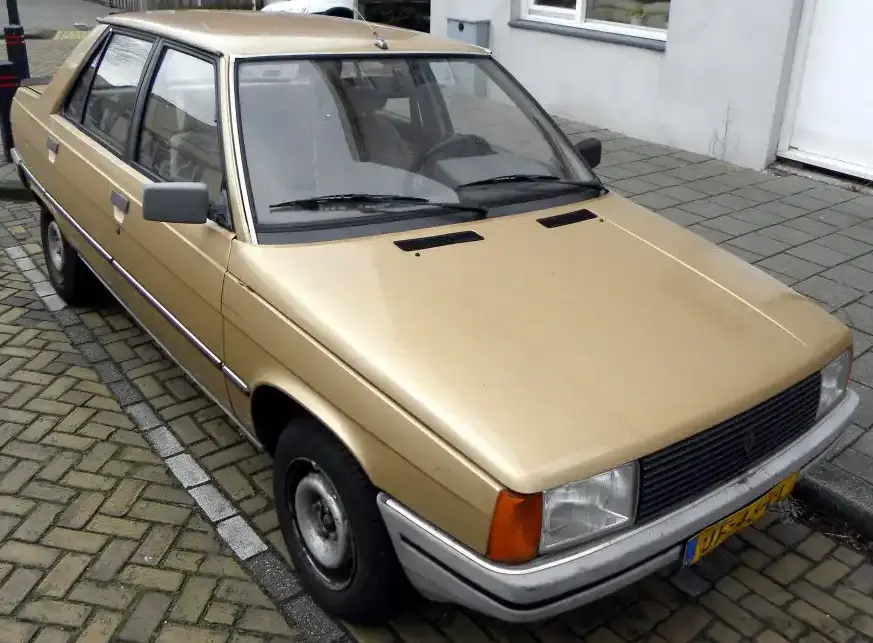
Technical Specifications
| Brand | Renault |
| Model | 9 |
| Generation | 9 (L42) |
| Type (Engine) | 1.1 (L421) (48 Hp) |
| Start of production | 1982 |
| End of production | 1987 |
| Powertrain Architecture | Internal Combustion engine |
| Body type | Sedan |
| Seats | 5 |
| Doors | 4 |
| Fuel Type | Petrol (Gasoline) |
| Maximum speed | 145 km/h (90.1 mph) |
| Power | 48 Hp @ 5250 rpm |
| Power per litre | 43.3 Hp/l |
| Engine layout | Front, Transverse |
| Engine Model/Code | C1E 715, C1E 720 |
| Engine displacement | 1108 cm3 (67.61 cu. in.) |
| Number of cylinders | 4 |
| Engine configuration | Inline |
| Number of valves per cylinder | 2 |
| Fuel injection system | Carburettor |
| Engine aspiration | Naturally aspirated engine |
| Engine oil capacity | 3.25 l (3.43 US qt | 2.86 UK qt) |
| Coolant capacity | 6 l (6.34 US qt | 5.28 UK qt) |
| Fuel tank capacity | 47 l (12.42 US gal | 10.34 UK gal) |
| Front track | 1395 mm (54.92 in.) |
| Rear track | 1360 mm (53.54 in.) |
| Drivetrain Architecture | The Internal combustion engine (ICE) drives the front wheels of the vehicle. |
| Drive wheel | Front wheel drive |
| Number of gears | 4 |
| Gearbox type | Manual transmission |
| Front suspension | Independent type McPherson |
| Rear suspension | Torsion |
| Front brakes | Disc |
| Rear brakes | Drum |
| Tires size | 145/80 R13 |
| Wheel rims size | 13 |
The Renault 9 (L42) 1.1 (L421), producing 48 horsepower, was a foundational model within the Renault 9 range, manufactured between 1982 and 1987. Positioned as the entry-level offering, it played a crucial role in making the Renault 9 accessible to a wider market, particularly in Europe where it competed with vehicles like the Peugeot 205 and Citroën Visa. The L42 generation represented a significant step forward for Renault, offering a more modern and efficient package compared to its predecessor, the Renault 11. This variant, with its modest engine, was designed for economy and practicality, appealing to buyers prioritizing fuel efficiency and affordability over outright performance.
Powertrain & Engine Architecture
The Renault 9 1.1L (L421) was powered by the C1E engine family, specifically the C1E 715 or C1E 720 variant. This was a simple, overhead valve (OHV) engine with two valves per cylinder. The engine’s 1108cc displacement was achieved with a bore of 76mm and a stroke of 80mm. Crucially, this engine utilized a single Solex carburetor for fuel delivery, a common feature for vehicles of this era aiming for affordability. The carburetor system, while reliable, was less efficient and offered less precise fuel control compared to fuel injection systems. The engine’s modest 48 horsepower at 5250 rpm and approximately 67 lb-ft of torque were delivered to the front wheels through a four-speed manual transmission. This transmission was chosen for its simplicity and cost-effectiveness, contributing to the overall affordability of the vehicle. The engine was transversely mounted, a layout becoming increasingly common in front-wheel-drive cars for packaging efficiency.
Driving Characteristics
The driving experience in the Renault 9 1.1L was characterized by its practicality and ease of use. Acceleration was modest, with a 0-60 mph time estimated around 16-18 seconds. The four-speed manual transmission required frequent shifting to maintain momentum, particularly when overtaking or climbing hills. The gear ratios were optimized for fuel economy rather than performance. Compared to the more powerful Renault 9 TL or GTS models, the 1.1L felt significantly slower. However, the lighter engine weight contributed to nimble handling in city driving. The suspension, while basic, provided a reasonably comfortable ride, absorbing most road imperfections adequately. The steering was light and easy, making it suitable for urban environments. The lack of power steering, standard on this base model, required a bit more effort at lower speeds.
Equipment & Trim Levels
The Renault 9 1.1L was the base trim level, and as such, it featured a relatively sparse equipment list. Standard features typically included cloth upholstery, basic instrumentation (speedometer, fuel gauge, temperature gauge), and a simple two-spoke steering wheel. The interior plastics were durable but utilitarian. Optional extras, such as a radio, heated rear window, and upgraded upholstery, were available at an additional cost. The exterior trim was minimal, with black plastic bumpers and steel wheels with hubcaps being standard. The overall focus was on providing a functional and affordable vehicle, rather than luxury or extensive features.
Chassis & Braking
The Renault 9 utilized a front-wheel-drive layout with an independent McPherson strut suspension at the front and a torsion beam suspension at the rear. This suspension setup provided a good balance between ride comfort and handling. The front brakes were disc brakes, offering adequate stopping power, while the rear brakes were drum brakes, a cost-saving measure common in this class of vehicle. The steering was a rack-and-pinion system, providing reasonably precise control. The 145/80 R13 tires offered adequate grip for everyday driving conditions. The chassis was relatively lightweight, contributing to the car’s fuel efficiency and maneuverability.
Market Reception & Comparison
The Renault 9 1.1L was generally well-received as an affordable and practical family car. Critics praised its fuel efficiency and ease of driving, but noted its lack of performance. Compared to the higher-spec Renault 9 models, such as the 1.4L or 1.7L versions, the 1.1L offered significantly less power and refinement. However, it was considerably cheaper to purchase and operate. In terms of fuel economy, the 1.1L typically achieved around 45-50 mpg, making it an attractive option for budget-conscious buyers. Reliability was generally good, although the carburetor required periodic adjustment and maintenance. Compared to competitors like the Peugeot 205 and Citroën Visa, the Renault 9 1.1L offered a similar level of practicality and affordability.
Legacy
The Renault 9 1.1L, while not the most exciting version of the model, played a vital role in establishing the Renault 9 as a popular and successful family car. The C1E engine, despite its simplicity, proved to be relatively durable and reliable. Today, the Renault 9 1.1L is a relatively rare sight on the roads, but it remains a popular choice among classic car enthusiasts looking for an affordable and easy-to-maintain vehicle. Parts availability can be a challenge, but many components are still available through specialist suppliers. The car’s simple design and robust construction make it a relatively easy vehicle to work on for DIY mechanics. It represents a significant era in European automotive history, showcasing the focus on practicality and affordability that characterized the 1980s.
