
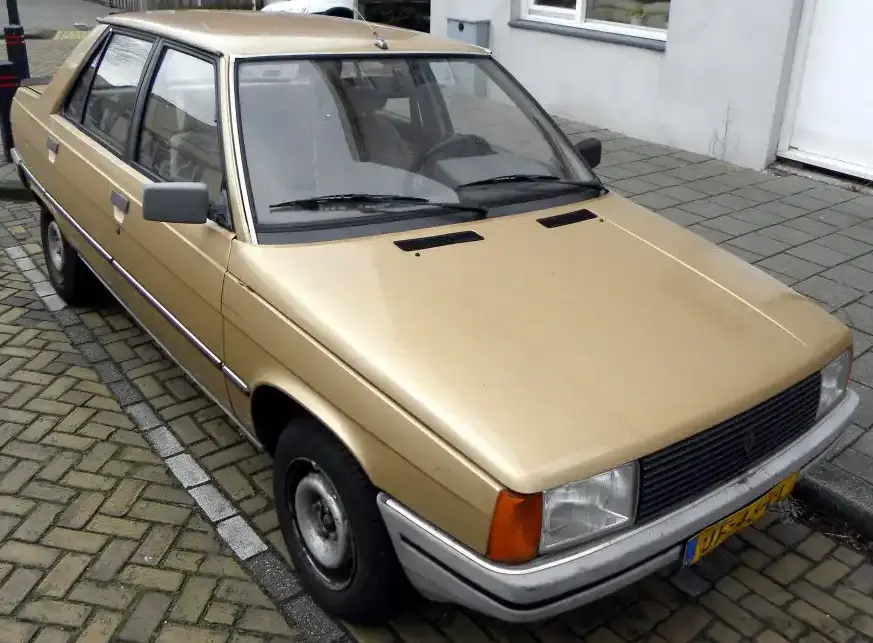
The Renault 9 (L42) 1.4 (L423), producing 72 horsepower, was a mainstay of the Renault lineup from 1981 to 1985. Positioned as an entry-level offering within the broader Renault 9 range, it represented a practical and affordable option for European buyers seeking a compact family sedan. The L42 series marked a significant step forward for Renault, utilizing a new platform and offering improved comfort and efficiency compared to its predecessors. This variant played a crucial role in establishing the Renault 9 as a popular choice in the competitive small car segment.
Technical Specifications
| Brand | Renault |
| Model | 9 |
| Generation | 9 (L42) |
| Type (Engine) | 1.4 (L423) (72 Hp) |
| Start of production | 1981 |
| End of production | 1985 |
| Powertrain Architecture | Internal Combustion engine |
| Body type | Sedan |
| Seats | 5 |
| Doors | 4 |
| Fuel consumption (extra urban) | 5.1 l/100 km (46.1 US mpg, 55.4 UK mpg, 19.6 km/l) |
| Fuel Type | Petrol (Gasoline) |
| Acceleration 0 – 100 km/h | 12.5 sec |
| Acceleration 0 – 62 mph | 12.5 sec |
| Acceleration 0 – 60 mph | 11.9 sec |
| Maximum speed | 178 km/h (110.6 mph) |
| Weight-to-power ratio | 12.4 kg/Hp, 80.9 Hp/tonne |
| Weight-to-torque ratio | 8.4 kg/Nm, 119.1 Nm/tonne |
| Power | 72 Hp @ 5750 rpm |
| Power per litre | 51.5 Hp/l |
| Torque | 106 Nm (78.18 lb.-ft.) |
| Engine layout | Front, Transverse |
| Engine Model/Code | C2J 717, C2J 755 |
| Engine displacement | 1398 cm3 (85.31 cu. in.) |
| Number of cylinders | 4 |
| Engine configuration | Inline |
| Compression ratio | 9:1 |
| Number of valves per cylinder | 2 |
| Fuel injection system | Carburettor |
| Engine aspiration | Naturally aspirated engine |
| Engine oil capacity | 3.25 l (3.43 US qt, 2.86 UK qt) |
| Coolant | 6 l (6.34 US qt, 5.28 UK qt) |
| Kerb Weight | 890 kg (1962.11 lbs.) |
| Fuel tank capacity | 47 l (12.42 US gal, 10.34 UK gal) |
| Drivetrain Architecture | The Internal combustion engine (ICE) drives the front wheels of the vehicle. |
| Drive wheel | Front wheel drive |
| Front brakes | Disc |
| Rear brakes | Drum |
| Steering type | Steering rack and pinion |
Powertrain & Engine Architecture
The Renault 9 1.4 (L423) was powered by the C2J engine family, specifically the C2J 717 or C2J 755 variant. This was a 1.4-liter (1398 cc) inline-four cylinder engine featuring a relatively simple, yet robust, design. The engine utilized a single overhead camshaft (SOHC) valvetrain with two valves per cylinder. Crucially, this version relied on a carburetor for fuel delivery, a common practice for vehicles of this era aiming for affordability. The carburetor system, while less precise than fuel injection, was relatively easy to maintain and repair. The engine produced 72 horsepower at 5750 rpm and 106 Nm (78.18 lb-ft) of torque. The engine was transversely mounted at the front of the vehicle, driving the front wheels. The transmission was a three or four-speed automatic, depending on the specific year and market. The automatic transmission, while offering convenience, was not known for its performance or efficiency.
Driving Characteristics
The 1.4L automatic Renault 9 offered a comfortable, if uninspiring, driving experience. Acceleration was modest, taking approximately 12.5 seconds to reach 62 mph (100 km/h). The automatic transmission contributed to a smoother ride, but at the expense of responsiveness. Compared to the manual transmission versions of the Renault 9, the automatic felt noticeably slower, particularly during overtaking maneuvers. The gear ratios were optimized for fuel economy rather than performance. The suspension, while adequate for everyday driving, wasn’t particularly sporty. The car felt stable and predictable, but lacked the agility of some of its competitors. The steering was light and easy, making it suitable for urban environments.
Equipment & Trim Levels
The 1.4L automatic Renault 9 typically came with a basic level of equipment. Standard features generally included cloth upholstery, a simple dashboard layout with analog gauges, and manual windows and door locks. Power steering was not always standard, and air conditioning was typically an optional extra. The interior was functional and durable, prioritizing practicality over luxury. Optional extras could include a radio, upgraded upholstery, and a sunroof. The trim level was generally considered the base model, aimed at buyers prioritizing affordability and reliability.
Chassis & Braking
The Renault 9 L42 featured a MacPherson strut front suspension and a torsion beam rear suspension. This setup provided a reasonable balance between comfort and handling. The front brakes were disc brakes, offering better stopping power than the drum brakes found on the rear wheels. The steering system utilized a rack and pinion setup, providing precise and responsive steering. The car’s relatively light weight (890 kg / 1962.11 lbs) helped to offset the modest engine power. Stabilizer bars were typically fitted to the front suspension to reduce body roll during cornering.
Market Reception & Comparison
The Renault 9 1.4 automatic was generally well-received as a practical and affordable family car. Critics praised its fuel efficiency and comfortable ride, but noted its lack of performance. Compared to other trims in the Renault 9 lineup, such as the 1.6L versions, the 1.4 automatic offered less power and acceleration. However, it was more fuel-efficient and generally less expensive to purchase and maintain. Compared to competitors like the Peugeot 205 and Citroën Visa, the Renault 9 offered a similar level of practicality and affordability, but was often considered less stylish.
Legacy
The Renault 9 1.4 automatic, while not a performance icon, proved to be a reliable and durable vehicle. The C2J engine, despite its carburetor-based fuel system, was known for its longevity. Today, these cars are relatively rare, but those that remain are often sought after by enthusiasts and collectors. The automatic transmission, while not particularly sophisticated, generally held up well over time. The car’s simple design and readily available parts make it relatively easy to maintain and repair. In the used car market, the Renault 9 1.4 automatic represents an affordable and charming piece of automotive history.
