
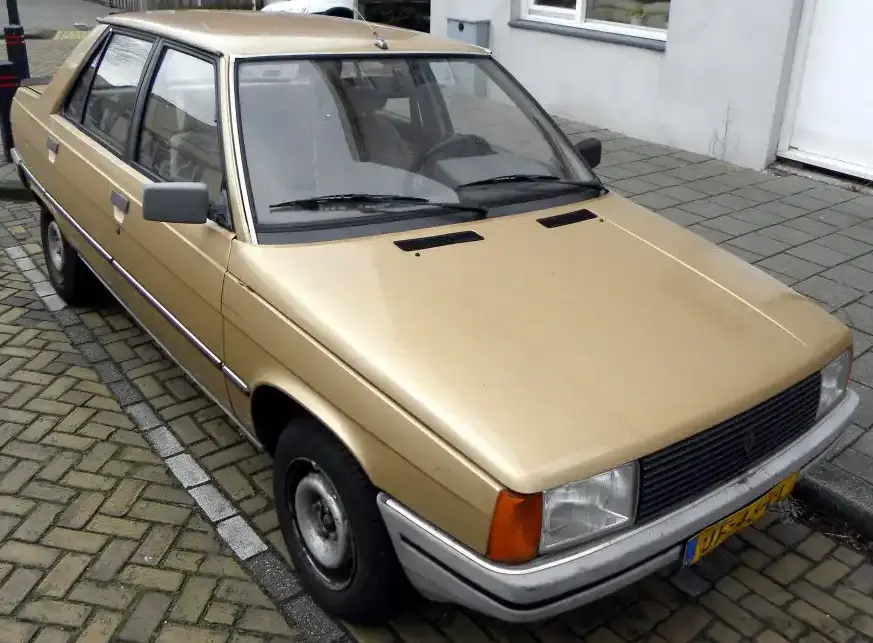
The Renault 9 (L42) 1.4 Turbo, designated internally as the L425 variant and producing 105 horsepower, was a significant offering in the compact car segment during its production run from 1984 to 1986. Positioned as a more performance-oriented version of the standard Renault 9, it aimed to attract buyers seeking a blend of practicality and spirited driving. This model was part of the first generation of the Renault 9, built on the L42 platform, and represented a step up in terms of engine technology and performance compared to the base models. It was primarily marketed in Europe, where compact, fuel-efficient cars were in high demand.
Technical Specifications
| Brand | Renault |
| Model | 9 |
| Generation | 9 (L42) |
| Type (Engine) | 1.4 Turbo (L425) (105 Hp) |
| Start of production | 1984 |
| End of production | 1986 |
| Powertrain Architecture | Internal Combustion engine |
| Body type | Sedan |
| Seats | 5 |
| Doors | 4 |
| Fuel Type | Petrol (Gasoline) |
| Power | 105 Hp |
| Engine Model/Code | C1J 760, C1J 764 |
| Engine aspiration | Turbocharger |
| Engine oil capacity | 3.5 l (3.7 US qt | 3.08 UK qt) |
| Coolant capacity | 5.8 l (6.13 US qt | 5.1 UK qt) |
| Fuel tank capacity | 47 l (12.42 US gal | 10.34 UK gal) |
Powertrain & Engine Architecture
The heart of the Renault 9 1.4 Turbo was the C1J engine, specifically the 760 and 764 variants. This was a 1.4-liter, inline-four cylinder engine featuring a single overhead camshaft (SOHC) valvetrain. The key differentiating factor was the addition of a turbocharger, significantly boosting power output compared to the naturally aspirated 1.1 and 1.4-liter engines available in other Renault 9 models. The turbocharger was a Garrett unit, and it utilized an intercooler to reduce intake air temperatures, further enhancing performance. Fuel delivery was managed by Bosch mechanical fuel injection, a relatively sophisticated system for the time. The engine block was cast iron, providing durability, while the cylinder head was aluminum. The compression ratio was approximately 8.8:1. While specific transmission options varied by market, the 1.4 Turbo was typically paired with a four-speed manual gearbox, though a three-speed automatic transmission was also available, albeit less common. The automatic transmission was a conventional hydraulic unit, offering smooth but not particularly sporty shifts.
Driving Characteristics
The 1.4 Turbo Renault 9 offered a noticeable performance improvement over the base models. With 105 horsepower, it could achieve a 0-60 mph time of around 9.5 seconds, which was competitive for its class in the mid-1980s. The turbocharger provided a distinct power surge, particularly in the mid-range, making overtaking maneuvers easier. However, the turbo lag was also noticeable, requiring drivers to anticipate acceleration. The four-speed manual transmission allowed for good control, while the automatic, though convenient, resulted in some power loss and a less engaging driving experience. The suspension was tuned for comfort, providing a relatively smooth ride, but the car wasn’t particularly sporty in handling. The steering was light and precise, making it easy to maneuver in urban environments. The gear ratios in the manual transmission were fairly widely spaced, prioritizing fuel economy at cruising speeds but requiring frequent shifting during spirited driving.
Equipment & Trim Levels
The Renault 9 1.4 Turbo typically came with a higher level of standard equipment than the base models. This included features like upgraded upholstery (often featuring a patterned cloth), a more comprehensive instrument cluster, and sometimes, power steering. Optional extras included a sunroof, upgraded audio systems, and metallic paint finishes. The interior design was functional and relatively simple, reflecting the car’s focus on practicality. The dashboard layout was straightforward, with easy-to-read gauges. The seats were comfortable, providing adequate support for long journeys. Trim levels varied depending on the market, but generally, the 1.4 Turbo represented a mid-range offering, bridging the gap between the basic models and the more luxurious versions.
Chassis & Braking
The Renault 9 1.4 Turbo utilized a MacPherson strut front suspension and a torsion beam rear suspension. This setup provided a good balance between ride comfort and handling. The front brakes were disc brakes, while the rear brakes were typically drum brakes, although some higher-spec models featured rear disc brakes. The braking system was adequate for everyday driving, but it lacked the stopping power of more modern cars. The car’s weight was relatively low, which helped to offset the limitations of the braking system. A stabilizer bar was fitted to the front suspension to reduce body roll during cornering. The tires were typically 175/70 R14, providing a reasonable level of grip.
Market Reception & Comparison
The Renault 9 1.4 Turbo was generally well-received by automotive critics. It was praised for its performance, fuel efficiency, and relatively affordable price. However, some critics noted the turbo lag and the somewhat basic interior. Compared to other cars in its class, such as the Peugeot 205 and the Citroën AX, the Renault 9 1.4 Turbo offered a good balance of features and performance. The 1.4 Turbo was more powerful than the base models but less expensive than the more luxurious versions. Fuel economy was respectable, averaging around 35-40 mpg. Reliability was generally good, although the turbocharger could be a potential source of problems if not properly maintained. Compared to the naturally aspirated 1.4-liter Renault 9, the Turbo offered a significant performance boost, but at the cost of slightly increased fuel consumption and maintenance complexity.
Legacy
The Renault 9 1.4 Turbo holds a modest but respected place in automotive history. It demonstrated Renault’s ability to produce a compact car that was both practical and enjoyable to drive. The C1J engine, with its turbocharger, was a relatively advanced design for its time. Today, the Renault 9 1.4 Turbo is a sought-after classic car, particularly among enthusiasts who appreciate its unique blend of performance and affordability. Finding well-maintained examples can be challenging, as many have succumbed to rust or have been modified over the years. The turbocharger remains the most critical component to inspect when considering a purchase, as rebuilds can be costly. The car’s relatively simple mechanical design makes it relatively easy to maintain for those with some mechanical aptitude. It represents a significant step in the evolution of the Renault 9, and a testament to the engineering capabilities of Renault in the 1980s.
