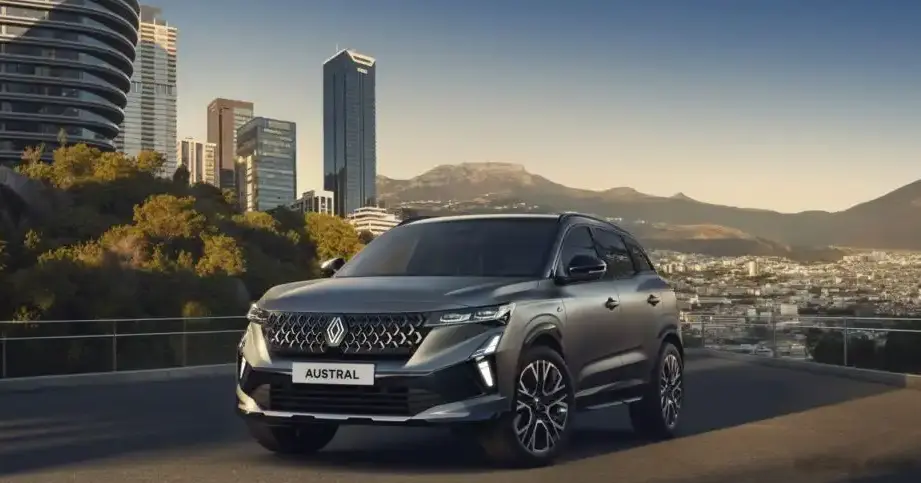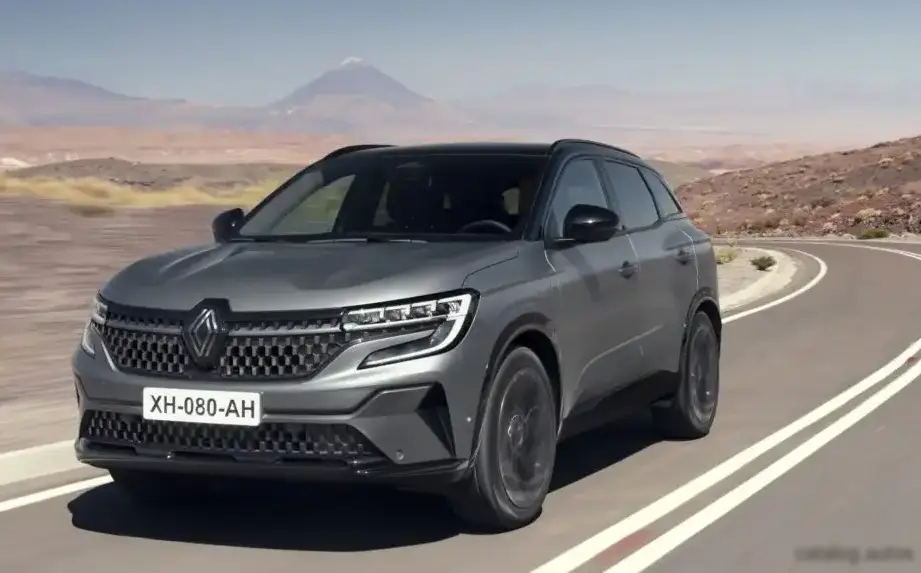
The Renault Austral 1.3 (140 hp) Mild Hybrid Automatic is a compact SUV introduced in September 2022 as part of the new Austral model range. Positioned as a mainstream offering within the lineup, it serves as a bridge between more basic trims and the higher-specification versions. The Austral represents Renault’s entry into the highly competitive C-segment SUV market, aiming to provide a blend of practicality, efficiency, and modern technology. It is built on the Renault-Nissan Alliance’s CMF-CD3 platform, shared with other models like the Nissan Qashqai, and is primarily targeted at the European market.
Technical Specifications
| Brand | Renault |
| Model | Austral |
| Type (Engine) | 1.3 (140 Hp) Mild Hybrid Automatic |
| Start of production | September, 2022 |
| Powertrain Architecture | MHEV (Mild Hybrid Electric Vehicle) |
| Body type | SUV |
| Seats | 5 |
| Doors | 5 |
| Combined fuel consumption (WLTP) | 6.1 l/100 km (38.6 US mpg) |
| CO2 emissions (WLTP) | 139 g/km |
| Fuel Type | Petrol (Gasoline) |
| Acceleration 0 – 100 km/h | 10 sec |
| Acceleration 0 – 62 mph | 10 sec |
| Acceleration 0 – 60 mph | 9.5 sec |
| Maximum speed | 175 km/h (108.74 mph) |
| Emission standard | Euro 6D Full |
| Weight-to-power ratio | 10.2 kg/Hp |
| Weight-to-torque ratio | 5.5 kg/Nm |
| Gross battery capacity | 0.15 kWh |
| Battery voltage | 12 V |
| Battery technology | Lithium-ion (Li-Ion) |
| Power | 140 Hp @ 4500-5750 rpm |
| Torque | 260 Nm @ 1750-3500 rpm (191.77 lb.-ft.) |
| Engine layout | Front, Transverse |
| Engine Model/Code | H5Ht |
| Engine displacement | 1333 cm3 (81.34 cu. in.) |
| Number of cylinders | 4 |
| Engine configuration | Inline |
| Cylinder Bore | 72.2 mm (2.84 in.) |
| Piston Stroke | 81.3 mm (3.2 in.) |
| Number of valves per cylinder | 4 |
| Fuel injection system | Direct injection |
| Engine aspiration | Turbocharger, Intercooler |
| Engine oil capacity | 5.5 l (5.81 US qt | 4.84 UK qt) |
| Kerb Weight | 1422 kg (3134.97 lbs.) |
| Max. weight | 2003 kg (4415.86 lbs.) |
| Max load | 581 kg (1280.89 lbs.) |
| Trunk (boot) space – minimum | 500 l (17.66 cu. ft.) |
| Trunk (boot) space – maximum | 1525 l (53.85 cu. ft.) |
| Fuel tank capacity | 55 l (14.53 US gal | 12.1 UK gal) |
| Permitted trailer load with brakes (12%) | 1800 kg (3968.32 lbs.) |
| Permitted trailer load without brakes | 745 kg (1642.44 lbs.) |
| Length | 4510 mm (177.56 in.) |
| Width | 1825 mm (71.85 in.) |
| Width with mirrors folded | 1843 mm (72.56 in.) |
| Width including mirrors | 2083 mm (82.01 in.) |
| Height | 1644 mm (64.72 in.) |
| Wheelbase | 2667 mm (105 in.) |
| Front track | 1482 mm (58.35 in.) |
| Rear (Back) track | 1476 mm (58.11 in.) |
| Front overhang | 925 mm (36.42 in.) |
| Rear overhang | 917 mm (36.1 in.) |
| Ride height (ground clearance) | 180 mm (7.09 in.) |
| Minimum turning circle | 11.2 m (36.75 ft.) |
| Drivetrain Architecture | Front wheel drive, MHEV |
| Number of gears and type of gearbox | 7 gears, automatic transmission |
| Front suspension | Independent type McPherson |
| Rear suspension | Torsion |
| Front brakes | Ventilated discs, 296×26 mm |
| Rear brakes | Disc, 292×16 mm |
| Steering type | Steering rack and pinion |
| Power steering | Electric Steering |
| Tires size | 215/65 R17; 235/55 R18; 205/55 R19; 235/45 R20 |
| Wheel rims size | 17; 18; 19; 20 |
Powertrain & Engine Architecture
The Renault Austral 1.3 (140 hp) utilizes a 1.3-liter turbocharged inline-four cylinder engine, internally designated as the H5Ht. This engine is part of Renault’s latest generation of gasoline engines, designed for efficiency and reduced emissions. It features direct fuel injection and a turbocharger with an intercooler, allowing for a good balance of power and fuel economy. The engine’s output is rated at 140 horsepower at 4,500-5,750 rpm and 260 Nm (191.77 lb-ft) of torque between 1,750 and 3,500 rpm.
Crucially, this variant incorporates a 48-volt mild hybrid system. This system comprises a small electric motor and a lithium-ion battery (0.15 kWh) that assists the engine during acceleration and allows for extended start/stop functionality. The mild hybrid system doesn’t provide full electric driving capability but contributes to improved fuel efficiency and reduced CO2 emissions. The engine is paired with a seven-speed dual-clutch automatic transmission (DCT), chosen for its smooth shifting and responsiveness. This transmission is a key component in optimizing the engine’s performance and efficiency.
Driving Characteristics
The 1.3-liter engine with the seven-speed automatic transmission delivers adequate performance for everyday driving. Acceleration from 0 to 100 km/h (0-62 mph) takes approximately 10 seconds. While not particularly sporty, the powertrain provides sufficient power for overtaking and merging onto highways. The DCT transmission contributes to a relatively smooth driving experience, with quick and precise gear changes. The mild hybrid system is most noticeable during initial acceleration, where it provides a small boost of power. Compared to higher-output versions of the Austral, this variant prioritizes fuel economy over outright performance. The gear ratios are tuned for efficiency, which can sometimes result in the engine feeling slightly strained when climbing hills or carrying a full load.
Equipment & Trim Levels
The 1.3 (140 hp) Mild Hybrid Automatic trim typically comes with a generous level of standard equipment. This includes features such as a touchscreen infotainment system with Apple CarPlay and Android Auto compatibility, automatic climate control, keyless entry, and a suite of advanced driver-assistance systems (ADAS) like automatic emergency braking, lane departure warning, and adaptive cruise control. Interior upholstery is generally cloth, with options for leather upgrades available. Higher trim levels within the 1.3 range may add features like a larger touchscreen, a panoramic sunroof, and premium audio systems. Optional extras often include metallic paint, parking sensors, and a hands-free power tailgate.
Chassis & Braking
The Renault Austral features a McPherson strut front suspension and a torsion beam rear suspension. This setup provides a comfortable ride quality, well-suited for everyday driving. The steering is electrically assisted, offering a light and precise feel. The braking system consists of ventilated discs at the front and solid discs at the rear. ABS (Anti-lock Braking System) is standard, along with electronic brake-force distribution and brake assist. The Austral’s chassis is tuned to prioritize comfort and stability, rather than sporty handling. The suspension effectively absorbs bumps and imperfections in the road, providing a smooth and refined driving experience.
Market Reception & Comparison
The Renault Austral 1.3 (140 hp) Mild Hybrid Automatic has been generally well-received by automotive critics. It is praised for its fuel efficiency, comfortable ride, and well-equipped interior. However, some reviewers have noted that the engine can feel slightly underpowered, particularly when fully loaded or driving uphill. Compared to other trims in the Austral lineup, this variant offers a more affordable entry point, making it attractive to budget-conscious buyers. Its fuel economy of 6.1 l/100 km (38.6 US mpg) is competitive within the compact SUV segment. Compared to diesel alternatives, the 1.3-liter gasoline engine offers lower NOx emissions, aligning with increasingly stringent emissions regulations.
Legacy
The Renault Austral 1.3 (140 hp) Mild Hybrid Automatic represents a significant step towards Renault’s electrification strategy. The mild hybrid powertrain demonstrates the brand’s commitment to reducing emissions and improving fuel efficiency. While it’s still relatively early to assess the long-term reliability of this specific powertrain, Renault’s gasoline engines have generally proven to be durable and dependable. On the used car market, the Austral 1.3 is expected to hold its value reasonably well, thanks to its fuel efficiency, practicality, and modern features. As the automotive industry continues to transition towards electric vehicles, the Austral 1.3 Mild Hybrid Automatic serves as a transitional model, offering a balance of traditional gasoline power and hybrid technology.