
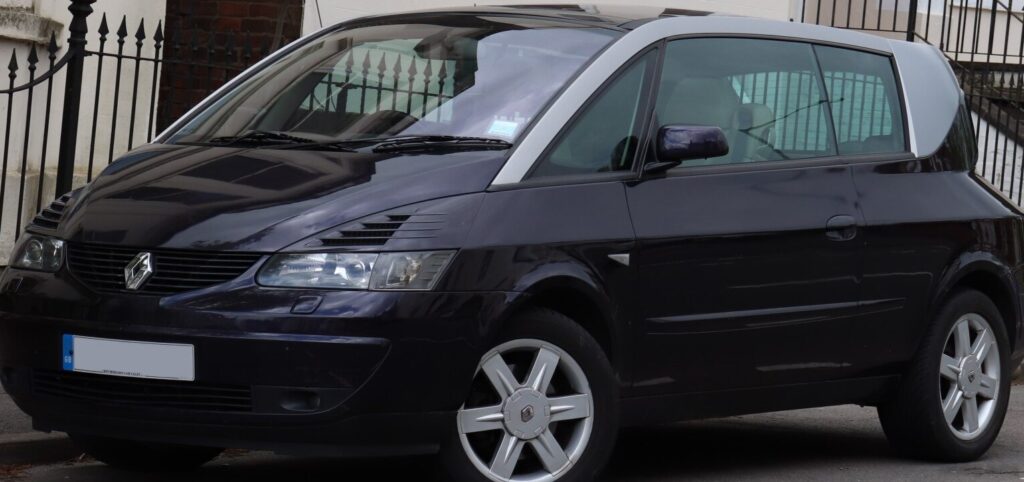
The Renault Avantime 3.0 V6 24V, produced between September 2001 and February 2003, was a unique and ambitious vehicle from the French automaker. Positioned as a luxury crossover or “coupé-minivan,” the Avantime aimed to blend the spaciousness of a minivan with the styling and driving experience of a coupé. It represented a bold design statement for Renault, and while commercially unsuccessful, it remains a distinctive vehicle with a dedicated following. The Avantime was built on a stretched version of Renault’s platform, sharing underpinnings with the Espace, but offering a significantly different aesthetic and intended market appeal. This particular 3.0 V6 variant represented the top-of-the-line offering in the Avantime range, providing the most powerful engine option.
Renault Avantime 3.0 V6 24V: An Overview
The Avantime was a short-lived experiment in automotive design, attempting to carve out a new niche in the market. Its unusual proportions – a high roofline combined with a relatively long wheelbase and a two-door configuration – were polarizing. The interior, however, was widely praised for its spaciousness, comfort, and innovative design. The 3.0 V6 24V model was the flagship, offering a substantial performance upgrade over the lower-spec engines. It was targeted towards buyers seeking a luxurious and distinctive vehicle, willing to overlook the Avantime’s unconventional styling.
Powertrain & Engine Architecture
At the heart of the Avantime 3.0 V6 24V lies Renault’s L7X engine, a 2.9-liter naturally aspirated V6. This engine, part of Renault’s V6 engine family, produced 207 horsepower at 6000 rpm and 285 Nm (210.21 lb-ft) of torque at 3750 rpm. The engine featured a double overhead camshaft (DOHC) valvetrain with four valves per cylinder, and utilized multi-port fuel injection. The engine’s layout was transverse, mounted at the front of the vehicle. The compression ratio was set at 10.9:1. The engine’s bore and stroke measured 87 mm (3.43 in) and 82.6 mm (3.25 in) respectively, resulting in a displacement of 2946 cm³ (179.78 cu. in). The engine required 6.5 liters (6.87 US qt) of oil, specified to Renault standards, and 10 liters (10.57 US qt) of coolant.
The Avantime 3.0 V6 was exclusively offered with a 6-speed manual transmission. This gearbox was chosen to complement the engine’s power output and provide a more engaging driving experience than an automatic option. The transmission sent power to the front wheels, as the Avantime was a front-wheel-drive vehicle.
Driving Characteristics
The 3.0 V6 Avantime offered a noticeably more spirited driving experience than its four-cylinder counterparts. Acceleration from 0 to 100 km/h (0-62 mph) took 8.6 seconds, while 0-60 mph was achieved in approximately 8.2 seconds. The top speed was electronically limited to 220 km/h (136.7 mph). The 6-speed manual transmission allowed drivers to keep the engine in its optimal power band, providing responsive acceleration. The weight-to-power ratio of 8.4 kg/Hp and a weight-to-torque ratio of 6.1 kg/Nm contributed to the vehicle’s respectable performance. While not a sports car, the Avantime 3.0 V6 offered a comfortable and capable driving experience, particularly on open roads. The front-wheel-drive configuration, however, could exhibit torque steer under hard acceleration.
Equipment & Trim Levels
The Avantime 3.0 V6 was generously equipped, reflecting its position as the range-topping model. Standard features included leather upholstery, automatic climate control, power-adjustable front seats, a premium audio system, and a comprehensive suite of safety features, including ABS (Anti-lock Braking System). The interior design was a key selling point, with a focus on spaciousness and comfort. The dashboard featured a unique, flowing design, and the rear seats offered ample legroom. Optional extras included a panoramic sunroof, upgraded audio systems, and various cosmetic enhancements. The Avantime’s interior was designed to create a luxurious and inviting atmosphere.
Chassis & Braking
The Avantime utilized a front-wheel-drive chassis with independent wishbone suspension at the front and a trailing arm suspension at the rear. This suspension setup was designed to provide a comfortable ride while maintaining reasonable handling characteristics. The Avantime 3.0 V6 was equipped with ventilated disc brakes at the front and solid disc brakes at the rear. Hydraulic power steering provided assistance for ease of maneuvering. The vehicle rode on 225/55 R16 tires mounted on 16-inch alloy wheels. The chassis was reinforced to handle the increased power and torque of the V6 engine.
Market Reception & Comparison
The Renault Avantime was met with mixed reviews upon its launch. Critics praised its innovative design, spacious interior, and comfortable ride. However, the Avantime’s unconventional styling proved to be a major barrier to sales. The two-door configuration, while contributing to the coupé-like appearance, made access to the rear seats somewhat challenging. Compared to other vehicles in its price range, such as luxury sedans and SUVs, the Avantime offered a unique proposition but struggled to find a clear market position. The 3.0 V6 model offered significantly better performance than the lower-spec engines, but its higher price tag further limited its appeal. Fuel economy was also a concern, with combined fuel consumption of 11.3 l/100 km (20.8 US mpg). Reliability was generally good, but the Avantime’s complex design and limited production run meant that parts availability could be an issue.
Technical Specifications
| Brand | Renault |
| Model | Avantime |
| Generation | Avantime |
| Type (Engine) | 3.0 V6 24V (207 Hp) |
| Start of production | September, 2001 |
| End of production | February, 2003 |
| Fuel consumption (economy) – urban | 15.9 l/100 km (14.8 US mpg, 17.8 UK mpg, 6.3 km/l) |
| Fuel consumption (economy) – extra urban | 8.9 l/100 km (26.4 US mpg, 31.7 UK mpg, 11.2 km/l) |
| Fuel consumption (economy) – combined | 11.3 l/100 km (20.8 US mpg, 25 UK mpg, 8.8 km/l) |
| Fuel Type | Petrol (Gasoline) |
| Acceleration 0 – 100 km/h | 8.6 sec |
| Acceleration 0 – 62 mph | 8.6 sec |
| Acceleration 0 – 60 mph | 8.2 sec |
| Maximum speed | 220 km/h (136.7 mph) |
| Weight-to-power ratio | 8.4 kg/Hp, 118.9 Hp/tonne |
| Weight-to-torque ratio | 6.1 kg/Nm, 163.7 Nm/tonne |
| Power | 207 Hp @ 6000 rpm |
| Torque | 285 Nm @ 3750 rpm (210.21 lb.-ft. @ 3750 rpm) |
| Engine layout | Front, Transverse |
| Engine Model/Code | L7X |
| Engine displacement | 2946 cm3 (179.78 cu. in.) |
| Number of cylinders | 6 |
| Engine configuration | V-engine |
| Cylinder Bore | 87 mm (3.43 in.) |
| Piston Stroke | 82.6 mm (3.25 in.) |
| Compression ratio | 10.9:1 |
| Number of valves per cylinder | 4 |
| Fuel injection system | Multi-port manifold injection |
| Engine aspiration | Naturally aspirated engine |
| Valvetrain | DOHC |
| Engine oil capacity | 6.5 l (6.87 US qt | 5.72 UK qt) |
| Coolant | 10 l (10.57 US qt | 8.8 UK qt) |
| Kerb Weight | 1741 kg (3838.25 lbs.) |
| Max. weight | 2300 kg (5070.63 lbs.) |
| Max load | 559 kg (1232.38 lbs.) |
| Trunk (boot) space – minimum | 530 l (18.72 cu. ft.) |
| Trunk (boot) space – maximum | 900 l (31.78 cu. ft.) |
| Fuel tank capacity | 80 l (21.13 US gal | 17.6 UK gal) |
| Length | 4642 mm (182.76 in.) |
| Width | 1835 mm (72.24 in.) |
| Height | 1627 mm (64.06 in.) |
| Wheelbase | 2700 mm (106.3 in.) |
| Front track | 1548 mm (60.94 in.) |
| Rear (Back) track | 1558 mm (61.34 in.) |
| Drivetrain Architecture | The Internal combustion engine (ICE) drives the front wheels of the vehicle. |
| Drive wheel | Front wheel drive |
| Number of gears and type of gearbox | 6 gears, manual transmission |
| Front suspension | Wishbone |
| Rear suspension | Trailing arm |
| Front brakes | Ventilated discs |
| Rear brakes | Disc |
| Assisting systems | ABS (Anti-lock braking system) |
| Steering type | Steering rack and pinion |
| Power steering | Hydraulic Steering |
| Tires size | 225/55 R16 |
| Wheel rims size | 16 |
Legacy
Despite its short production run, the Renault Avantime has gained a cult following among automotive enthusiasts. Its unique design and luxurious interior have made it a sought-after vehicle in the used car market. The 3.0 V6 model, with its superior performance, is particularly desirable. While parts availability can be a challenge, the Avantime’s robust mechanicals and relatively simple engine design contribute to its long-term reliability. The Avantime remains a testament to Renault’s willingness to take risks and push the boundaries of automotive design. It serves as a reminder that sometimes, the most memorable cars are the ones that dare to be different.
