
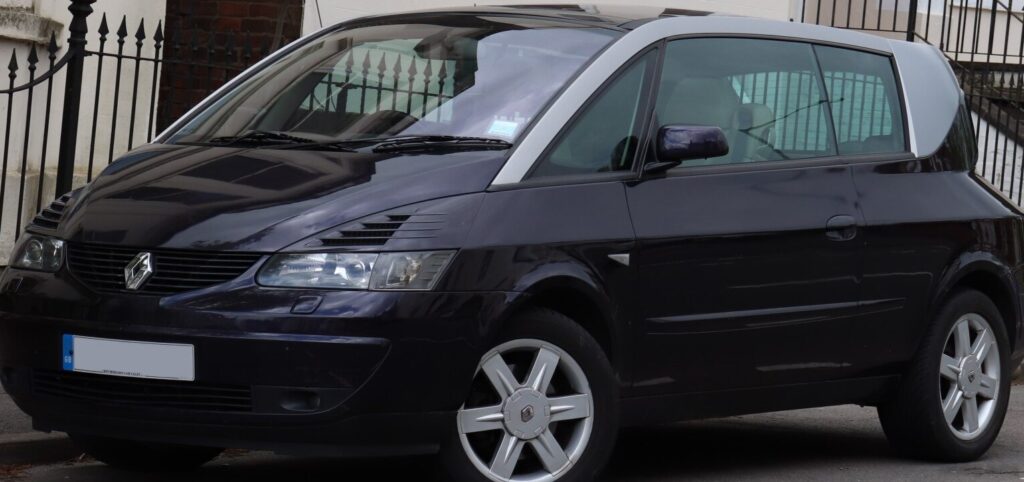
The Renault Avantime 3.0 V6 24V Automatic, produced between September 2001 and February 2003, was a unique and ambitious vehicle from the French automaker. Positioned as a premium, spacious, and somewhat unconventional “coupé-minivan,” the Avantime aimed to blend the practicality of a family vehicle with the style and perceived luxury of a grand tourer. It represented a bold design statement for Renault, and while commercially unsuccessful, it remains a distinctive vehicle with a dedicated following. The Avantime was built on the Renault Vel Satis platform, sharing its underlying architecture, but offering a significantly different body style and interior experience. It was a flagship model intended to showcase Renault’s engineering and design capabilities.
Powertrain & Engine Architecture
The Avantime 3.0 V6 was powered by Renault’s L7X engine, a 2,946 cc (179.78 cu. in.) naturally aspirated V6. This engine, part of Renault’s ‘V6 Initiale’ family, featured a 60-degree V-angle, four valves per cylinder, and a double overhead camshaft (DOHC) valvetrain. The engine produced 207 horsepower (Hp) at 6000 rpm and 285 Nm (210.21 lb.-ft.) of torque at 3750 rpm. The engine utilized multi-port fuel injection for precise fuel delivery. The compression ratio was set at 10.9:1. Engine oil capacity was 6.5 liters (6.87 US qt / 5.72 UK qt), and the engine required 10 liters (10.57 US qt / 8.8 UK qt) of coolant.
The engine was mated exclusively to a five-speed automatic transmission. This transmission was a conventional torque converter automatic, chosen for its smoothness and ease of use, aligning with the Avantime’s intended luxury positioning. While not known for particularly rapid shifts, the transmission was generally reliable and well-suited to the engine’s characteristics. The drivetrain was front-wheel drive, a configuration common for Renault vehicles of this era.
Engine Code & Specifics
The L7X engine code designates this specific variant of the 3.0L V6. It’s important to note that this engine was also used in other Renault models, such as the Vel Satis and Espace, but the Avantime’s tuning and application were optimized for its unique weight and aerodynamic profile. The engine’s transverse mounting within the front-wheel-drive chassis contributed to its compact packaging.
Driving Characteristics
The Avantime 3.0 V6 Automatic offered a comfortable and refined driving experience. Acceleration from 0 to 100 km/h (0-62 mph) took approximately 9.2 seconds, while 0-60 mph was achieved in around 8.7 seconds. Top speed was electronically limited to 215 km/h (133.59 mph). The automatic transmission, while smooth, did contribute to a slight loss of responsiveness compared to a manual transmission. The gear ratios were tuned for comfortable cruising rather than outright performance. The engine delivered its peak torque at a relatively low 3750 rpm, providing good mid-range acceleration for overtaking and merging. However, the Avantime’s considerable weight (1741 kg / 3838.25 lbs) meant that it wasn’t a particularly sporty vehicle. The focus was on providing a relaxed and effortless driving experience.
Equipment & Trim Levels
The Avantime was designed to be a luxurious vehicle, and as such, came standard with a generous array of features. Standard equipment included leather upholstery, automatic climate control, power-adjustable front seats, a premium audio system, and a sunroof. The interior design was particularly notable for its unique dashboard layout and high-quality materials. Optional extras included satellite navigation, heated seats, and upgraded audio systems. The Avantime was offered in a limited number of trim levels, with the 3.0 V6 Automatic representing the top-of-the-line offering. Interior color schemes were typically subdued and elegant, reflecting the vehicle’s premium positioning.
Chassis & Braking
The Avantime’s chassis featured an independent wishbone suspension at the front and a trailing arm suspension at the rear. This setup provided a comfortable ride quality, absorbing bumps and imperfections in the road surface effectively. The Avantime 3.0 V6 was equipped with ventilated disc brakes at the front and solid disc brakes at the rear. Anti-lock Braking System (ABS) was standard. The steering was a hydraulic power-assisted rack and pinion system, providing precise and responsive steering feel. The vehicle rode on 225/55 R16 tires mounted on 16-inch alloy wheels. Stabilizer bars were fitted to both the front and rear axles to reduce body roll during cornering.
Market Reception & Comparison
The Renault Avantime received mixed reviews from automotive critics. While praised for its innovative design, spacious interior, and comfortable ride, it was criticized for its high price, unconventional styling (which didn’t appeal to all buyers), and relatively modest performance. Compared to other vehicles in its price range, such as luxury sedans and SUVs, the Avantime offered a unique proposition but struggled to find a clear market niche. Fuel economy was also a concern, with combined fuel consumption of 11.3 l/100 km (20.8 US mpg / 25 UK mpg). The 3.0 V6 Automatic was generally considered more refined than the base 2.0L engine, but also more expensive to run and maintain. Reliability was generally good, although the complex electronic systems could occasionally present issues.
Technical Specifications
| Brand | Renault |
| Model | Avantime |
| Generation | Avantime |
| Type (Engine) | 3.0 V6 24V (207 Hp) Automatic |
| Start of production | September, 2001 |
| End of production | February, 2003 |
| Powertrain Architecture | Internal Combustion engine |
| Body type | Minivan |
| Seats | 5 |
| Doors | 2 |
| Fuel consumption (urban) | 16.3 l/100 km (14.4 US mpg / 17.3 UK mpg) |
| Fuel consumption (extra urban) | 8.8 l/100 km (26.7 US mpg / 32.1 UK mpg) |
| Fuel consumption (combined) | 11.3 l/100 km (20.8 US mpg / 25 UK mpg) |
| Fuel Type | Petrol (Gasoline) |
| Acceleration 0 – 100 km/h | 9.2 sec |
| Acceleration 0 – 62 mph | 9.2 sec |
| Acceleration 0 – 60 mph | 8.7 sec |
| Maximum speed | 215 km/h (133.59 mph) |
| Weight-to-power ratio | 8.4 kg/Hp |
| Weight-to-torque ratio | 6.1 kg/Nm |
| Power | 207 Hp @ 6000 rpm |
| Torque | 285 Nm @ 3750 rpm (210.21 lb.-ft. @ 3750 rpm) |
| Engine layout | Front, Transverse |
| Engine Model/Code | L7X |
| Engine displacement | 2946 cm3 (179.78 cu. in.) |
| Number of cylinders | 6 |
| Engine configuration | V-engine |
| Cylinder Bore | 87 mm (3.43 in.) |
| Piston Stroke | 82.6 mm (3.25 in.) |
| Compression ratio | 10.9:1 |
| Number of valves per cylinder | 4 |
| Fuel injection system | Multi-port manifold injection |
| Engine aspiration | Naturally aspirated engine |
| Valvetrain | DOHC |
| Engine oil capacity | 6.5 l (6.87 US qt | 5.72 UK qt) |
| Coolant | 10 l (10.57 US qt | 8.8 UK qt) |
| Kerb Weight | 1741 kg (3838.25 lbs.) |
| Max. weight | 2300 kg (5070.63 lbs.) |
| Max load | 559 kg (1232.38 lbs.) |
| Trunk (boot) space – minimum | 530 l (18.72 cu. ft.) |
| Trunk (boot) space – maximum | 900 l (31.78 cu. ft.) |
| Fuel tank capacity | 80 l (21.13 US gal | 17.6 UK gal) |
| Length | 4642 mm (182.76 in.) |
| Width | 1835 mm (72.24 in.) |
| Height | 1627 mm (64.06 in.) |
| Wheelbase | 2700 mm (106.3 in.) |
| Front track | 1548 mm (60.94 in.) |
| Rear (Back) track | 1558 mm (61.34 in.) |
| Drivetrain Architecture | The Internal combustion engine (ICE) drives the front wheels of the vehicle. |
| Drive wheel | Front wheel drive |
| Number of gears and type of gearbox | 5 gears, automatic transmission |
| Front suspension | Wishbone |
| Rear suspension | Trailing arm |
| Front brakes | Ventilated discs |
| Rear brakes | Disc |
| Assisting systems | ABS (Anti-lock braking system) |
| Steering type | Steering rack and pinion |
| Power steering | Hydraulic Steering |
| Tires size | 225/55 R16 |
| Wheel rims size | 16 |
Legacy
The Renault Avantime, despite its short production run, has gained a cult following among enthusiasts who appreciate its unique design and luxurious features. The L7X 3.0 V6 engine, when properly maintained, has proven to be a relatively reliable unit. However, as with any vehicle of this age, preventative maintenance is crucial. Parts availability can be a challenge, as many components are specific to the Avantime and other Renault models that used the L7X engine. On the used car market, the Avantime 3.0 V6 Automatic typically commands a higher price than lower-spec models, reflecting its premium positioning and rarity. It remains a distinctive and eye-catching vehicle, representing a bold and ambitious chapter in Renault’s history.
