
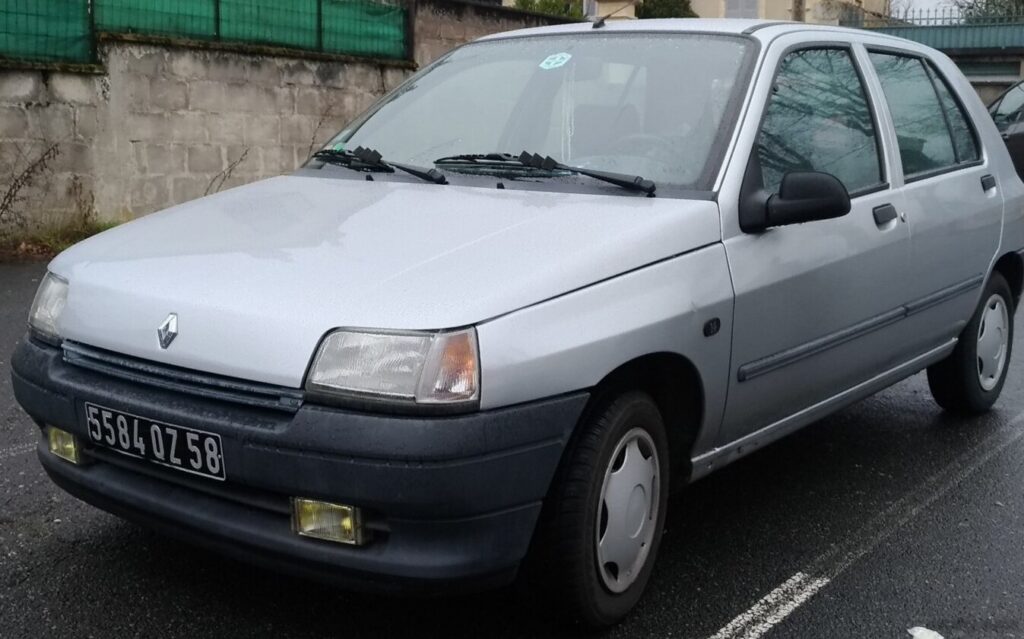
The Renault Clio I (Phase I) 1.9 D RL, produced from 1991 to 1998, represented a significant entry point into the supermini segment for Renault. This variant, powered by a 1.9-liter diesel engine producing 64 horsepower, was primarily aimed at buyers prioritizing fuel economy and practicality over outright performance. It occupied the lower end of the Clio I range, serving as a more affordable alternative to the gasoline-powered models and the later, more powerful diesel iterations. The Clio I itself was a pivotal model for Renault, built on the 1HX0/A3 platform, and marked a shift towards more modern and rounded styling compared to its predecessors.
The 1.9 D RL Powertrain & Engine Architecture
The heart of the Clio I 1.9 D RL is the F8Q engine, a 1870cc (114.11 cubic inches) inline four-cylinder diesel. This engine utilized precombustion chamber injection, a common diesel technology of the era. This system involved injecting fuel into a precombustion chamber connected to the main cylinder, promoting more complete combustion and reducing engine noise. The F8Q engine featured an overhead camshaft (OHC) valvetrain with two valves per cylinder. The engine’s bore and stroke measured 80mm x 93mm, resulting in a compression ratio of 21.5:1 – typical for a diesel engine of this period. The engine produced 64 hp at 4500 rpm and 118 Nm (87.03 lb-ft) of torque at 2250 rpm.
Unlike many of its gasoline counterparts, the 1.9 D RL was exclusively offered with a five-speed manual transmission. Renault did not offer an automatic transmission option for this specific engine and trim level. The gearbox was designed to maximize fuel efficiency and provide reasonable acceleration, though it was not geared for sporty driving. The transmission’s gear ratios were optimized for low-end torque delivery, crucial for a diesel engine of this displacement.
Fuel Injection and Engine Management
The precombustion chamber injection system, while effective for its time, was less sophisticated than direct injection systems that would become prevalent in later diesel engines. This resulted in slightly higher emissions and a less refined engine note. The engine management system was relatively basic, focusing primarily on controlling fuel delivery and injection timing. Engine oil capacity was 5.5 liters (5.81 US quarts / 4.84 UK quarts), and the recommended coolant capacity was 6.6 liters (6.97 US quarts / 5.81 UK quarts).
Driving Characteristics
The Clio I 1.9 D RL offered a utilitarian driving experience. Acceleration was modest, taking approximately 14.8 seconds to reach 100 km/h (62 mph) and around 14.1 seconds to 60 mph. The engine’s strength lay in its low-end torque, making it reasonably capable for everyday driving and urban commutes. However, it lacked the responsiveness and high-speed performance of the gasoline-powered Clio variants. The five-speed manual transmission allowed drivers to keep the engine in its optimal torque band, but frequent gear changes were often necessary, particularly when tackling hills or overtaking. The steering was light and precise, typical of Renault’s designs, making the car easy to maneuver in tight spaces. The suspension, while comfortable, was not particularly sporty, prioritizing ride quality over handling precision.
Equipment & Trim Levels
The 1.9 D RL typically represented the base trim level for the Clio I diesel range. Standard equipment was relatively sparse, reflecting its position as an affordable option. Interior upholstery was typically a durable cloth material, often in a dark color scheme. The dashboard featured a simple layout with basic instrumentation, including a speedometer, fuel gauge, and temperature gauge. Power steering was not always standard, and air conditioning was typically an optional extra. Other optional features included central locking, electric windows, and a radio/cassette player. The 3-door body style was more common in this base trim, with the 5-door version often commanding a slight premium.
Chassis & Braking
The Clio I 1.9 D RL utilized a front-engine, front-wheel-drive layout. The front suspension consisted of a spring strut configuration, while the rear suspension employed a torsion beam. This setup provided a reasonable balance between ride comfort and handling. The braking system featured ventilated discs on the front wheels and discs on the rear wheels. Anti-lock braking system (ABS) was not standard on all models, often being an optional extra. The tires were typically 155/70 R13 T size, mounted on 13-inch steel wheels. The curb weight of the vehicle was approximately 920 kg (2028.25 lbs), contributing to its relatively modest performance.
Market Reception & Comparison
The Clio I 1.9 D RL was well-received by buyers seeking an economical and reliable supermini. Critics praised its fuel efficiency – achieving around 5.5 l/100 km (42.8 US mpg / 51.4 UK mpg) on a combined cycle – and its robust diesel engine. However, it was often criticized for its lack of performance and its relatively basic interior. Compared to the gasoline-powered Clio models, the 1.9 D RL offered significantly better fuel economy but considerably slower acceleration. Compared to later diesel variants, such as the 1.9 TDI, it lacked the refinement and power of those more advanced engines. The 1.9 D RL’s target audience was primarily budget-conscious buyers, fleet operators, and those who prioritized fuel economy over driving excitement.
Technical Specifications
| Brand | Renault |
| Model | Clio |
| Generation | Clio I (Phase I) |
| Type (Engine) | 1.9 D RL (64 Hp) |
| Start of production | 1991 |
| End of production | 1998 |
| Engine Displacement | 1870 cm3 (114.11 cu. in.) |
| Number of Cylinders | 4, Inline |
| Power | 64 Hp @ 4500 rpm |
| Torque | 118 Nm @ 2250 rpm (87.03 lb.-ft. @ 2250 rpm) |
| Fuel Type | Diesel |
| Fuel Consumption (Urban) | 6.2 l/100 km (37.9 US mpg / 45.6 UK mpg) |
| Fuel Consumption (Extra Urban) | 4.8 l/100 km (49 US mpg / 58.9 UK mpg) |
| Fuel Consumption (Combined) | 5.5 l/100 km (42.8 US mpg / 51.4 UK mpg) |
| Acceleration 0-100 km/h | 14.8 sec |
| Acceleration 0-60 mph | 14.1 sec |
| Maximum Speed | 161 km/h (100.04 mph) |
| Kerb Weight | 920 kg (2028.25 lbs) |
| Fuel Tank Capacity | 43 l (11.36 US gal / 9.46 UK gal) |
| Length | 3709 mm (146.02 in) |
| Width | 1616 mm (63.62 in) |
| Height | 1395 mm (54.92 in) |
| Wheelbase | 2472 mm (97.32 in) |
| Gearbox | 5-speed Manual |
Legacy
The Renault Clio I 1.9 D RL, while not the most exciting variant in the range, proved to be a reliable and economical workhorse for many owners. The F8Q engine, despite its relatively simple design, is known for its durability and longevity. Today, these cars are increasingly rare and sought after by classic car enthusiasts and those looking for a simple, affordable, and fuel-efficient vehicle. While maintenance costs can be higher due to the age of the vehicles, the F8Q engine is generally considered relatively easy to work on. The 1.9 D RL represents a significant chapter in Renault’s history and a testament to the enduring appeal of practical and economical motoring.
