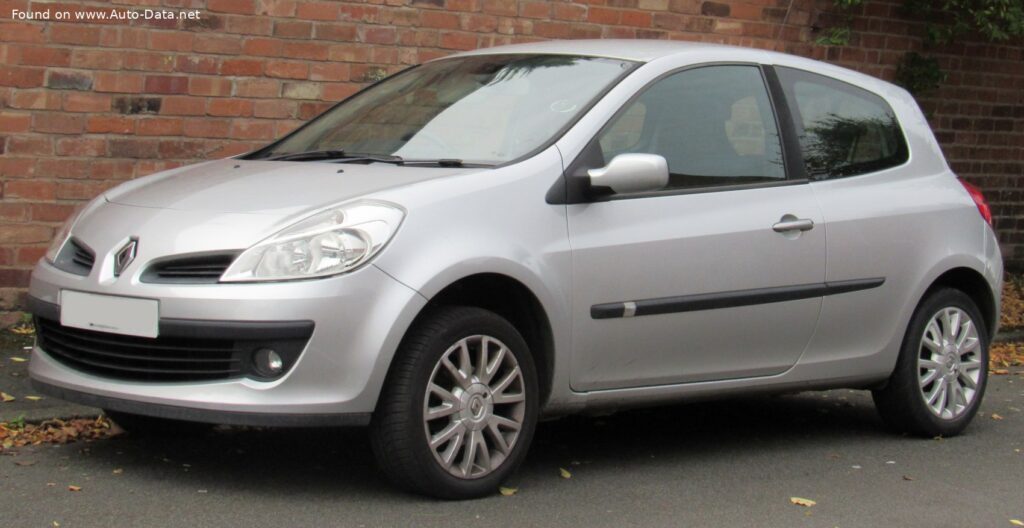
The Renault Clio III (Phase I) 3-door 2.0 16V (139 Hp) Automatic, produced from 2006 to 2009, was a significant evolution in Renault’s successful supermini lineage. As the third generation of the Clio, it aimed to raise the standards for safety, refinement, and interior quality within its segment. While never officially sold in the United States, the Clio III represents a distinctive example of European automotive engineering and market focus. This specific variant offered a compelling combination of spirited performance and convenience, positioning itself as a more premium and dynamic option within the Clio III range, targeting buyers who desired more power than the typical smaller-displacement engines available.
The Clio III Phase I: Positioning and Overview
Launched in 2005 and crowned European Car of the Year in 2006, the Clio III moved away from the rounded aesthetics of its predecessor, adopting a more mature and sophisticated design. The “Phase I” designation refers to the initial production run before a mid-cycle refresh. The 3-door hatchback configuration, paired with the 2.0-liter engine and automatic transmission, was a less common but noteworthy offering, providing a smoother, more relaxed driving experience compared to manual versions while still delivering respectable acceleration and top speed for its class. This variant occupied a mid-range to premium position within the Clio III lineup, bridging the gap between the base models with smaller engines and the high-performance Clio Renault Sport versions.
Powertrain & Engine Architecture
The heart of this Clio III variant is the M4R 701 engine, a 2.0-liter (1997 cc) naturally aspirated inline four-cylinder powerplant. This engine features a Double Overhead Camshaft (DOHC) valvetrain with 16 valves (four per cylinder), optimized for both efficiency and power delivery. It produces 139 horsepower at 6000 rpm and 143.09 lb-ft of torque at 3750 rpm, providing ample power for a car of its size and class. The engine utilizes multi-port fuel injection for precise fuel delivery.
Power is transmitted to the front wheels via a 4-speed automatic transmission. While a 4-speed automatic may seem dated by today’s standards, it offered a smooth and convenient driving experience, particularly in urban environments. The transmission is electronically controlled, offering adaptive shift patterns based on driving conditions. The automatic transmission was designed for ease of use and reliability, prioritizing comfort over outright performance.
Driving Characteristics
The 2.0-liter engine and 4-speed automatic combination delivers a comfortable and refined driving experience. Compared to the manual transmission versions of the Clio III, the automatic offers smoother acceleration and eliminates the need for constant gear changes, making it ideal for city driving. However, the automatic transmission does result in a slight performance deficit compared to the manual, as some power is lost through the torque converter. The gear ratios are optimized for everyday driving, with a focus on smooth transitions and fuel efficiency. While not as sporty as the manual or Renault Sport models, the 2.0L automatic provides sufficient power for confident overtaking and highway cruising.
Equipment & Trim Levels
The Clio III 2.0 16V Automatic typically came equipped with a generous level of standard features. These included air conditioning, power windows, central locking, and an integrated audio system. Interior upholstery was typically cloth, with options for upgraded materials available. Higher trim levels offered features such as alloy wheels, fog lights, a trip computer, and automatic headlights and windshield wipers. Optional extras included a panoramic sunroof, leather upholstery, and a more advanced audio system with CD changer. The dashboard layout was modern and ergonomically designed, with a focus on ease of use and driver comfort.
Chassis & Braking
The Clio III utilizes an independent McPherson strut suspension setup with coil springs and an anti-roll bar at the front, providing responsive handling and a comfortable ride. The rear suspension employs a coil spring and torsion beam arrangement, balancing ride comfort with stability. The braking system consists of ventilated discs at the front (280 mm) and solid discs at the rear (240 mm). Anti-lock Braking System (ABS) was standard, enhancing safety and control during emergency braking situations. The electric power steering provides light and precise steering feel, making it easy to maneuver in tight spaces.
Market Reception & Comparison
Critics generally praised the Clio III for its refined interior, comfortable ride, and strong safety credentials. The 2.0-liter engine was considered a significant upgrade over the smaller engines in the range, providing ample power for everyday driving. However, the 4-speed automatic transmission was sometimes criticized for being slightly dated and less responsive than more modern automatic gearboxes. Compared to other trims in the Clio III lineup, the 2.0 16V Automatic offered a balance between performance and convenience, appealing to buyers who prioritized comfort and ease of use over outright sportiness. Fuel economy was reasonable for its class, with combined figures around 29.8 US mpg, but slightly lower than the smaller-engined models. Reliability was generally good, with the M4R engine proving to be a durable and dependable unit.
Technical Specifications
| Category | Specification |
| Brand | Renault |
| Model | Clio |
| Generation | Clio III (Phase I) 3-door |
| Type (Engine) | 2.0 16V (139 Hp) Automatic |
| Production Years | 2006 – 2009 |
| Body Type | Hatchback |
| Doors / Seats | 3 / 5 |
| Powertrain Architecture | Internal Combustion Engine, Front-wheel drive |
| Fuel Consumption (Urban) | 21.6 US mpg (10.9 l/100 km) |
| Fuel Consumption (Extra Urban) | 37.9 US mpg (6.2 l/100 km) |
| Fuel Consumption (Combined) | 29.8 US mpg (7.9 l/100 km) |
| CO2 Emissions (NEDC) | 187 g/km |
| Fuel Type | Petrol (Gasoline) |
| Acceleration 0-60 mph | 8.6 seconds |
| Maximum Speed | 124.27 mph (200 km/h) |
| Emission Standard | Euro 4 |
| Weight-to-Power Ratio | 8.7 kg/Hp (114.4 Hp/tonne) |
| Power | 139 Hp @ 6000 rpm |
| Torque | 143.09 lb.-ft. (194 Nm) @ 3750 rpm |
| Engine Layout | Front, Transverse |
| Engine Model/Code | M4R 701 |
| Engine Displacement | 2.0 liters (1997 cm3, 121.86 cu. in.) |
| Number of Cylinders | 4, Inline |
| Valves per Cylinder | 4 |
| Compression Ratio | 10:1 |
| Fuel Injection System | Multi-port manifold injection |
| Engine Aspiration | Naturally Aspirated |
| Valvetrain | DOHC |
| Length | 156.93 in (3986 mm) |
| Width | 67.68 in (1719 mm) |
| Height | 58.86 in (1495 mm) |
| Wheelbase | 101.38 in (2575 mm) |
| Kerb Weight | 2678.62 lbs (1215 kg) |
Legacy
The Renault Clio III, including the 2.0 16V Automatic variant, has proven to be a reliable and durable vehicle in the used car market. The M4R engine is known for its longevity, and with proper maintenance, can provide many years of trouble-free service. While the 4-speed automatic transmission may not be as sophisticated as more modern units, it is generally reliable and relatively inexpensive to repair. Today, the Clio III represents a good value proposition for buyers seeking a comfortable, safe, and well-equipped supermini. Its enduring popularity and strong reputation for reliability have ensured its continued presence on European roads.