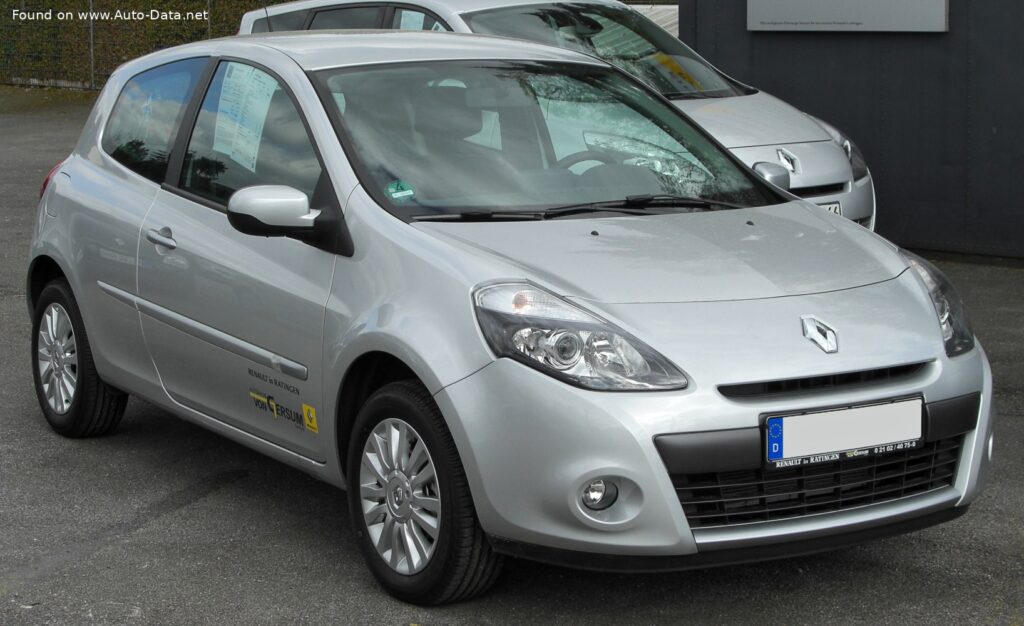
The Renault Clio III (Phase II, 2009) 3-door 1.2 16V (75 Hp) Quickshift represents a significant iteration of one of Europe’s most enduring and successful subcompact cars. Produced from 2009 to 2012, this specific model is part of the third generation of the Clio, which itself garnered the prestigious European Car of the Year award in 2006. The “Phase II” designation indicates a mid-cycle refresh, bringing updated styling, enhanced features, and subtle mechanical refinements to maintain its competitive edge in the fiercely contested B-segment market. While never officially sold in the United States, the Clio line has been a cornerstone of Renault’s global strategy, particularly in its home continent of Europe, where its blend of compact dimensions, practical design, and efficient powertrains made it a popular choice for urban drivers and small families alike. This particular variant, with its 1.2-liter 16-valve engine and Quickshift automated manual transmission, was designed to offer an accessible and economical driving experience, emphasizing ease of use in congested city environments.
Powertrain & Engine Architecture
Under the hood of the 2009 Renault Clio III (Phase II) 3-door lies a naturally aspirated 1.2-liter (1149 cm3 or 70.12 cu. in.) inline-four engine, designated by the code D4F. This powerplant features a double overhead camshaft (DOHC) valvetrain with 16 valves (four per cylinder), optimized for efficiency and smooth power delivery. It generates a modest but entirely adequate 75 horsepower at 5500 rpm, with a peak torque of 105 Newton-meters (77.44 lb.-ft.) available at 4250 rpm. This power output, combined with the car’s relatively low curb weight of 2403.04 lbs (1090 kg), results in a weight-to-power ratio of 14.5 kg/Hp, or 68.8 Hp per tonne.
The D4F engine utilizes a multi-point fuel injection system, delivering fuel directly to each intake port. This system, common for its time, provides precise fuel metering for optimal combustion and reduced emissions. The engine’s block is constructed from cast iron for durability, while the cylinder head is made of aluminum alloy to reduce weight. The Quickshift transmission is a 5-speed automated manual transmission. Unlike a traditional automatic transmission with a torque converter, the Quickshift uses actuators to operate the clutch and shift gears, offering a more direct connection to the engine. It allows for both fully automatic operation and manual gear selection via buttons on the steering wheel or the gear selector. While offering the convenience of two pedals, it doesn’t provide the smoothness of a conventional automatic or a modern dual-clutch transmission.
Driving Characteristics
The 1.2L 75 hp engine paired with the Quickshift transmission delivers a driving experience geared towards urban practicality rather than spirited performance. Acceleration from 0 to 60 mph takes approximately 12.4 seconds (0-100 km/h in 13 seconds), and the top speed is around 103.77 mph (167 km/h). The Quickshift transmission’s gear ratios are optimized for fuel efficiency and smooth low-speed operation. The first gear is relatively short, providing good acceleration from a standstill, while higher gears are spaced to maintain low engine speeds during highway cruising. Compared to the higher-output 1.6L 16V versions of the Clio III, this variant feels noticeably slower, particularly during overtaking maneuvers. The manual transmission versions of the 1.2L engine offer slightly improved acceleration and fuel economy due to the absence of transmission losses. However, the Quickshift provides a level of convenience that appeals to drivers who prioritize ease of use over outright performance. The car’s light steering and compact dimensions make it easy to maneuver in tight city streets, and the suspension provides a comfortable ride, absorbing most road imperfections effectively.
Equipment & Trim Levels
The 1.2 16V Quickshift variant of the Clio III (Phase II) typically occupied an entry-level to mid-range position within the lineup. Standard equipment included power steering, ABS, front airbags, and a basic audio system with CD player. The interior featured cloth upholstery, and the dashboard was constructed from durable plastics. The 3-door configuration came with a 60/40 split-folding rear seat, enhancing cargo versatility. Optional extras available for this trim included air conditioning, alloy wheels, electric front windows, and a more advanced audio system with MP3 compatibility. Higher trim levels, such as the Dynamique and Privilège, offered additional features like automatic headlights and rain sensors, cruise control, and upgraded interior trim materials. The Quickshift transmission was often bundled with certain equipment packages, making it a convenient option for buyers seeking a well-equipped and easy-to-drive Clio.
Chassis & Braking
The Clio III (Phase II) utilizes a MacPherson strut front suspension and a torsion beam rear suspension. This configuration provides a good balance between ride comfort and handling. The front suspension features coil springs and a stabilizer bar to reduce body roll during cornering. The rear torsion beam is a simple and cost-effective design that offers adequate stability for everyday driving. The braking system consists of ventilated disc brakes at the front and drum brakes at the rear. While the front discs provide effective stopping power, the rear drums are less powerful and offer less fade resistance under heavy braking. The ABS system helps to prevent wheel lockup during emergency stops, enhancing safety and control. The car’s relatively low weight contributes to its braking performance, and the standard tires (165/65 R15) provide adequate grip in most conditions.
Market Reception & Comparison
The Renault Clio III (Phase II) 1.2 16V Quickshift received generally positive reviews from automotive critics, particularly for its fuel efficiency and ease of driving. It was praised as a practical and affordable option for urban commuters and first-time car buyers. However, the Quickshift transmission was a point of contention for some reviewers, who found its shifts to be jerky and less refined than those of traditional automatic transmissions. Compared to the higher-output 1.6L versions of the Clio III, the 1.2L variant offered significantly lower performance but also better fuel economy. The 1.6L models were targeted towards drivers who prioritized performance and driving enjoyment, while the 1.2L appealed to those who valued economy and convenience. The 1.2L also compared favorably to other subcompact cars in its class, such as the Ford Fiesta and Volkswagen Polo, in terms of fuel efficiency and price. Its compact dimensions and nimble handling made it a popular choice for navigating congested city streets.
Technical Specifications
| Brand | Renault |
| Model | Clio III (Phase II, 2009) 3-door |
| Type (Engine) | 1.2 16V (75 Hp) Quickshift |
| Start of Production | 2009 |
| End of Production | 2012 |
| Powertrain Architecture | Internal Combustion Engine |
| Body Type | Hatchback |
| Seats | 5 |
| Doors | 3 |
| Fuel Consumption (Urban) | 7.6 l/100 km (30.9 US mpg) |
| Fuel Consumption (Extra Urban) | 4.9 l/100 km (48 US mpg) |
| Fuel Consumption (Combined) | 5.9 l/100 km (39.9 US mpg) |
| Fuel Type | Petrol (Gasoline) |
| Acceleration 0 – 60 mph | 12.4 sec |
| Acceleration 0 – 100 km/h | 13 sec |
| Maximum Speed | 103.77 mph (167 km/h) |
| Weight-to-Power Ratio | 14.5 kg/Hp (68.8 Hp/tonne) |
| Weight-to-Torque Ratio | 10.4 kg/Nm (96.3 Nm/tonne) |
| Power | 75 Hp @ 5500 rpm |
| Power per Liter | 65.3 Hp/l |
| Torque | 105 Nm (77.44 lb.-ft.) @ 4250 rpm |
| Engine Layout | Front, Transverse |
| Engine Model/Code | D4F |
| Engine Displacement | 1149 cm3 (70.12 cu. in.) |
| Number of Cylinders | 4 |
| Engine Configuration | Inline |
| Cylinder Bore | 69 mm (2.72 in.) |
| Piston Stroke | 76.8 mm (3.02 in.) |
| Compression Ratio | 9.8:1 |
| Number of Valves per Cylinder | 4 |
| Fuel Injection System | Multi-port manifold injection |
| Engine Aspiration | Naturally aspirated |
| Valvetrain | DOHC |
| Engine Oil Capacity | 4 l (4.23 US qt) |
| Coolant Capacity | 5 l (5.28 US qt) |
| Kerb Weight | 1090 kg (2403.04 lbs) |
| Max. Weight | 1580 kg (3483.3 lbs) |
| Max Load | 490 kg (1080.27 lbs) |
| Trunk (Boot) Space – Minimum | 288 l (10.17 cu. ft.) |
| Trunk (Boot) Space – Maximum | 1038 l (36.66 cu. ft.) |
| Fuel Tank Capacity | 55 l (14.53 US gal) |
| Length | 4032 mm (158.74 in.) |
| Width | 1720 mm (67.72 in.) |
| Width Including Mirrors | 2025 mm (79.72 in.) |
| Height | 1497 mm (58.94 in.) |
| Wheelbase | 2575 mm (101.38 in.) |
| Front Track | 1472 mm (57.95 in.) |
| Rear (Back) Track | 1470 mm (57.87 in.) |
| Front Overhang | 830 mm (32.68 in.) |
| Rear Overhang | 626 mm (24.65 in.) |
| Minimum Turning Circle | 10.3 m (33.79 ft.) |
| Drivetrain Architecture | Front-wheel drive, Internal Combustion Engine |
| Drive Wheel | Front-wheel drive |
| Number of Gears and Type of Gearbox | 5 gears, automatic transmission Quickshift |
| Front Suspension | Spring Strut |
| Rear Suspension | Coil Spring |
| Front Brakes | Ventilated discs |
| Rear Brakes | Drum |
| Assisting Systems | ABS (Anti-lock braking system) |
| Steering Type | Steering rack and pinion |
| Power Steering | Electric Steering |
| Tires Size | 165/65 R15 |
| Wheel Rims Size | 5.5J x 15 |
Legacy
The Renault Clio III (Phase II), and particularly the 1.2 16V Quickshift variant, has proven to be a relatively reliable powertrain in the used car market. The D4F engine is known for its durability and low running costs, provided it receives regular maintenance. The Quickshift transmission, while not as robust as a traditional automatic, can provide years of service with proper care. Common issues include wear and tear on the transmission’s actuators and occasional sensor failures. However, these are generally inexpensive to repair. Today, these Clios are often found as affordable and economical transportation options, particularly for students and city dwellers. Their compact size, fuel efficiency, and relatively low maintenance costs make them attractive to budget-conscious buyers. While not a collector’s item, the Clio III (Phase II) 1.2 16V Quickshift remains a testament to Renault’s ability to produce practical, reliable, and affordable cars that meet the needs of a wide range of drivers.