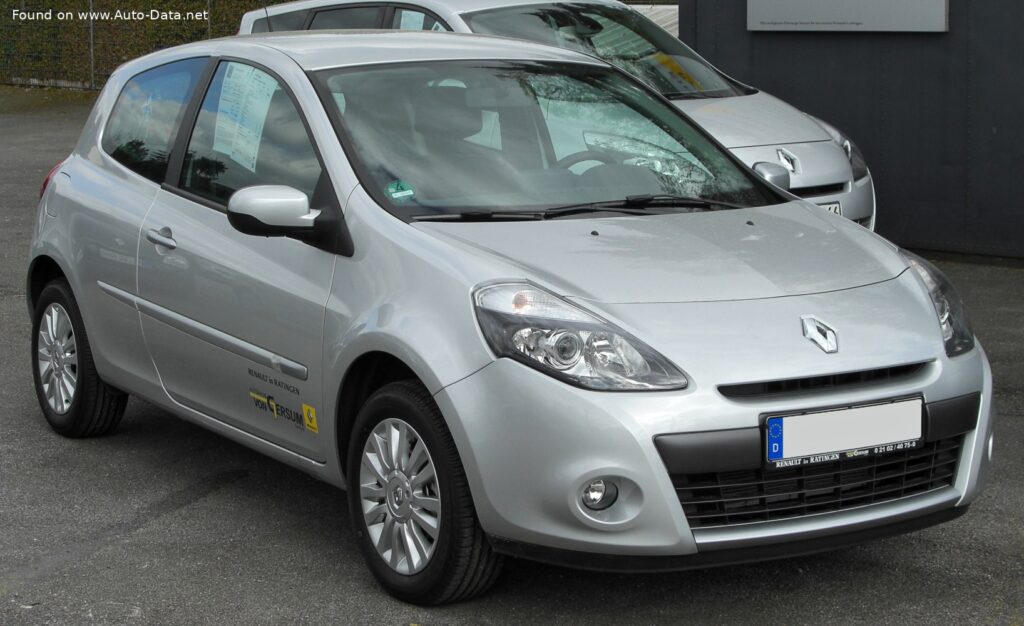
The Renault Clio III (Phase II, 2009) 3-door 1.2 16V (78 Hp) Quickshift represents a significant iteration of Renault’s highly successful supermini, a segment fiercely contested in the European automotive market. Launched in May 2009 as part of the Clio’s third generation (Phase II facelift), this particular model combined a compact, three-door hatchback body style with a small-displacement, fuel-efficient gasoline engine and an automated manual transmission. While the Renault Clio has never been officially sold in the United States, it has consistently been one of Europe’s best-selling cars, renowned for its blend of practicality, style, and accessible technology. This 2009 model aimed to further refine the Clio’s appeal, offering enhanced efficiency and updated aesthetics to maintain its competitive edge against rivals across the continent.
Positioning and Target Audience
Positioned as an ideal urban commuter and a versatile small family car, the Clio III (Phase II) continued the legacy of its predecessors by providing a comfortable ride, nimble handling, and a thoughtfully designed interior within a compact footprint. This specific 1.2-liter 16-valve variant, paired with the Quickshift automated manual gearbox, emphasized ease of driving in congested city environments and aimed for optimal fuel economy, a crucial factor for European buyers facing high fuel prices and stringent emissions regulations. It occupied the entry-level position within the Phase II Clio range, serving as the most affordable option for buyers prioritizing efficiency and low running costs over outright performance. Compared to higher-trim models featuring larger engines (like the 1.6 16V) or different transmissions, this variant was geared towards a more budget-conscious consumer base.
Powertrain & Engine Architecture
At the heart of this particular Renault Clio III (Phase II, 2009) 3-door 1.2 16V (78 Hp) Quickshift model was Renault’s D4F 764 engine, a naturally aspirated 1.2-liter (1149 cm3 or 70.12 cu. in.) inline four-cylinder gasoline unit. This engine featured a Double Overhead Camshaft (DOHC) valvetrain with four valves per cylinder, a configuration designed for efficient breathing and responsiveness. It produced a modest but adequate 78 horsepower at 5500 rpm, delivering a power output of approximately 67.9 Hp per liter. Peak torque stood at 108 Newton-meters (79.66 lb.-ft.) at 4250 rpm, providing sufficient thrust for city driving and maintaining momentum on extra-urban roads. The multi-port manifold injection system ensured precise fuel delivery, contributing to both performance and efficiency.
Power was sent to the front wheels via a 5-speed Quickshift automated manual transmission. This type of gearbox, distinct from a conventional automatic with a torque converter, used an electronically controlled clutch and gear selection mechanism. While offering the convenience of two-pedal driving, it typically provided a more direct feel and often better fuel economy than traditional automatics of the era, albeit sometimes with noticeable shifts. The Quickshift system utilized sensors to determine the optimal gear based on vehicle speed and throttle position, and could also be manually shifted via a sequential shift mode, though this was less common among drivers.
Driving Characteristics
The Renault Clio III (Phase II, 2009) 3-door 1.2 16V (78 Hp) Quickshift was engineered for practicality rather than outright speed. It accelerated from 0 to 60 mph in a calculated 14.2 seconds, with a top speed of 101.28 mph (163 km/h). These figures placed it firmly in the realm of efficient urban transport. The engine’s power delivery was linear, but required the driver to utilize the full rev range to extract maximum performance. The Quickshift transmission, while convenient, could exhibit slightly jerky shifts, particularly at lower speeds. Compared to the manual transmission versions of the 1.2 16V, the Quickshift offered a smoother, less physically demanding driving experience, but at the expense of some driver engagement. Against higher-powered Clio variants, such as those equipped with the 1.6-liter engine, this model felt noticeably slower, particularly during overtaking maneuvers or when climbing hills.
Equipment & Trim Levels
The Clio III (Phase II) 1.2 16V Quickshift typically came equipped with a reasonable level of standard features, reflecting its position as an entry-level model. These included power steering, central locking, electric front windows, and an adjustable steering column. Safety features such as ABS with Electronic Brakeforce Distribution (EBD) and front airbags were also standard. Interior upholstery was typically cloth, with a functional, if not luxurious, dashboard layout. Optional extras available for this trim included air conditioning, alloy wheels, a CD player with MP3 compatibility, and rear electric windows. Higher trim levels, such as the Dynamique and Privilège, offered more extensive equipment lists, including features like automatic climate control, cruise control, and parking sensors.
Chassis & Braking
Key chassis and safety features included an independent McPherson strut front suspension with coil springs and an anti-roll bar, providing a good balance of comfort and handling. The rear suspension utilized a coil spring torsion beam setup, a common and cost-effective solution for compact cars that also maximizes interior space. Braking was handled by ventilated discs at the front (260×22 mm) and drum brakes at the rear (203 mm), augmented by an Anti-lock Braking System (ABS) for enhanced stopping power and control. The steering system was a rack and pinion type with electric power steering, offering light and precise control, particularly beneficial for urban maneuvering. Various tire and wheel options were available, ranging from 15-inch to 16-inch sizes, impacting both aesthetics and ride characteristics. The relatively light weight of the vehicle (around 1090 kg) contributed to its nimble handling and braking performance.
Market Reception & Comparison
The Renault Clio III (Phase II) 1.2 16V Quickshift was generally well-received by European automotive critics as a practical and economical city car. Its fuel economy was a major selling point, with a combined NEDC rating of 5.6 liters per 100 kilometers (42 US mpg). However, the Quickshift transmission received mixed reviews, with some testers finding it hesitant and jerky, while others appreciated its convenience. Compared to the manual transmission version, the Quickshift offered slightly lower fuel economy but greater ease of use in stop-and-go traffic. Against competitors like the Ford Fiesta and Volkswagen Polo, the Clio was often praised for its comfortable ride and stylish interior, but criticized for its relatively modest performance. Reliability was generally considered good, although some owners reported minor issues with the Quickshift transmission over the long term.
Technical Specifications
| Feature | Specification |
| Brand | Renault |
| Model | Clio III (Phase II, 2009) 3-door |
| Type (Engine) | 1.2 16V (78 Hp) Quickshift |
| Production Start | May, 2009 |
| Production End | January, 2011 |
| Body Type | Hatchback |
| Doors | 3 |
| Seats | 5 |
| Fuel Type | Petrol (Gasoline) |
| Engine Displacement | 1149 cm3 (70.12 cu. in.) |
| Power | 78 Hp @ 5500 rpm |
| Torque | 108 Nm (79.66 lb.-ft.) @ 4250 rpm |
| Engine Layout | Front, Transverse |
| Cylinders | 4, Inline |
| Valves per Cylinder | 4 |
| Fuel Injection | Multi-port manifold injection |
| Engine Aspiration | Naturally aspirated |
| Valvetrain | DOHC |
| Compression Ratio | 10.6:1 |
| 0-60 mph Acceleration | 14.2 sec |
| Maximum Speed | 101.28 mph (163 km/h) |
| Fuel Economy (Combined) | 5.6 l/100 km (42 US mpg) |
| CO2 Emissions | 133 g/km (Euro 4) |
| Transmission Type | 5-speed automatic transmission Quickshift |
| Drive Wheel | Front-wheel drive |
| Kerb Weight | 2403.04 lbs (1090 kg) |
| Maximum Weight | 3483.3 lbs (1580 kg) |
| Fuel Tank Capacity | 14.53 US gal (55 l) |
| Trunk Space (Min/Max) | 10.17 / 36.66 cu. ft. (288 / 1038 l) |
| Length | 158.74 in (4032 mm) |
| Width | 67.72 in (1720 mm) |
| Height | 58.94 in (1497 mm) |
| Wheelbase | 101.38 in (2575 mm) |
| Ground Clearance | 4.72 in (120 mm) |
| Turning Circle | 33.79 – 37.07 ft (10.3 – 11.3 m) |
| Front Suspension | Independent McPherson with coil spring and anti-roll bar |
| Rear Suspension | Coil spring, Torsion beam |
| Front Brakes | Ventilated discs, 260×22 mm |
| Rear Brakes | Drum, 203 mm |
| Assisting Systems | ABS (Anti-lock braking system) |
| Steering Type | Steering rack and pinion, Electric Power Steering |
Legacy
The Renault Clio, throughout its generations, has consistently been a cornerstone of the European supermini segment, and the Clio III (Phase II) was instrumental in maintaining this strong market position. The 1.2 16V Quickshift variant, while not the most powerful or engaging version, offered a compelling combination of affordability, fuel efficiency, and ease of use. On the used car market today, these models are generally available at very reasonable prices, making them attractive options for first-time car buyers or those seeking a reliable and economical city runabout. The D4F engine is known for its durability, although the Quickshift transmission may require more careful inspection due to potential wear and tear. Overall, the Clio III (Phase II) 1.2 16V Quickshift remains a practical and well-regarded small car, representing a significant chapter in Renault’s long history of successful superminis.