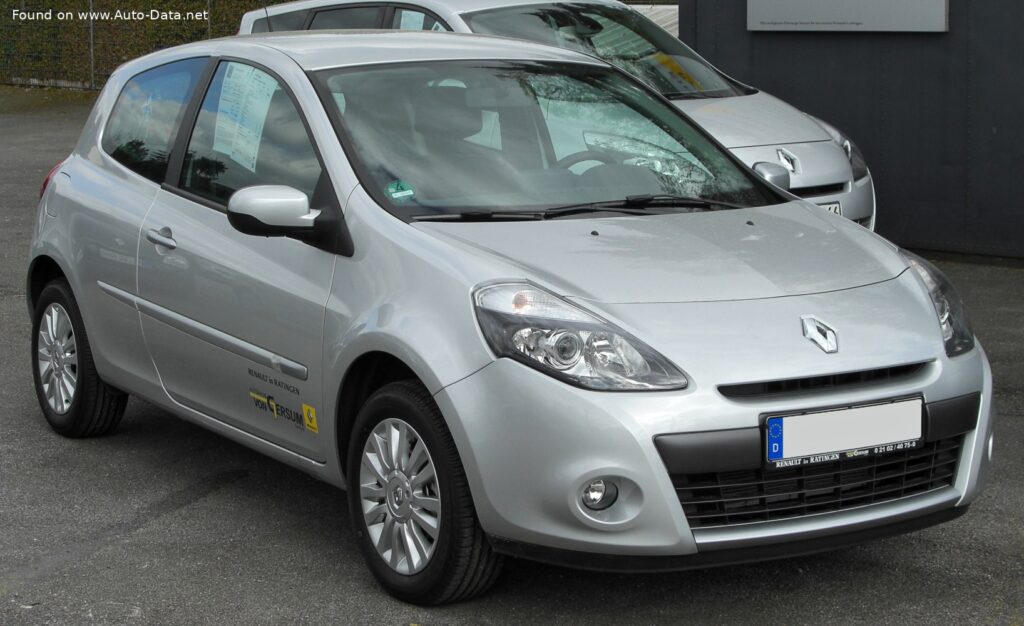
The Renault Clio III (Phase II, 2009) 3-door 1.4 16V (98 Hp) represents a significant iteration within the third generation of Renault’s highly successful supermini, the Clio. Unveiled in 2009, this Phase II update brought subtle but impactful refinements to a model that had already garnered critical acclaim, including the prestigious European Car of the Year award in 2006. As a cornerstone of the European B-segment, the Clio III was designed to offer a compelling blend of compact dimensions, practical interior space, impressive safety features for its class, and an engaging driving experience. This particular variant, with its 1.4-liter, 16-valve engine, was positioned as a well-balanced option, providing sufficient power for urban and highway driving while maintaining a focus on fuel efficiency. Primarily sold in European and other international markets, the Clio has never been officially imported to the United States, making it a distinctive example of European automotive engineering and market preferences.
Powertrain & Engine Architecture
At the heart of this particular Renault Clio III (Phase II, 2009) 3-door lies Renault’s well-regarded K4J engine, a naturally aspirated 1.4-liter (1390 cm³ or 84.82 cu. in.) inline-four gasoline unit. This 16-valve engine, employing a multi-port manifold injection system and a Single Overhead Camshaft (SOHC) valvetrain, was engineered for smooth operation and accessible power delivery throughout its rev range. It produces a respectable 98 horsepower at 5700 rpm, translating to a power-per-liter ratio of 70.5 horsepower per liter, which was competitive for its class at the time. Torque output stands at 127 Nm (93.67 lb.-ft.) at 4250 rpm, providing adequate pulling power for daily driving scenarios.
The powertrain architecture is a conventional front-engine, transverse layout, driving the front wheels. The K4J engine utilizes a cast iron block with an aluminum cylinder head, a common configuration for balancing durability and weight. The multi-port fuel injection system delivers fuel directly to each intake port, optimizing combustion efficiency. The SOHC valvetrain, while simpler than a Dual Overhead Camshaft (DOHC) setup, contributes to the engine’s reliability and ease of maintenance. The engine is paired with a 5-speed manual transmission, a standard offering for this trim level. While an automatic transmission was available on some Clio III models, it was not typically paired with the 1.4 16V engine due to the engine’s relatively modest torque output. The 5-speed manual transmission features a conventional shift linkage and is known for its smooth operation and relatively precise gear changes.
Driving Characteristics
The 1.4 16V Clio III Phase II offers a driving experience geared towards practicality and efficiency rather than outright performance. Acceleration from 0 to 60 mph is estimated at 10.5 seconds (0-100 km/h in 11 seconds), and it reaches a maximum speed of 113.71 mph (183 km/h). While not a performance hot hatch, these figures underscore its capability as a brisk and responsive commuter car. The engine’s power delivery is linear and predictable, making it easy to modulate in urban traffic. The 5-speed manual transmission allows drivers to keep the engine in its optimal power band, maximizing acceleration and fuel efficiency.
Compared to the higher-output 1.6-liter gasoline or diesel versions of the Clio III, the 1.4 16V feels less eager to rev and offers less overall grunt. However, it also provides a more relaxed and forgiving driving experience, particularly for less experienced drivers. The manual transmission, while engaging, requires more driver involvement than an automatic, but it also allows for greater control and responsiveness. The Clio’s suspension is tuned for comfort, providing a compliant ride over most road surfaces. However, it’s not as sporty or engaging as some of its rivals, such as the Ford Fiesta. Overall, the 1.4 16V Clio III Phase II offers a balanced and practical driving experience that prioritizes usability and efficiency.
Equipment & Trim Levels
The Renault Clio III (Phase II, 2009) 3-door 1.4 16V typically came equipped with a reasonable level of standard features, positioning it as a mid-range offering within the Clio lineup. Standard equipment generally included power steering, central locking, electric front windows, an adjustable steering column, and a basic audio system with CD player. Safety features, as mentioned previously, included an Anti-lock Braking System (ABS) and driver and passenger airbags.
Optional extras varied depending on the market and specific trim level, but commonly included air conditioning, alloy wheels, rear electric windows, a trip computer, and upgraded audio systems with MP3 compatibility. Higher trim levels, such as the “Dynamique” or “Privilege” variants, often included additional features such as automatic headlights and rain-sensing wipers. Interior upholstery was typically cloth, with a range of colors and patterns available. The dashboard configuration was functional and ergonomically designed, with easy-to-read gauges and intuitive controls. The 3-door body style often appealed to buyers seeking a sportier aesthetic, and some trims included sport seats and a leather-wrapped steering wheel.
Chassis & Braking
The Renault Clio III (Phase II, 2009) 3-door utilizes a MacPherson strut front suspension and a torsion beam rear suspension. This configuration provides a good balance of ride comfort and handling, making it well-suited for everyday driving. The front suspension features coil springs and dampers, while the rear suspension relies on a torsion beam for simplicity and cost-effectiveness. The steering system is an electric power steering (EPS) system, which provides light and precise steering feel.
The braking system consists of ventilated disc brakes at the front and drum brakes at the rear. While the front discs provide ample stopping power, the rear drums are a cost-saving measure that can sometimes feel less progressive than disc brakes. ABS (Anti-lock Braking System) is standard, helping to prevent wheel lockup during hard braking. The Clio III’s chassis is relatively lightweight, contributing to its agility and fuel efficiency. The 3-door body style further reduces weight compared to the 5-door version. Stabilizer bars are fitted to both the front and rear axles, helping to reduce body roll during cornering.
Market Reception & Comparison
Critics generally viewed the Renault Clio III (Phase II, 2009) 3-door 1.4 16V as a competent and well-rounded supermini. It was praised for its stylish design, comfortable ride, and strong safety features. However, some critics noted that the 1.4-liter engine could feel underpowered, particularly when fully loaded or driving on steep hills. Fuel economy was consistently praised, with the Clio III achieving competitive figures in its class.
Compared to other trims in the Clio lineup, the 1.4 16V offered a good balance of performance and economy. The 1.2-liter engine was more fuel-efficient but lacked the power for confident highway driving, while the 1.6-liter engine offered more performance but at the expense of fuel economy. The diesel versions of the Clio III were even more fuel-efficient but were typically more expensive to purchase. In terms of reliability, the Clio III is generally considered to be a reliable car, but some owners have reported issues with the electrics and the cooling system. Overall, the 1.4 16V Clio III Phase II represented a pragmatic and sensible choice for buyers seeking a stylish, comfortable, and economical supermini.
Technical Specifications
| Category | Specification |
| Brand | Renault |
| Model | Clio |
| Generation | Clio III (Phase II, 2009) 3-door |
| Type (Engine) | 1.4 16V (98 Hp) |
| Start of Production | 2009 year |
| End of Production | 2012 year |
| Powertrain Architecture | Internal Combustion engine, Front-wheel drive |
| Body type | Hatchback |
| Seats | 5 |
| Doors | 3 |
| Fuel Type | Petrol (Gasoline) |
| Fuel consumption (economy) – urban | 8.7 l/100 km (27 US mpg) |
| Fuel consumption (economy) – extra urban | 5.4 l/100 km (43.6 US mpg) |
| Fuel consumption (economy) – combined | 6.6 l/100 km (35.6 US mpg) |
| Acceleration 0 – 60 mph | 10.5 sec |
| Acceleration 0 – 100 km/h | 11 sec |
| Maximum speed | 183 km/h (113.71 mph) |
| Power | 98 Hp @ 5700 rpm. |
| Power per liter | 70.5 Hp/l |
| Torque | 127 Nm @ 4250 rpm. (93.67 lb.-ft. @ 4250 rpm.) |
| Engine layout | Front, Transverse |
| Engine Model/Code | K4J |
| Engine displacement | 1390 cm³ (1.4 liters / 84.82 cu. in.) |
| Number of cylinders | 4 (Inline configuration) |
| Cylinder Bore | 79.5 mm (3.13 in.) |
| Piston Stroke | 70 mm (2.76 in.) |
| Compression ratio | 10:1 |
| Number of valves per cylinder | 4 (Total 16 valves) |
| Fuel injection system | Multi-port manifold injection |
| Engine aspiration | Naturally aspirated engine |
| Valvetrain | SOHC (Single Overhead Camshaft) |
| Engine oil capacity | 5 l (5.28 US qt) |
| Coolant capacity | 5.5 l (5.81 US qt) |
| Kerb Weight | 1145 kg (2524.29 lbs.) |
| Max. weight | 1635 kg (3604.56 lbs.) |
| Max load | 490 kg (1080.27 lbs.) |
| Trunk (boot) space – minimum | 288 l (10.17 cu. ft.) |
| Trunk (boot) space – maximum | 1038 l (36.66 cu. ft.) |
| Fuel tank capacity | 55 l (14.53 US gal) |
| Length | 4032 mm (158.74 in.) |
| Width | 1720 mm (67.72 in.) |
| Width including mirrors | 2025 mm (79.72 in.) |
| Height | 1497 mm (58.94 in.) |
| Wheelbase | 2575 mm (101.38 in.) |
| Front track | 1472 mm (57.95 in.) |
| Rear (Back) track | 1470 mm (57.87 in.) |
| Front overhang | 830 mm (32.68 in.) |
| Rear overhang | 626 mm (24.65 in.) |
| Minimum turning circle | 10.7 m (35.1 ft.) |
| Drivetrain Architecture | Front wheel drive, Internal Combustion engine drives front wheels |
| Number of gears and type of gearbox | 5 gears, manual transmission |
| Front suspension | Spring Strut |
| Rear suspension | Coil spring |
| Front brakes | Ventilated discs |
| Rear brakes | Drum |
| Assisting systems | ABS (Anti-lock braking system) |
| Steering type | Steering rack and pinion |
| Power steering | Electric Steering |
| Tires size | 185/60 R15 |
| Wheel rims size | 6J x 15 |
Legacy
The Renault Clio III, particularly in its Phase II iteration, solidified the model’s reputation as a leader in the fiercely competitive European supermini segment. Since its inception in 1990, the Clio has consistently been one of Europe’s best-selling cars, and the third generation, produced from 2005 to 2012, continued this trend with its blend of style, practicality, and safety. The 2009 Phase II update ensured the Clio remained fresh against newer rivals, maintaining its strong appeal to a broad demographic, from first-time drivers to small families seeking an economical and reliable vehicle.
The 1.4 16V engine variant was a popular choice, occupying a sweet spot in the lineup. It offered more power than the entry-level 1.2-liter engines, making it more capable on highways, without incurring the higher running costs or purchase price of the larger 1.6-liter gasoline or diesel options. This balance of performance and economy made it a pragmatic choice for many European consumers. The 3-door body style, while slightly less practical for rear passenger access than the 5-door, often appealed to buyers seeking a sportier aesthetic and a more compact feel.
On the used car market today, the Clio III 1.4 16V remains an affordable and practical option. Its relatively simple engine and mechanicals make it relatively easy and inexpensive to maintain. While older examples may require some attention to common issues such as the electrics and cooling system, the K4J engine is generally considered to be durable and reliable. The Clio III’s enduring popularity and strong build quality ensure that it remains a viable choice for budget-conscious buyers seeking a dependable and economical supermini.