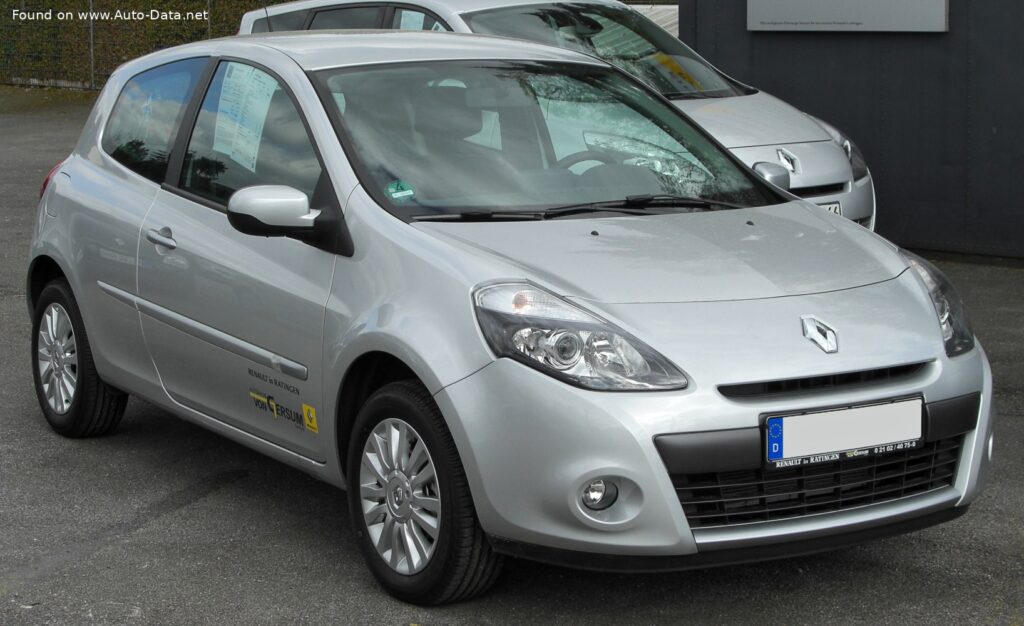
The Renault Clio, a nameplate synonymous with the European supermini segment, entered its third generation in 2005, quickly establishing itself as a formidable contender. The model under scrutiny, the Renault Clio III (Phase II, 2009) 3-door, represents a mid-cycle refresh that introduced subtle yet significant updates to design, technology, and powertrain options. Launched in May 2009, this particular variant, equipped with the 1.5 dCi (68 Hp) diesel engine, was positioned as an economical and practical choice for urban dwellers and those prioritizing fuel efficiency across Europe.
While never officially sold in the United States market, the Renault Clio has consistently been a top-seller in its primary European strongholds, praised for its blend of style, comfort, and dynamic handling. The Phase II update aimed to keep the Clio competitive against a rapidly evolving field of rivals, solidifying its reputation for offering a sophisticated driving experience in a compact package. This specific 3-door hatchback configuration, powered by a modest but highly efficient diesel engine, exemplified the pragmatic automotive choices prevalent in Europe during the late 2000s, where fuel costs and emissions standards played a crucial role in purchasing decisions.
Engine & Performance: The Efficient 1.5 dCi Powertrain
At the heart of the Renault Clio III (Phase II, 2009) 3-door lies Renault’s ubiquitous 1.5-liter dCi (diesel Commonrail injection) engine, specifically the 68 horsepower variant (K9K 714 or K9K 768 code). This inline four-cylinder unit, with an engine displacement of 1461 cm³ (89.16 cu. in.), was engineered for impressive fuel economy and low emissions, rather than outright speed. It delivered a modest 68 Hp at 4000 rpm, translating to a power-per-liter figure of 46.5 Hp/l.
Despite the lower horsepower, the engine’s real strength lay in its torque delivery. It produced 160 Nm (118.01 lb.-ft.) of torque at a low 1700 rpm, a characteristic that made it feel surprisingly spry in city traffic and provided adequate pulling power for its size. This low-end torque, coupled with a standard 5-speed manual transmission, allowed for relaxed cruising and reduced the need for frequent gear changes. The engine utilized a turbocharger with an intercooler and a Diesel Commonrail fuel injection system, contributing to its efficiency and responsiveness.
Performance figures reflected its economical focus: acceleration from 0 to 60 mph was achieved in a calculated 14.4 seconds, with 0-100 km/h taking 15.2 seconds. The maximum speed was 162 km/h (100.66 mph). However, its fuel efficiency was truly remarkable for its time, with a combined NEDC rating of 4.5 l/100 km, equivalent to an outstanding 52.3 US mpg. This efficiency was further highlighted by its low CO2 emissions of 120 g/km, meeting the Euro 4 emission standard, making it a highly attractive option for environmentally conscious European drivers facing strict regulations and high fuel prices. The powertrain architecture featured a front, transverse engine layout driving the front wheels, a typical and effective setup for a compact hatchback.
Design & Features: Practicality and Refinement in a Compact Form
The Clio III (Phase II) retained the core design language of its pre-facelift predecessor but introduced several refinements to enhance its appeal. The 3-door hatchback body type offered a sporty silhouette, appealing to younger buyers or those who didn’t require the added practicality of rear doors. With a length of 4032 mm (158.74 in.) and a width of 1720 mm (67.72 in.), the Clio III was a relatively substantial supermini for its generation, contributing to a more planted road presence and improved interior space compared to earlier models.
Inside, the Clio III provided seating for five occupants, though the rear bench in the 3-door model was naturally less accessible. The cabin was designed with user-friendliness in mind, featuring clear instrumentation and ergonomic controls. Trunk space was practical for its class, offering 288 liters (10.17 cu. ft.) with the rear seats up, expanding significantly to 1038 liters (36.66 cu. ft.) when the rear seats were folded down, demonstrating its versatility for cargo.
Suspension-wise, the Clio III utilized an independent McPherson strut setup with coil springs and an anti-roll bar at the front, providing a comfortable and predictable ride. The rear featured a coil spring torsion beam, a cost-effective and space-efficient solution common in this segment. Braking was handled by ventilated discs (260×22 mm) at the front and solid discs (240×8 mm) at the rear, complemented by an Anti-lock Braking System (ABS) for enhanced safety. The car featured electric power steering with a rack and pinion system, offering light and precise control, particularly beneficial for urban maneuvering. Standard tire sizes ranged from 185/60 R15 to 195/50 R16, mounted on 6J x 15 or 6.5J x 16 wheel rims, respectively.
Renault Clio III (Phase II, 2009) 3-door 1.5 dCi (68 Hp): Variant Positioning
The 1.5 dCi (68 Hp) variant of the Renault Clio III (Phase II) occupied the entry-level position within the range. It was designed to appeal to budget-conscious buyers and those prioritizing fuel economy above all else. Compared to other engine options, such as the 1.2 16V gasoline engine (75 hp) or the more powerful 1.5 dCi 90 hp version, the 68 hp model offered the lowest purchase price and the best fuel consumption figures. However, it came at the cost of performance. The 90 hp diesel provided noticeably more responsive acceleration and was better suited for highway driving, while the 1.2 gasoline engine offered a smoother, albeit less efficient, driving experience.
In terms of trim levels, the 68 hp dCi was typically offered in base ‘Authentique’ and mid-range ‘Expression’ trims. The ‘Authentique’ trim was very basic, featuring steel wheels, manual windows, and limited safety equipment. The ‘Expression’ trim added features like alloy wheels, air conditioning, and electric front windows, making it a more appealing option for those willing to spend a little more. Optional extras included a panoramic sunroof, satellite navigation, and upgraded audio systems.
Chassis & Braking
The Clio III’s chassis was designed to balance comfort and handling. The front suspension utilized independent McPherson struts, providing a good level of control and absorbing bumps effectively. The rear torsion beam setup, while simpler, contributed to a compact design and minimized costs. The 68 hp variant, being the lightest in the range, benefited from slightly more agile handling compared to its higher-powered siblings.
Braking performance was adequate for the vehicle’s weight and power output. The front ventilated discs provided strong stopping power, while the rear solid discs offered sufficient braking force for everyday driving. ABS was standard across the range, enhancing safety by preventing wheel lockup during emergency braking. The braking system was tuned to provide a progressive feel, allowing drivers to modulate braking force effectively.
Market Reception & Comparison
Critics generally praised the Renault Clio III (Phase II) 1.5 dCi (68 Hp) for its fuel efficiency and low running costs. Automotive publications consistently highlighted its impressive fuel economy figures, making it a standout performer in its class. However, the engine’s modest power output was often criticized, with reviewers noting its lack of acceleration, particularly when fully loaded or on uphill gradients. Compared to rivals like the Volkswagen Polo and Ford Fiesta, the Clio offered a more comfortable ride but lacked the same level of driving engagement.
In terms of reliability, the 1.5 dCi engine proved to be generally dependable, although some owners reported issues with the diesel particulate filter (DPF) and turbocharger. Regular maintenance, including oil changes and filter replacements, was crucial to ensure long-term reliability. The Clio’s overall build quality was considered average for its class, with some reports of minor electrical issues.
Technical Specifications
| Category | Specification |
| Brand | Renault |
| Model | Clio |
| Generation | Clio III (Phase II, 2009) 3-door |
| Type (Engine) | 1.5 dCi (68 Hp) |
| Start of Production | May, 2009 |
| End of Production | October, 2010 |
| Powertrain Architecture | Internal Combustion engine |
| Body type | Hatchback |
| Seats | 5 |
| Doors | 3 |
| Fuel consumption (economy) – urban (NEDC) | 5.3 l/100 km |
| Fuel consumption (economy) – extra urban (NEDC) | 4.1 l/100 km |
| Fuel consumption (economy) – combined (NEDC) | 4.5 l/100 km |
| CO2 emissions (NEDC) | 120 g/km |
| Fuel Type | Diesel |
| Acceleration 0 – 60 mph (Calculated) | 14.4 sec |
| Acceleration 0 – 100 km/h | 15.2 sec |
| Maximum speed | 162 km/h (100.66 mph) |
| Emission standard | Euro 4 |
| Weight-to-power ratio | 17 kg/Hp |
| Weight-to-torque ratio | 7.2 kg/Nm |
| Power | 68 Hp @ 4000 rpm |
| Power per litre | 46.5 Hp/l |
| Torque | 160 Nm @ 1700 rpm (118.01 lb.-ft. @ 1700 rpm) |
| Engine layout | Front, Transverse |
| Engine Model/Code | K9K 714, K9K 768 |
| Engine displacement | 1461 cm³ (89.16 cu. in.) |
| Number of cylinders | 4 |
| Engine configuration | Inline |
| Cylinder Bore | 76 mm (2.99 in.) |
| Piston Stroke | 80.5 mm (3.17 in.) |
| Compression ratio | 17.9:1 |
| Number of valves per cylinder | 2 |
| Fuel injection system | Diesel Commonrail |
| Engine aspiration | Turbocharger, Intercooler |
| Valvetrain | SOHC |
| Engine oil capacity | 4.5 l (4.76 US qt) |
| Coolant | 6.5 l (6.87 US qt) |
| Kerb Weight | 1155 kg (2546.34 lbs.) |
| Max. weight | 1645 kg (3626.6 lbs.) |
| Trunk (boot) space – minimum | 288 l (10.17 cu. ft.) |
| Trunk (boot) space – maximum | 1038 l (36.66 cu. ft.) |
| Fuel tank capacity | 55 l (14.53 US gal) |
| Length | 4032 mm (158.74 in.) |
| Width | 1720 mm (67.72 in.) |
| Height | 1497 mm (58.94 in.) |
Legacy
The Renault Clio III (Phase II, 2009) 3-door, particularly with its 1.5 dCi engine, remains a popular choice in the used car market, especially for buyers seeking an affordable and fuel-efficient vehicle. While its age means that maintenance costs are likely to increase, the engine’s inherent reliability and the availability of spare parts make it a relatively easy car to maintain. The 68 hp variant, while not the most exciting to drive, offers a practical and economical solution for urban commuting and short journeys. Its enduring appeal is a testament to Renault’s successful formula of combining style, comfort, and efficiency in a compact package.