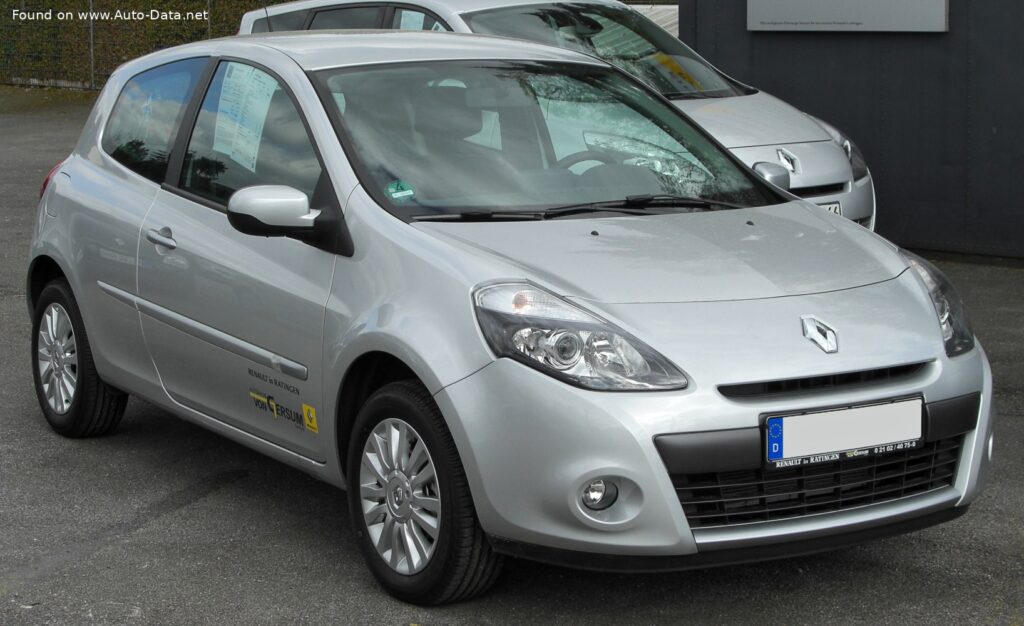
The Renault Clio III (Phase II, 2009) 3-door 1.5 dCi (75 Hp) FAP represents a significant iteration of one of Europe’s most popular subcompact vehicles. As part of the third-generation Clio lineup, this specific model, produced between October 2010 and November 2012, showcases Renault’s commitment to efficiency, practicality, and accessible technology in the highly competitive European supermini segment. While never officially sold in the United States, the Clio has been a cornerstone of Renault’s global strategy, particularly in its home continent, where its blend of compact dimensions, comfortable ride, and economical powertrains has consistently resonated with a broad customer base. The Phase II facelift, introduced in 2009, brought refreshed styling and technological updates, further solidifying the Clio III’s appeal. This particular variant, equipped with the 1.5-liter dCi diesel engine, was especially geared towards fuel economy and low emissions, making it an attractive option for urban commuters and those seeking long-distance efficiency across Europe.
The Clio III Phase II: Positioning and Overview
The Clio III itself was a critically acclaimed model, earning the prestigious European Car of the Year award in 2006. The Phase II refresh built upon this strong foundation, refining its aesthetics and technical specifications. The 3-door hatchback configuration emphasized a sportier, more compact profile, appealing to younger buyers or those who prioritized style and maneuverability in congested city environments. Its front-wheel-drive architecture and well-tuned suspension offered a balanced driving experience, characteristic of European hatchbacks. This 75 horsepower diesel variant occupied the entry-level to mid-range position within the Clio III lineup. It sat below the more powerful gasoline engines (like the 1.6 16V) and the higher-output diesel options (such as the 1.5 dCi 90 hp and 1.5 dCi 110 hp), offering a more affordable and fuel-efficient alternative.
Powertrain & Engine Architecture
At the heart of this specific Clio variant is the renowned K9K 770 1.5-liter dCi diesel engine, a powerplant celebrated for its impressive fuel efficiency and robust torque delivery. This four-cylinder, inline engine features a Single Overhead Camshaft (SOHC) valvetrain and a sophisticated Diesel Commonrail fuel injection system, ensuring precise fuel delivery and optimal combustion. Crucially for a modern diesel, it incorporates a turbocharger and intercooler, which significantly boost power output and efficiency, especially at lower RPMs.
With an engine displacement of 1461 cubic centimeters (approximately 89.16 cubic inches or 1.5 liters), this unit produces a modest but highly effective 75 horsepower at 4000 revolutions per minute. More impressive for its class is the torque output: 180 Newton-meters, or approximately 132.76 pound-feet, available at a low 1750 rpm. This low-end torque is a key characteristic of modern diesel engines, providing excellent drivability and reducing the need for frequent gear changes, particularly in city driving or when merging onto highways. Power is channeled to the front wheels via a smooth-shifting 5-speed manual transmission, a common and reliable setup for vehicles in this segment. This combination prioritizes efficiency and driver engagement, allowing the driver to optimize fuel consumption based on driving conditions. The engine’s high compression ratio of 17.9:1 is typical for a diesel, contributing to its thermal efficiency. Furthermore, the inclusion of a Particulate Filter (FAP) ensures compliance with stringent Euro 5 emission standards, a vital consideration in the European market.
Driving Characteristics
The Renault Clio III (Phase II, 2009) 3-door 1.5 dCi (75 Hp) FAP wasn’t designed for outright speed. Its acceleration from 0 to 60 miles per hour takes approximately 14.3 seconds, and it has a top speed of around 102.53 miles per hour. Compared to the more powerful versions of the Clio III, such as the 1.6 16V gasoline engine or the 1.5 dCi 90 hp diesel, this variant feels noticeably slower, particularly when accelerating for overtaking maneuvers or climbing hills. However, the abundance of low-end torque makes it surprisingly capable in everyday driving situations. The 5-speed manual transmission is well-matched to the engine’s characteristics, with gear ratios optimized for fuel efficiency and drivability. The gear changes are light and precise, and the clutch is relatively forgiving. The power delivery is linear and predictable, making it easy to modulate the throttle and maintain control. While not a sporty experience, the Clio 1.5 dCi offers a comfortable and relaxed driving experience, particularly well-suited for urban commuting and long-distance cruising.
Equipment & Trim Levels
The Clio III Phase II 1.5 dCi (75 Hp) FAP typically came with a reasonable level of standard equipment, reflecting its position as an entry-level to mid-range trim. Standard features generally included power steering, central locking, electric front windows, an adjustable steering column, and a basic audio system with CD player. Safety features included ABS brakes, front airbags, and seatbelt pretensioners. Interior upholstery was typically cloth, with a durable and practical finish. Optional extras available for this trim included air conditioning, alloy wheels, rear electric windows, a trip computer, and upgraded audio systems. Higher trim levels, such as the Dynamique or Privilège, added more luxurious features like automatic climate control, parking sensors, and leather upholstery. The dashboard configuration was functional and user-friendly, with clearly labeled controls and a straightforward instrument cluster.
Chassis & Braking
The Clio III’s chassis was engineered for a compliant and engaging ride. It features an independent McPherson strut front suspension with coil springs and an anti-roll bar, a common and effective setup for front-wheel-drive vehicles. The rear employs a torsion beam with coil springs, balancing cost-effectiveness with capable handling. Braking performance is handled by ventilated discs measuring 260×22 mm at the front and solid discs measuring 240×8 mm at the rear, complemented by an Anti-lock Braking System (ABS) for enhanced safety during emergency stops. The electric power steering system provides light and responsive feedback, making parking and city driving effortless. The choice of tire sizes, 185/60 R15 or 195/50 R16, allowed for a balance of grip, comfort, and rolling resistance. The suspension setup was tuned to prioritize ride comfort over sporty handling, resulting in a smooth and forgiving ride quality, even on uneven road surfaces.
Market Reception & Comparison
Critics generally praised the Renault Clio III 1.5 dCi (75 Hp) FAP for its fuel efficiency, low emissions, and comfortable ride. It was often cited as one of the most economical cars in its class, offering significant savings at the pump. However, some reviewers noted that the engine lacked outright power, particularly when fully loaded or driving uphill. Compared to the gasoline-powered Clio III models, the 1.5 dCi offered superior fuel economy but less responsive acceleration. Compared to the higher-output diesel versions, the 75 hp variant provided a more affordable entry point into the Clio range, but at the expense of performance. In terms of reliability, the K9K engine proved to be generally robust, although the FAP (diesel particulate filter) could require occasional maintenance or replacement, particularly on vehicles used primarily for short journeys. Overall, the Clio III 1.5 dCi (75 Hp) FAP was considered a sensible and practical choice for buyers seeking an economical and reliable supermini.
Technical Specifications
| General Information | |
| Brand | Renault |
| Model | Clio |
| Generation | Clio III (Phase II, 2009) 3-door |
| Type (Engine) | 1.5 dCi (75 Hp) FAP |
| Start of Production | October, 2010 |
| End of Production | November, 2012 |
| Powertrain Architecture | Internal Combustion Engine |
| Body Type | Hatchback |
| Seats | 5 |
| Doors | 3 |
| Performance Specifications | |
| Fuel Consumption (Economy) – Urban (NEDC) | 4.9 l/100 km (48 US mpg) |
| Fuel Consumption (Economy) – Extra Urban (NEDC) | 3.5 l/100 km (67.2 US mpg) |
| Fuel Consumption (Economy) – Combined (NEDC) | 4.0 l/100 km (58.8 US mpg) |
| CO2 Emissions (NEDC) | 106 g/km |
| Fuel Type | Diesel |
| Acceleration 0 – 60 mph | 14.3 seconds |
| Maximum Speed | 165 km/h (102.53 mph) |
| Emission Standard | Euro 5 |
| Weight-to-Power Ratio | 15.5 kg/Hp (64.4 Hp/tonne) |
| Weight-to-Torque Ratio | 6.5 kg/Nm (154.6 Nm/tonne) |
| Engine Specifications | |
| Power | 75 Hp @ 4000 rpm |
| Power per Liter | 51.3 Hp/l |
| Torque | 180 Nm (132.76 lb.-ft.) @ 1750 rpm |
| Engine Layout | Front, Transverse |
| Engine Model/Code | K9K 770 |
| Engine Displacement | 1461 cm³ (89.16 cu. in. / 1.5 Liters) |
| Number of Cylinders | 4 |
| Engine Configuration | Inline |
| Cylinder Bore | 76 mm (2.99 in.) |
| Piston Stroke | 80.5 mm (3.17 in.) |
| Compression Ratio | 17.9:1 |
| Number of Valves per Cylinder | 2 |
| Fuel Injection System | Diesel Commonrail |
| Engine Aspiration | Turbocharger, Intercooler |
| Valvetrain | SOHC |
Legacy
The Renault Clio III, and particularly its Phase II iteration with the efficient 1.5 dCi engine, cemented its position as a highly successful and influential model in the European supermini segment. It continued the legacy of its predecessors, which had already established the Clio nameplate as a benchmark for practicality, affordability, and stylish design. In a market where fuel efficiency and lower emissions were becoming increasingly critical, the 1.5 dCi (75 Hp) FAP variant stood out. Its low running costs, combined with Renault’s reputation for comfortable rides and robust engineering, made it a popular choice for a wide demographic, from first-time car buyers to small families and urban professionals. On the used car market today, the Clio III 1.5 dCi (75 Hp) FAP remains a relatively affordable and practical option. While higher mileage examples may require attention to the FAP and other age-related components, the K9K engine is generally considered durable and reliable. Its fuel efficiency and low running costs continue to make it an attractive proposition for budget-conscious buyers.